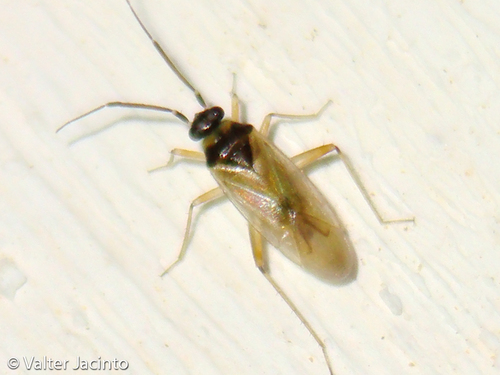
(c) Valter Jacinto, all rights reserved
Tytthus
Sign in to saveTytthus is a genus of insects in family Miridae, the plant bugs. They are carnivorous, feeding upon the eggs of various planthoppers in the family Delphacidae, and thus are important in the biological control of pests. The genus is distributed throughout the Holarctic of the Northern Hemisphere, but species are also found in the tropics, in China, South America, Australia, and the Indo-Pacific.
Species
GENUS
- KingdomAnimalia
- PhylumArthropoda
- ClassInsecta
- OrderHemiptera
- FamilyMiridae
via GBIF
Museum specimens
- Specimen records
- 5
- Family
- Miridae
- Collections
- TAMU, WAM
- Recorded in
- Brazil, Mexico, Australia
Wikidata facts
Show 3 more facts
- taxon name
- Tytthus
- taxon rank
- genus
- Commons category
- Tytthus
Sources (1)
via Wikidata · CC0
~5 min read
Encyclopedic overview
8 sectionsContents
- Type species
- Tribe
- Species
- No longer valid
- Description
- Ecology
- References
- External links
Tytthus is a genus of insects in family Miridae, the plant bugs. They are carnivorous, feeding upon the eggs of various planthoppers in the family Delphacidae, and thus are important in the biological control of pests. The genus is distributed throughout the Holarctic of the Northern Hemisphere, but species are also found in the tropics, in China, South America, Australia, and the Indo-Pacific.
==Type species== In 1860 Gustav Flor described a bug he found in Estonia and named it Capsus geminus. When Fieber established the genus Tytthus in 1864, he named two species to the genus, Zetterstedt's Capus pygmaeus and Flor's Capus geminus. Capus geminus thus became Tytthus geminus, by which name it was known as for well over a hundred years. In 1906 Kirkaldy named then Tytthus geminus as the type species for the genus. But, as Henry and Wheeler discovered in 1988, the name Capsus geminus was not available in 1860, because Thomas Say had already used it 1832 for another species entirely. So, after researching the various previous nomenclaturial acts regarding the bug, they discovered that the next available name was one used by Harry H. Knight in 1931 to describe the same bug as if it were a new species, but placing it in the genus Cyrtorhinus Fieber, 1858 as Reuter had made Tytthus a junior synonym of Cyrtorhinus. Knight's name, Cyrtorhinus pubescens was the oldest junior synonym. In 1992, Wheeler and Henry published a treatise reviewing the Miridae family occurring in the Holarctic, and formally corrected the nomenclaturial error in accordance with the International Code of Zoological Nomenclature, with the result that the type species was henceforth called Tytthus pubescens (Knight, 1931).
Excerpted from Wikipedia’s “Tytthus” article, available under the CC BY-SA 4.0 licence.