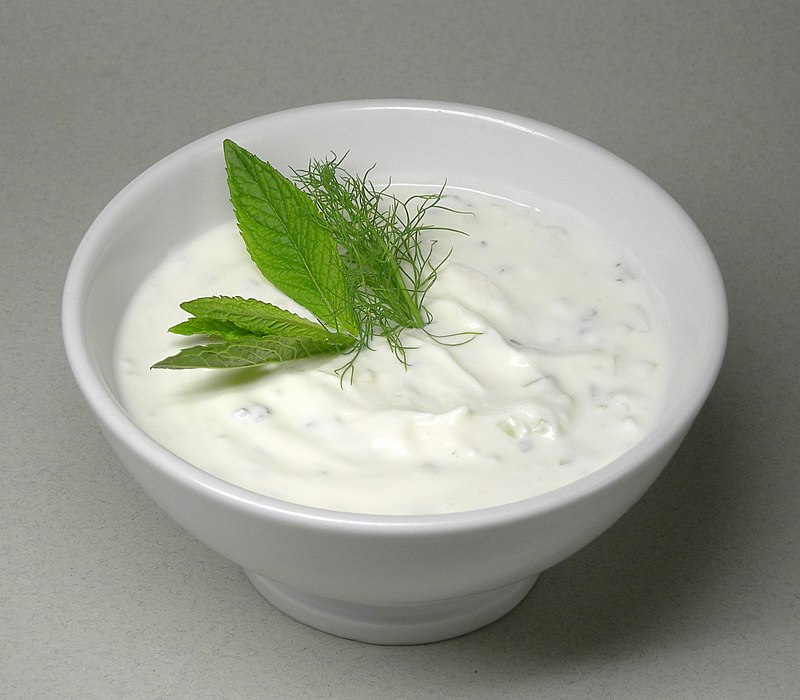
File:Cacik-1.jpg · Wikimedia Commons · See Wikimedia Commons
tzatziki
Sign in to saveAlso known as tzatzíki
Tzatziki ( ), also known as cacık () or tarator, is a class of dip, soup, or sauce found in the cuisines of Southeastern Europe and West Asia. It is made of salted strained yogurt or diluted yogurt mixed with cucumbers, garlic, salt, olive oil, red wine vinegar, sometimes with lemon juice, and herbs such as dill, mint, parsley and thyme. It is served as a cold appetiser (meze), a side dish, and as a sauce for souvlaki and gyros sandwiches and other foods.
OverviewAI-generated
Tzatziki is a food product categorized under tzatzikis. Nutritional data for the product indicates an energy value of 148 kcal. It contains 11.4 of fat, with 4.9 being saturated fat. The carbohydrate content is 8.4, including 3.9 of sugars. Additionally, it provides 0.6 of fiber, 4.3 of proteins, and 1.21 of salt. The product holds a nutriscore of c and a nova rating of 4.
In the Openfoodfacts database, there are 113 products associated with this category. The subject is referenced by 1,232 other encyclopedia articles.
Synthesized by Vinony from 18 facts across 4 sources: Wikidata, NASA, Openfoodfacts, Vinony graph. Generated from structured data (not the Wikipedia text) and checked against those facts — may still contain errors.
Key facts
- Food.name
- Tzatziki
- Food.image
- Cacik-1.jpg
- Food.image_size
- 250px
- Food.alternate_name
- Cacık, tarator
- Food.country
- Central Asia
- Food.creator
- Turkic people
- Food.course
- Appetiser, side dish, meze
- Food.type
- Dip or soup
- Food.served
- Cold
- Food.main_ingredient
- Strained yogurt, cucumbers, garlic, olive oil, red wine vinegar, salt, sometimes lemon juice, dill, mint, parsley, thyme
- Food.variations
- With strained or diluted yogurt and other herbs and vegetables
via Wikipedia infobox
Nutrition · Open Food Facts
Typical values per 100 g · averaged across 113 products
- Energy
- 148 kcal
- Fat
- 11.4 g
- — of which saturates
- 4.9 g
- Carbohydrates
- 8.4 g
- — of which sugars
- 3.9 g
- Fibre
- 0.6 g
- Protein
- 4.3 g
- Salt
- 1.21 g
via Open Food Facts · ODbL
Wikidata facts
- Instance of
- food
- Subclass of
- food
- Country of origin
- Greece
- Material used
- garlic
- Image
- Tzatiki (3656301454).jpg
- Said to be same as
- cacık
Show 4 more facts
- Commons category
- Tzatziki
- native label
- τζατζίκι
- cuisine
- Greek cuisine
- course
- hors-d'œuvre
Sources (2)
via Wikidata · CC0
~8 min read
Encyclopedic overview
12 sectionsContents
- Etymology
- History
- Variations
- Turkey
- Balkans
- Greece
- Cyprus
- Arab world
- Similar dishes
- Notes
- See also
- References
Tzatziki ( ), also known as cacık () or tarator, is a class of dip, soup, or sauce found in the cuisines of Southeastern Europe and West Asia. It is made of salted strained yogurt or diluted yogurt mixed with cucumbers, garlic, salt, olive oil, red wine vinegar, sometimes with lemon juice, and herbs such as dill, mint, parsley and thyme. It is served as a cold appetiser (meze), a side dish, and as a sauce for souvlaki and gyros sandwiches and other foods.
==Etymology== The word tzatziki appeared in English around the mid-20th century as a loanword from Modern Greek (), which in turn comes from the Turkish word . The root is likely related to several words in West Asian languages. Persian '' () refers to various herbs used for cooking, and Kurdish jaj or refers to the caraway herb. That word is combined with the Turkish diminutive suffix -cık to yield cacık. The Armenian word cacıg'' is also related to this term and may itself derive from Turkish or Kurdish.
Excerpted from Wikipedia’s “tzatziki” article, available under the CC BY-SA 4.0 licence.