
File:Uffizi_Gallery_logo.svg · Wikimedia Commons · See Wikimedia Commons
Uffizi Gallery
Sign in to saveAlso known as Uffizi, Galleria degli Uffizi
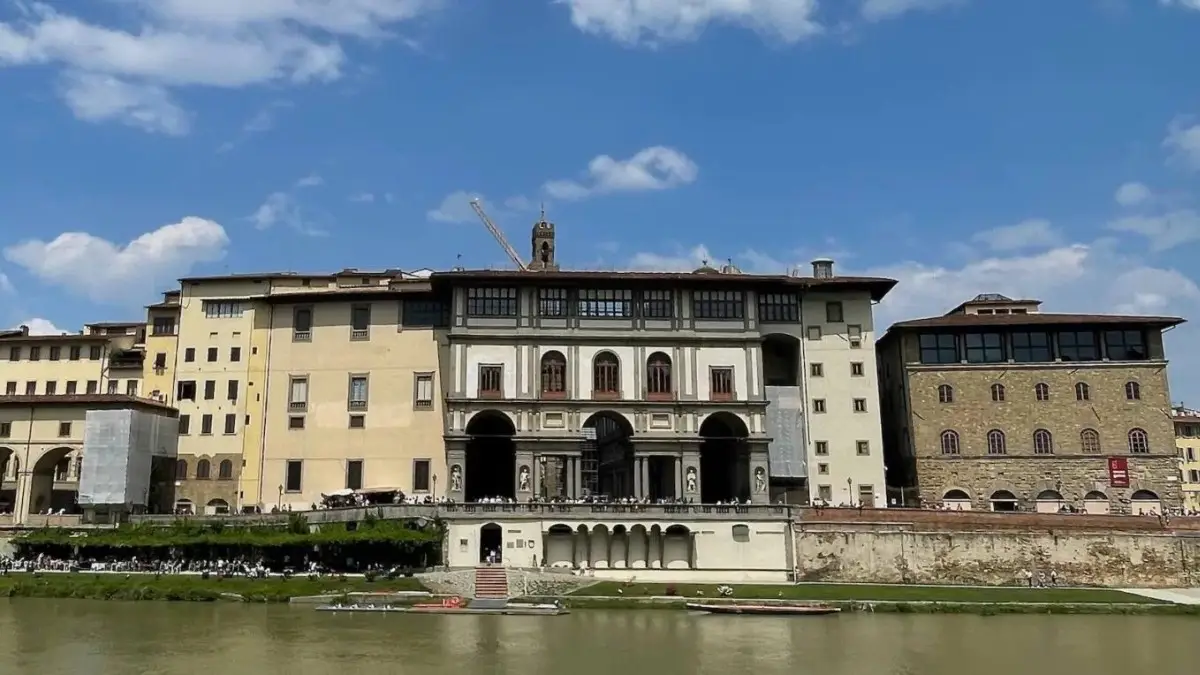
The Uffizi Gallery ( ; , ) is a prominent art museum adjacent to the Piazza della Signoria in the Historic Centre of Florence in the region of Tuscany, Italy. One of the most important Italian museums and the most visited, it is also one of the largest and best-known in the world and holds a collection of priceless works, particularly from the period of the Italian Renaissance.
The Uffizi Gallery is a major art museum located in Florence, Italy, that houses one of the world's most important collections of paintings and sculptures, especially from the Italian Renaissance. It is one of the most visited and best-known museums in the world, making it a significant destination for understanding Italian art and culture.
AI-generated from the Wikipedia summary — may contain errors.
Key facts
- Museum.name
- Uffizi
- Museum.logo
- 150px
- Museum.image
- Florence, Italy - panoramio (125).jpg
- Museum.caption
- Narrow courtyard between the two wingsof the museum, with view toward the Arno river
- Museum.mapframe
- yes
- Museum.mapframe caption
- Interactive fullscreen map
- Museum.mapframe zoom
- 15
- Museum.mapframe marker
- museum
- Museum.mapframe wikidata
- yes
- Museum.mapframe height
- 180
- Museum.location
- Piazzale degli Uffizi,50122 Florence, Italy
- Museum.type
- Art museum, design/textile museum, historic site
- Museum.visitors
- 5,249,968 (2024)
- Museum.director
- Simone Verde
via Wikipedia infobox
Described at
Uffizi Gallery Floor Map & Room Guide 2026 | All Three Floors Explained
Navigate the Uffizi Gallery with our floor-by-floor guide. Find out what is on each floor, which rooms hold the most famous works, and how to plan the most efficient route through the museum.
uffizigallery-tickets.org →The Uffizi Gallery has three floors: a ground floor (entry, orientation, temporary exhibitions), a second floor (the main permanent collection — Renaissance paintings from the 13th to 16th century, including Botticelli, Leonardo, Michelangelo, and Raphael), and a first floor (Mannerist and Baroque works — Caravaggio, Titian, Rubens, and the Spanish, Dutch, and French collections). The second floor holds the most visited rooms. The gallery has 101 rooms in total. The Uffizi Gallery covers three floors and 101 rooms — enough to disorient any first-time visitor. But the museum’s layout is more logical than it first appears: it follows a roughly chronological progression through Western art, from Gothic and Byzantine painting in the first rooms of the second floor through to 17th-century Baroque on the first floor below. This guide walks you through each floor, the key rooms on each level, and how to plan the most efficient route depending on how much time you have. The ground floor of the Uffizi Gallery is the entry and orientation level. It contains the main entrance (Door 1), the ticket collection point, the cloakroom for bags and umbrellas, the information point in the Uffizi Courtyard, and gallery spaces for temporary exhibitions. The permanent collection begins on the second floor. Two entrance staircases — the Buontalenti Staircase and the Vasari Staircase — lead up from the ground floor. When you enter through Door 1, you are on the ground floor. Here you will find: For accessibility information, including alternative routes for visitors who cannot use stairs, see our Uffizi Gallery accessibility guide . The second floor of the Uffizi Gallery contains the main permanent collection — the heart of the museum. It traces the development of painting from the medieval period (Cimabue, Duccio, Giotto) through the Early Renaissance (Masaccio, Fra Angelico, Filippo Lippi) to the High Renaissance (Botticelli, Leonardo da Vinci, Michelangelo, Raphael). The famous Botticelli rooms (currently Room A9), the Leonardo da Vinci room (Room 35), and the Raphael room (Room 66) are all on this floor. The second floor is where most visitors spend the majority of their time, and rightly so. The rooms run in roughly chronological sequence, creating a narrative of how painting evolved over three centuries in Florence and Italy. Note: From December 2025, Botticelli’s five major works (including Birth of Venus and Primavera) are temporarily displayed in Room A9 — a room on the second floor facing the First Corridor, near their usual location. Your guide or the gallery’s information point will confirm the current room allocation. Running along the entire length of the second floor on both sides is the First Corridor — a long, light-filled passageway lined with ancient Roman busts, statues, and inscriptions from the Medici collection. Most visitors walk quickly through the corridor on the way to the painting rooms without stopping. This is worth slowing down for. The busts — depicting Roman emperors, senators, and philosophers — are among the finest ancient sculptures in Italy, and the corridor’s views through the windows over Piazza della Signoria and toward the Arno are exceptional. Our sculptures at the Uffizi guide covers the most significant pieces along this corridor. The first floor of the Uffizi Gallery holds the Mannerist and Baroque collections, including major works by Caravaggio (Medusa, Bacchus), Titian (Venus of Urbino), Rubens, and important collections of Spanish, Dutch, French, and German painting. It also contains the Cabinet of Prints and Drawings and rooms dedicated to Raphael and Andrea del Sarto. The first floor is less crowded than the second floor, making it one of the best places to spend time on a busy day. The first floor is generally less crowded than the second floor — particularly in rooms 46–65, which hold the Northern European and Spanish collections. If you are visiting in peak season and the Botticelli and
Excerpt from a page describing this subject · 12,860 chars · not written by Vinony
Wikidata facts
- Instance of
- art museum
- Country
- Italy
- Located in
- Florence
- Area
- 47515
- Elevation
- 56
- Body of water
- Arno
- Owned by
- Ministry of Culture
- Employees
- 234
- Official website
- www.uffizi.it/en
- Image
- Florence, Italy - panoramio (125).jpg
Show 22 more facts
- owner of
- Madonna of the Roses
- commissioned by
- Cosimo I de' Medici, Grand Duke of Tuscany
- architect
- Alfonso Parigi
- Commons category
- Uffizi
- date of official opening
- 1581-00-00
- native label
- Galleria degli Uffizi
- topic's main category
- Category:Uffizi
- inception
- 1560-00-00
- street address
- Piazzale degli Uffizi 6, I-50122 Firenze
- Commons gallery
- Galleria degli Uffizi
- visitors per year
- 969978
- postal code
- 50122
- located on street
- Piazzale degli Uffizi
- Commons Institution page
- Uffizi Gallery
- social media followers
- 72342
- phone number
- +39 055 294883
- Wi-Fi access
- gratis
- number of volunteers
- 12
- has facility
- bookstore
- on focus list of Wikimedia project
- Wikipedia:Vital articles/Level/4
- name
- galerie du duc Cosme
- described at URL
- archive.org/details/gliuffizicatalog0000gall/page/n9/mode/2up
Sources (9)
via Wikidata · CC0
~7 min read
Encyclopedic overview
9 sectionsContents
- History
- Modern times
- Incidents
- Key works
- Films
- Gallery
- See also
- References
- External links
The Uffizi Gallery ( ; , ) is a prominent art museum adjacent to the Piazza della Signoria in the Historic Centre of Florence in the region of Tuscany, Italy. One of the most important Italian museums and the most visited, it is also one of the largest and best-known in the world and holds a collection of priceless works, particularly from the period of the Italian Renaissance.
After the ruling House of Medici died out, their art collections were given to the city of Florence under the famous Patto di famiglia ("family pact") negotiated by Anna Maria Luisa, the last Medici heiress. The Uffizi is one of the first modern museums. The gallery had been open to visitors by request since the sixteenth century, and in 1769 it was officially opened to the public, formally becoming a museum in 1865.
Excerpted from Wikipedia’s “Uffizi Gallery” article, available under the CC BY-SA 4.0 licence.
Gallery (14)
On the map
Available in 71 languages
- Español
- Français
- Deutsch
- 中文
- 日本語
- Русский
- Português
- Italiano
- العربية
- Afrikaans
- Albanian
- Armenian
- Asturian
- Azerbaijani
- Bahasa Indonesia
- Basque
- Belarusian
- Bosnian
Show 52 more
- Breton
- Bulgarian
- Catalan
- Croatian
- Czech
- Danish
- Egyptian Arabic
- Esperanto
- Estonian
- Filipino
- Finnish
- Galician
- Georgian
- Greek
- Hebrew
- Hungarian
- Icelandic
- Irish
- Latvian
- Ligurian
- Lithuanian
- Luxembourgish
- Macedonian
- Malay
- Malayalam
- Mazanderani
- Nederlands
- Norwegian
- Norwegian Nynorsk
- Polski
- Romanian
- Scots
- Serbian
- Serbian (Latin)
- simple
- Slovak
- Slovenian
- Svenska
- Tiếng Việt
- Türkçe
- Ukrainian
- Urdu
- Uzbek
- Venetian
- Welsh
- West Flemish
- Western Panjabi
- Wu Chinese
- zh_yue
- فارسی
- ไทย
- 한국어
via Wikidata sitelinks · CC0