
File:Giuseppe_Arcimboldo_-_Self_Portrait_-_Google_Art_Project.jpg · Wikimedia Commons · See Wikimedia Commons
Giuseppe Arcimboldo
Sign in to saveAlso known as Giuseppe Arcimboldi, Josephus Arcimboldus, Giuseppe Archimboldo, Arcimboldo, Guiseppe Archimboldi, Arcimboldi, Archimboldo, Arcimlardo
Italian painter of the late Renaissance (1527–1593)
OverviewAI-generated
Giuseppe Arcimboldo was an Italian painter, architectural draftsperson, designer, and draftsperson born in Milan in 1527. He worked within the Mannerism movement and specialized in still life, portrait painting, animal painting, and religious art. His notable works include The Jurist, The Four Seasons, and Rudolf II of Habsburg as Vertumnus. Arcimboldo held the position of court painter and was employed by Ferdinand I, Holy Roman Emperor, while receiving sponsorship from Maximilian II, Holy Roman Emperor, and Emperor Rudolf II.
He resided in Spain, Luxembourg, Madrid, and Milan, and worked in Milan, Vienna, Prague, and Como. Arcimboldo spoke, wrote, or signed in Italian and was a citizen of the Duchy of Milan. He died in Milan on July 11, 1593. His works are held in the collections of the National Gallery of Art, Nationalmuseum, Austrian National Library, and Skokloster Castle.
Synthesized by Vinony from 26 facts across 3 sources: Wikidata, Firecrawl, Europeana Sparql. Generated from structured data (not the Wikipedia text) and checked against those facts — may still contain errors.
Described at
The Renaissance Painter Who Made Fantastical Portraits From Food
Looked at one way, Renaissance painter Giuseppe Arcimboldo’s "The Vegetable Gardener" (1587-1590) looks like a black bowl overflowing with root vegetables,...
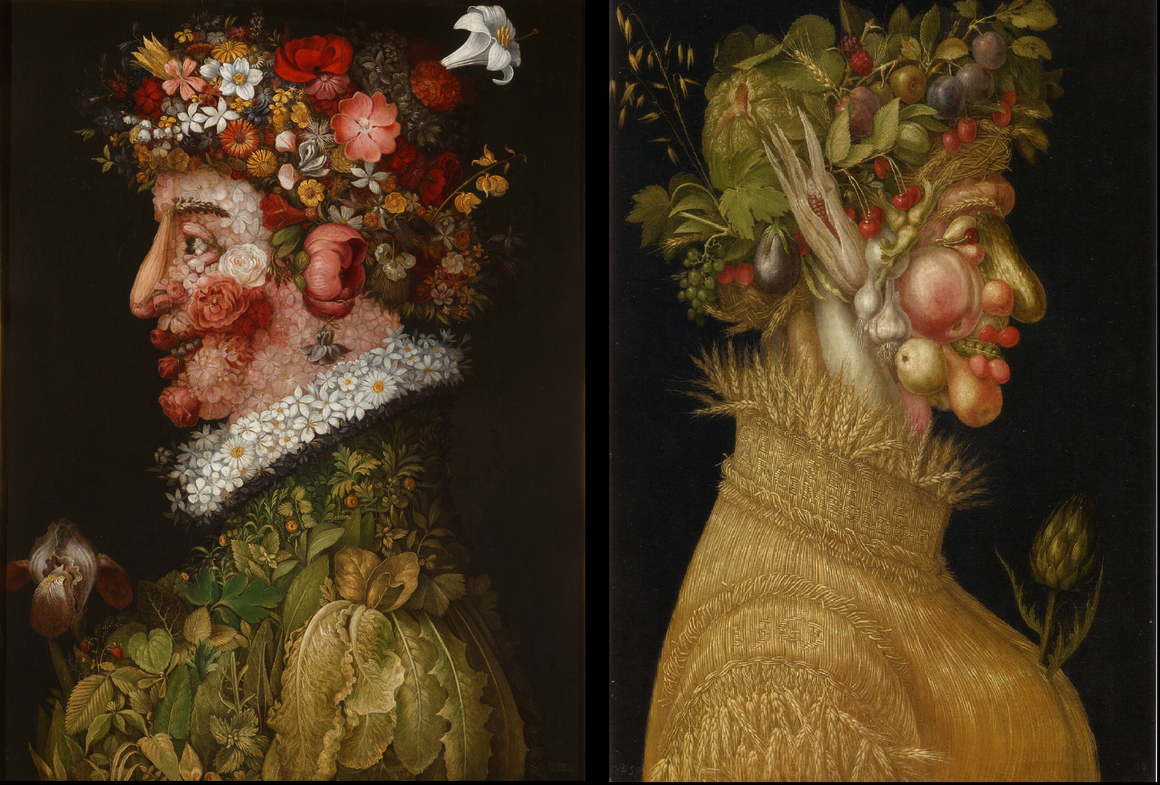
atlasobscura.com →Humble produce makes up the face of “The Vegetable Gardener.” Giuseppe Arcimboldo/Public Domain Looked at one way, Renaissance painter Giuseppe Arcimboldo’s “The Vegetable Gardener” (1587-1590) looks like a black bowl overflowing with root vegetables, greens, and one huge onion. But flipped, the painting become something else entirely. The onion has become a plump cheek, while the huge parsnip is a bulbous nose. The bowl is now a hat, perched on what is now obviously a smiling face. Many of Arcimboldo’s peers in the 16th century were painting portraits or still lifes, but Arcimboldo had the bright idea of combining the two, creating an instantly recognizable style that inspired 20th century Surrealists. A daily dose of hidden gems to visit, extraordinary places to eat and wondrous stories from around the world. In this painting depicting the element of water, each sea creature is scientifically accurate, but many are miniaturized. Giuseppe Arcimboldo/Public Domain Nothing about Arcimboldo’s early career as a stained glass and fresco designer suggested that he’d develop this distinctive style. It wasn’t until he landed a cushy post as court portraitist to Emperor Maximilian II of the Holy Roman Empire in 1562 that he started painting, along with typical portraits of court members, his series of composite faces. Often set against pitch-black backgrounds, each composite face is made of animals, objects, or, most famously, food. “Four Seasons in One Head” is hailed as one of Arcimboldo’s greatest works. Giuseppe Arcimboldo/Public Domain His royal patrons had a taste for the odd and unusual. Emperor Maximilian II and his son Rudolf II were reportedly delighted by Arcimboldo’s style. They kept him busy with commissions, including paintings and drawings that documented the imperial family’s collection of artistic works and natural curiosities. These Wunderkammers —compilations of oddities owned by the royal and rich—were the predecessors to museums, and they often focused on novel objects (taxidermied animals, preserved plants, cultural artifacts) brought back by European explorers. Organizing and displaying wild and wonderful objects not only fed the Renaissance appetite for the esoteric, but also exerted power over and made sense of a changing world. Arcimboldo portrayed the seasons as male figures made of produce and flowers. Giuseppe Arcimboldo/Public Domain Undoubtedly influenced by the imperial collections, many of Arcimboldo’s food faces featured ingredients from the Americas. His 1563 series of paintings depicts the four seasons as male figures, from young Spring to geriatric Winter, using seasonal produce. Along with Spring’s literally rosy cheeks and and Winter’s lemons, newer additions to Europe’s gardens appear. Summer’s ear is an an ear of corn, while Autumn’s head is a white pumpkin. Both were relatively recent arrivals from the Americas. Emperor Rudolf II was painted as produce from all seasons, signifying his dominion over all. Erik Lernestål/Public Domain Arcimboldo’s whimsical faces sometimes had real-world models, the most famous example being his 1590 painting of Rudolf as Vertumnus, the Roman god of the four seasons. Arcimboldo painted figures made of books, wine-making supplies, and, most eerily, meat. In a style similar to “The Vegetable Gardener ,” “ The Cook” (1570) is a reversible painting. When displayed on one end, it’s a haphazard pile of roasted piglet and chicken. Flipped, it’s a grotesque face, with a small bird as a deformed-looking nose and a pig’s tail as a curl of hair. The silver serving platter becomes a broad hat, decorated with greens and a slice of lemon. At one recent exhibition of Arcimboldo’s work, mirrors installed beneath the painting showed visitors the flipped version. One hopes Arcimboldo’s “The Cook” wasn’t based on a real person. Giuseppe Arcimboldo/Public Domain Though Arcimboldo was renowned during his life, his fame didn’t last long after his death in 1593. But his w
Excerpt from a page describing this subject · 39,824 chars · not written by Vinony
Wikidata facts
- Instance of
- human
- Given name
- Giuseppe
- Gender
- male
- Citizenship
- Duchy of Milan
- Place of birth
- Milan
- Place of death
- Milan
- Position held
- court painter
- Employer
- Ferdinand I, Holy Roman Emperor
- Languages spoken
- Italian
- Field of work
- painting
- Genre
- portrait
- Movement
- Mannerism
- Image
- Giuseppe Arcimboldo - Self Portrait - Google Art Project.jpg
- Work location
- Bratislava
- Residence
- Milan
Show 11 more facts
- Commons category
- Giuseppe Arcimboldo
- date of death
- 1593-07-11
- date of birth
- 1527-01-01
- Commons gallery
- Giuseppe Arcimboldo
- Commons Creator page
- Giuseppe Arcimboldo
- topic's main category
- Category:Giuseppe Arcimboldo
- sponsor
- Emperor Rudolf II
- has works in the collection
- Palace of Versailles
- name in native language
- Giuseppe Arcimboldo
- different from
- 6556 Arcimboldo
- described at URL
- artsandculture.google.com/entity/%2Fm%2F030b1q
Sources (10)
via Wikidata · CC0
Works in European collections
33 objects attributed to Giuseppe Arcimboldo, held across European museums, libraries & archives · via Europeana


~16 min read
Encyclopedic overview
Giuseppe Arcimboldo, also spelled Arcimboldi ( Italian: [dʒuˈzɛppe artʃimˈbɔldo]; 5 April 1527 – 11 July 1593), was an Italian Mannerist painter best known for creating imaginative portrait heads made entirely of objects such as fruits, vegetables, flowers, fish and books.
These works form a category distinct from his other productions. He was a conventional court painter of portraits for three Holy Roman Emperors in Vienna and Prague; also producing religious subjects and, among other things, a series of coloured drawings of exotic animals in the imperial menagerie. He specialized in grotesque symbolical compositions of fruits, animals, landscapes, or various inanimate objects arranged into human forms.
Excerpted from Wikipedia’s “Giuseppe Arcimboldo” article, available under the CC BY-SA 4.0 licence.
Gallery (12)
Available in 63 languages
- Español
- Français
- Deutsch
- 中文
- 日本語
- Русский
- Português
- Italiano
- العربية
- Armenian
- Azerbaijani
- Bahasa Indonesia
- Basque
- Bavarian
- be_x_old
- Belarusian
- Breton
- Bulgarian
Show 44 more
- Catalan
- Croatian
- Czech
- Danish
- Egyptian Arabic
- Esperanto
- Estonian
- Finnish
- Galician
- Georgian
- Greek
- Hebrew
- Hungarian
- Ido
- Latin
- Latvian
- Lithuanian
- Lombard
- Luxembourgish
- Malayalam
- Mongolian
- Nederlands
- Northern Frisian
- Norwegian
- Norwegian Nynorsk
- Occitan
- Piedmontese
- Polski
- Romanian
- Saterland Frisian
- Serbian
- Serbian (Latin)
- Sicilian
- Slovak
- Svenska
- Türkçe
- Ukrainian
- Uzbek
- Venetian
- Western Frisian
- Wu Chinese
- فارسی
- ไทย
- 한국어
via Wikidata sitelinks · CC0