
Also known as uy, URU, Oriental Republic of Uruguay, Eastern Republic of Uruguay
南美洲國家
Uruguay is a South American country located between Argentina and Brazil, bordered by the Río de la Plata and the Atlantic Ocean, with a population of nearly 3.5 million people. It matters as part of the Southern Cone region, and most of its population is concentrated in the capital city of Montevideo.
AI-generated from the Wikipedia summary — may contain errors.
Weather now
7-day forecast
via Open-Meteo
Country

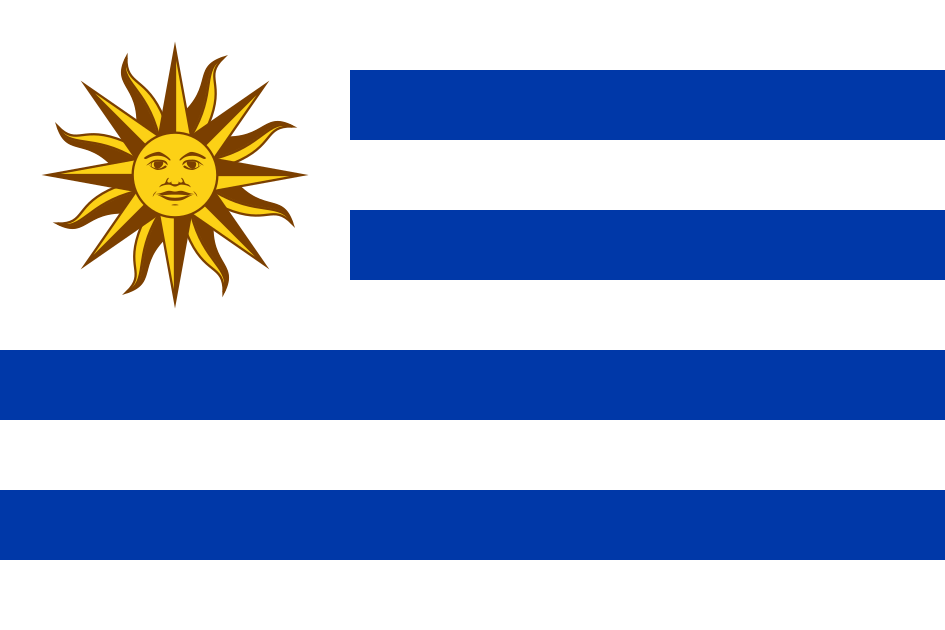
- Capital
- Montevideo
- Population
- 3,499,451
- Region
- Americas · South America
- Demonym
- Uruguayan
- Currencies
- UYU ($)
- Languages
- Spanish
- Calling code
- +598
- Drives on
- Right
- Gini
- 39.7 (2019)
- FIFA code
- URU
- TLD
- .uy
- Timezones
- UTC-03:00
- Borders
- ARG, BRA
via REST Countries
Indicators · World Bank
- GDP
- $81B(2024)
- Population
- 3,386,588(2024)
- Life expectancy
- 78.3 yrs(2024)
- Unemployment
- 7.5 %(2025)
- Urban population
- 95.6 %(2024)
- Internet users
- 92 %(2024)
- Forest area
- 12 %(2023)
- Renewable energy
- 57.8 %(2021)
via World Bank Open Data · CC BY 4.0
Place details
- Region
- Río Negro
- Country
- Uruguay
- Population
- 3,449,299
- Timezone
- America/Montevideo
via OpenStreetMap · GeoNames
Wikipedia views (30d)
128,027 totalvia Wikimedia Pageviews API
Key facts
- Country.conventional_long_name
- Oriental Republic of Uruguay
- Country.common_name
- Uruguay
- Country.image_flag
- Flag of Uruguay.svg
- Country.flag_type
- Flag
- Country.image_coat
- Coat of arms of Uruguay.svg
- Country.national_motto
- Libertad o Muerte (Spanish)"Freedom or Death"
- Country.national_anthem
- Himno Nacional del Uruguay "National Anthem of Uruguay"
- Country.other_symbol
- 90x90px|alt=Sol de Mayo
- Country.other_symbol_type
- Sol de Mayo
- Country.image_map
- URY orthographic.svg
- Country.map_width
- 220px
- Country.capital
- Montevideo
- Country.largest_city
- capital
- Country.ethnic_groups_year
- 2023
- Country.demonym
- Uruguayan
- Country.government_type
- Unitary presidential republic
- Country.leader_title1
- President
- Country.leader_name1
- Yamandú Orsi
via Wikipedia infobox
Research
22,214 papers- Uruguay.Department of State publication. Background notes series · 1988United States. Department of State. Bureau of Public Affairs
- 1950s-1990s: The pioneering era of insect neuroscience in Uruguay.ReviewNeuroscience · 2025Silvera MC, Prieto DDOI: 10.1016/j.neuroscience.2025.01.027
- Epidemiology Update of Hepatitis E Virus (HEV) in Uruguay: Subtyping, Environmental Surveillance and Zoonotic Transmission.ReviewViruses · 2023Cancela F, Icasuriaga R, Cuevas S et al.DOI: 10.3390/v15102006
- Equine Encephalomyelitis Outbreak, Uruguay, 2023-2024.Emerging infectious diseases · 2025Frabasile S, Morel N, Pérez R et al.DOI: 10.3201/eid3101.240915
- Uruguay's water crisis: prepare for future events.Nature · 2023Goyenola GDOI: 10.1038/d41586-023-01933-x
- Cancer incidence and mortality in Uruguay: 2013-2017.Colombia medica (Cali, Colombia) · 2022Garau M, Alonso R, Musetti C et al.DOI: 10.25100/cm.v53i1.4966
- Strongyloidiasis (Strongyloides papillosus) in lambs in Uruguay.Veterinary parasitology, regional studies and reports · 2022Romero A, García JA, Castells D et al.DOI: 10.1016/j.vprsr.2022.100737
- Physical activity-related indicators in children and adolescents in Uruguay: A scoping review based on the Global Matrix initiative.Frontiers in public health · 2022Bizzozero-Peroni B, Fernández-Giménez S, Pintos-Toledo E et al.DOI: 10.3389/fpubh.2022.954621
via PubMed
Wikidata facts
- Instance of
- constitutional republic
- Named after
- Uruguay River
- Official name
- Estado Oriental del Uruguay
- Demonym
- Urugvajka
- Country
- Uruguay
- Contains
- Treinta y Tres Department
- Continent
- South America
- Capital
- Montevideo
- Population
- 3444263
- Area
- 176215
- Body of water
- Atlantic Ocean
- Head of government
- Yamandú Orsi
- Head of state
- Yamandú Orsi
- Form of government
- presidential system
- Legislature
- General Assembly of Uruguay
- Shares border with
- Argentina
- Highest point
- Cerro Catedral
- Follows
- Oriental State of Uruguay
- Official website
- www.gub.uy
- Image
- Uruguay - Location Map (2013) - URY - UNOCHA.svg
- Life expectancy
- 78
- Nominal GDP
- 71177146197
Show 69 more facts
- Unemployment rate
- 7.5
- Calling code
- +598
- Licence plate code
- UY
- Mains voltage
- 230
- Flag
- flag of Uruguay
- Coat of arms
- Coat of arms of Uruguay
- topic's main Wikimedia portal
- Portal:Uruguay
- Unicode character
- 🇺🇾
- category of associated people
- Category:Uruguayan people
- emergency phone number
- 911
- geography of topic
- Geography of Uruguay
- has characteristic
- free country
- number of out-of-school children
- 59553
- diplomatic relation
- Riograndense Republic
- inception
- 1825-08-25
- Commons gallery
- Uruguay
- history of topic
- history of Uruguay
- compulsory education (maximum age)
- 14
- mobile country code
- 748
- total fertility rate
- 2.02
- maritime identification digits
- 770
- compulsory education (minimum age)
- 6
- marriageable age
- 16
- topic's main category
- Category:Uruguay
- category for people buried here
- Category:Burials in Uruguay
- age of majority
- 18
- member of
- World Customs Organization
- railway traffic side
- right
- GS1 country code
- 773
- category for films shot at this location
- Category:Films shot in Uruguay
- category for people who died here
- Category:Deaths in Uruguay
- office held by head of state
- President of Uruguay
- Commons category
- Uruguay
- top-level Internet domain
- .uy
- category for people born here
- Category:Births in Uruguay
- short name
- Uruguay
- driving side
- right
- lowest point
- Atlantic Ocean
- maintained by WikiProject
- WikiProject Uruguay
- central bank
- Central Bank of Uruguay
- language used
- Uruguayan Portuguese
- culture
- culture of Uruguay
- VAT rate
- 10
- P6413
- Uruguay
- BTI Status Index
- 9.12
- BTI Governance Index
- 7.39
- replaces
- Provincia Oriental
- economy of topic
- economy of Uruguay
- demographics of topic
- demographics of Uruguay
- different from
- Uruguay
- native label
- República Oriental del Uruguay
- Democracy Index
- 8.85
- highest judicial authority
- Supreme Court of Uruguay
- Human Development Index
- 0.809
- P11012
- Taiwan
- hashtag
- Uruguay
- on focus list of Wikimedia project
- Wikipedia:Vital articles/Level/4
- nickname
- La Suiza de América
- Happy Planet Index score
- 57.5
- Gini coefficient
- 40.2
- Inequality-adjusted Human Development Index
- 0.710
- suicide rate
- 18.8
- P12749
- Dortmund
- male population
- 1658372
- rural population
- 147591
- female population
- 1764421
- urban population
- 3275203
- office held by head of government
- President of Uruguay
- located in/on physical feature
- South America
Sources (15)
via Wikidata · CC0
Travel guide
Understand
Uruguay is formally known as the Oriental Republic of Uruguay (República Oriental del Uruguay).
The name Uruguay means river of the colorful birds. It is related to the name Guyana: Arawak Guayana, land of many waters.
Often called the Switzerland of South America not for geographical features, but for a stable democracy and social benefits such as free education. In 2002, Uruguay faced one of its biggest economic crises which had very negative effects on safety due to the rise in crime, and although the activity levels in 2008 were at pre-crisis levels, crime is still relatively high, but still low for the region. Long a desired country for immigration, Uruguay has been suffering from high levels of emigration for almost four decades, mainly of highly trained workers and people with high level studies (brain drain) seeking better opportunities abroad.
Uruguay has a rich agricultural and civic history. It has more than three times as many cattle as people (the highest ratio of any country in the world by far). The dominant pre-20th century live stock driving techniques are still utilized in some areas, and are less visited tourist attractions than the pleasant beaches and city centers. The country has a mostly low-lying landscape. Cerro Catedral, the country's highest point, is high.
Get in
thumb|375px|A map showing the visa requirements of Uruguay: countries in blue have visa-free access with a passport, and countries in yellow have visa-free access with a passport or ID card.
See
thumbnail|Castillo de Piria
While there are interesting things to see all over Uruguay, the main sights of interest are concentrated on the coastline. Perhaps unsurprisingly the largest concentration of things to see is the capital, Montevideo. There the "father of Uruguayan nationhood", general Jose Artigas rests in a mausoleum under an equestrian statue of himself in the middle of Plaza Independencia surrounded by buildings iconic to the capital such as Palacio Salvo, the old and new presidential palaces, the city gate and the Edificio Ciudadela. Passing through the city gate one will arrive in the old town of Montevideo hosting several museums, old buildings that once were the residences of wealthy families as well as the Puerto del Mercado. Other points of interest not to be missed in Montevideo include the neoclassical parliament building Palacio Legislativo, the Centenario Stadium and the adjacent football museum and the 22 km long beach promenade Rambla stretching along the Atlantic shore with several sights next to or nearby it.
A two and a half hour bus trip west takes you to Colonia del Sacramento, a city established in 1680 by the Portuguese. While the modern part of the city isn't much of a tourist attraction, the well-preserved colonial barrio histórico is a UNESCO World Heritage site. As it is located a mere one hour from Buenos Aires by catamaran, it is also a popular day trip for visitors to the Argentinian capital.
East of Montevideo is Punta del Este, a b…
Do
thumbnail|Beach in Punta del Este One of the best experiences to have during your stay in Uruguay is to watch a football game between Nacional and Peñarol, the two most followed football teams in the nation, but be careful with the radical fans of both teams, since they can engage in fights and violence. Sunbathing, surfing and swimming at the beaches of the Atlantic coast. The most important beaches are in Punta del Este, Piriapolis, La Paloma, La Pedrera, Cabo Polonio, Punta del Diablo and Santa Teresa (national park and campground). Stargazing at places mentioned by the project Mirá las Estrellas by Fefo Bouvier Birdwatching at Rocha's tourist "estancias".
Eat
thumbnail|Asado, traditional barbecue Uruguayan cuisine is typical for temperate countries, high on butter, fat, and grains, low on spice. It has an important Italian influence due to the strong Italian immigration. If you are from the Mediterranean or Mexico, you will find it bland, but if you come from the Northern Europe, Russia or the US, you won't have trouble getting used to it.
Drink
thumbnail|Thermos bottle, gourd with mate and bombilla Mate (MAH-teh) – Mate is derived from the yerba mate plant that was originally used by the indigenous Guarani living near the Rio de la Plata. This traditional drink is ubiquitous—you will see more people carrying a mate gourd and thermos bottle on the streets of Montevideo than people with take-away coffee in New York. However, it can hardly be ordered in restaurants; as young and old go around with their own cup and thermos bottle on the street, there would likely be no-one ordering it in a café or restaurant if they offered it. You may have to buy a package at a supermarket and make your own. The drinking gourds are widely available and range from economical to super-deluxe silver and horn. Most Uruguayans prefer to drink their mate without sugar, called a Mate amargo. Gourds and horns are constantly being refilled with the brew from sun-up to sun-down. But as everyone prepares their own mate, cafés and restaurants seldom serve it. Mate is a social drink. If you are with a group of Uruguayans they will probably offer you some, do be mindful, it will be hot and may taste somewhat bitter. If you try some it will make everybody happy. Salus – A mineral water bottled in Uruguay. If you're a little apprehensive about drinking tap water, this is a great way to go! Tutti Frutti — A mix of delicious freshly squeezed fruit juice with ice. Beer – Alcohol is relatively inexpensive. Beer is often sold…
Sleep
thumbnail|Landscape in San José department in the southern part of the country For nature lovers, birdwatchers, and those seeking a respite from the fast-paced world, there are many "estancias" in serene and peaceful environments, surrounded by many species of native and migrating birds, which offer a unique opportunity to reconnect with nature.
There are many more beach houses to rent along the coast than actual hotel rooms. They are plentiful, and outside the high season affordable. During the first two weeks of January it's impossible to find anything, every cottage and hotel room is booked months in advance.
In addition, camping is possible in many places (free or including amenities), especially near the beach. However, consider that many grounds are private property, so you should not camp here. Consult OpenStreetMap, which many mobile Apps like OsmAnd or Mapy.cz use, to find places which have been tagged by other people as possible camping sites.
Stay safe
thumbnail|Night view of Plaza Constitución in Montevideo's old town
Historically, Uruguay used to enjoy a low rate of violent crime compared to some of its neighbors.
However, this does not mean that Uruguay is crime free. The major differences are that most Uruguayan crimes are either nonconfrontational or do not involve the gratuitous use of firearms. Montevideo in particular has seen its crime rate gradually rise since the severe 2001-2002 financial crisis, and now has moderately high levels of theft, burglary, and robbery similar to those found in major U.S. cities. Fortunately, Punta del Este and most rural areas continue to enjoy relatively low crime levels. In Montevideo, take precautions: use a money belt and/or hotel safe for valuables, look alert, keep out of obvious slums, and avoid wandering around unfamiliar or iffy neighborhoods at night.
In a security emergency, call 911 or 999. For firefighters, call, 104. For ambulance, call 105.
Cannabis is one of the most widely used drugs in the country and legal as well. Uruguay is the first country in the world where the sale, growth and distribution of cannabis is legal. Regarding the legality of marijuana, possession for personal use is not penalized if it concerns minor quantities (a few grams), either Uruguayan or foreign. Possession of major quantities (for example, one kilogram) is illegal and punishable by law. The 2013 legalization of this drug for personal use (medicinal or recreational), sale or storage of …
Stay healthy
Uruguay has one of the best healthcare systems in South America; most medical facilities are comparable to US standards and the country has one of the highest life expectancies on the continent.
Tap water is safe to drink in all major cities, though most locals prefer to drink bottled water. That said, if your hotel or host tells you to drink bottled water, you should follow their instructions—some houses have water storage tanks that may not be completely clean.
The Hospital Britanico (British Hospital), SUMMUM and BlueCross & BlueShield Uruguay have European-quality service and they are clean and efficient. Asociación Española, Medica Uruguaya and CASMU are the largest healthcare companies in Uruguay and they have European-quality level. Just don't make any unwise alcohol drinking decisions.
Tropical diseases are not a major concern in Uruguay; the malaria and dengue present in parts of nearby countries are absent here. Vaccines are generally recommended for Hepatitis A and typhoid, though.
In the Southern Hemisphere winter you won't encounter many insects in Uruguay, but in the summer there are some mosquitoes, especially after big rainstorms.
Respect
thumbnail|Supporters of the samba school Los Academicos in Artigas Uruguay is a socially progressive country. Women got the vote in Uruguay 12 years before France. Uruguay is a secular state unlike Argentina, Chile or Paraguay; the Uruguayan state has not supported any religion since 1917. Even national holidays are officially referred to with secular names—the week before Easter is officially "Tourism Week" and December 25th is "Family Day"! The population is mainly Catholic, but not very practicing.
Uruguay is considered to be safe and welcoming to gay and lesbian visitors: it is ranked 12th in the world in the Spartacus Gay Travel Index. It was the first Latin American country to pass a civil union law, and same-sex marriage was legalized in mid-2013. Even in rural areas, gay travelers experience little overt discrimination. There are a few gay and lesbian bars in Montevideo and in Punta del Este. The only public monument to sexual diversity is in Ciudad Vieja (the old city) in Montevideo. On the last Friday of September, Montevideo celebrates "Diversity Month" with a parade on 18 of July in the center of the city.
Like in other Latin American countries, it's common to greet people with a kiss on the cheek. But unlike most other countries, where this is only done between two women or between a woman and a man, in Uruguay it's not uncommon for men to greet each other this way too! (Those men who prefer not to kiss another man on the cheek will shake hands instead.) As in …
Travel guide from Wikivoyage (CC BY-SA 4.0)
Article · 中文
乌拉圭东岸共和国(西班牙語:República Oriental del Uruguay),通称乌拉圭(西班牙語:Uruguay),南美洲东南部国家,西邻阿根廷,东与北邻巴西,南濒拉普拉塔河,东南濒大西洋。乌拉圭人口342万,其中近180万居于其首都和最大城市蒙得维的亚及其都市区。乌拉圭领土面积为176,000平方公里(68,000平方英里),为南美洲第二小,仅大于苏里南。 查鲁亚人在乌拉圭地区定居时间近四千年。1680年,葡萄牙殖民者抵达并建立科洛尼亚-德尔萨克拉门托,亦为这一区域内最古老的欧洲定居点。18世纪初西班牙在此建立军事据点蒙得维的亚,对这一区域开始进行争夺。1811年至1828年,在西班牙、葡萄牙、阿根廷及巴西四国爭鬥之中,乌拉圭获得独立地位。在19世纪乌拉圭频繁受到外国影响及入侵,其军队在国内政治常年扮演重要角色,这一状况一直持续至20世纪末期。现代乌拉圭为一民主制立宪共和国,其总统为国家元首及政府首脑。 在拉丁美洲国家中,乌拉圭于民主程度、和平程度、清廉程度及电子政务方面均排列首位,并于新闻自由、经济上列南美洲首位。乌拉圭对联合国维持和平部队的人均贡献量居世界第一。在经济自由度、收入均衡、人均收入及外商直接投资流入方面,乌拉圭亦居区域第二位。在全美洲范围内,乌拉圭的人类发展指数、GDP增长、创新能力及基础设施建设居大洲第三。联合国将乌拉圭归为高收入国家(最高层级)。在电子参与程度上,乌拉圭居世界第三。乌拉圭亦为世界重要的羊毛、稻米、大豆、冷冻牛肉、麦芽和牛奶出口国。 2013年,《经济学人》将乌拉圭列为“世界年度国家”,并对其生产、销售及使用合法化举措做出认同;承認同性婚姻,堕胎亦为合法。由此,乌拉圭被认为是世界上最为自由及社会进步的国家之一,在个人权利、宽容及包容尺度上均居世界前列。
Abstract from DBpedia / Wikipedia · CC BY-SA
Gallery (59)
On the map
6 mapped locations
Available in 260 languages
- Español
- Français
- Deutsch
- 中文
- 日本語
- Русский
- Português
- Italiano
- العربية
- हिन्दी
- abstract
- Achinese
- Afrikaans
- Albanian
- Albanian
- Amharic
- ami
- Angika
Show 241 more
- Aragonese
- Armenian
- Arpitan
- Asturian
- Awadhi
- Aymara
- azb
- Azerbaijani
- Bahasa Indonesia
- Balinese
- Bangla
- Bashkir
- Basque
- bat_smg
- Bavarian
- be_x_old
- Belarusian
- Betawi
- Bhojpuri
- Bikol
- Bishnupriya
- Bislama
- Bosnian
- Breton
- Bulgarian
- Buriat
- Burmese
- Catalan
- cbk_zam
- cdo
- Cebuano
- Central Kurdish
- Chechen
- Church Slavic
- Chuvash
- Cornish
- Corsican
- Crimean Tatar
- Croatian
- Czech
- dag
- Danish
- Divehi
- dty
- Egyptian Arabic
- Esperanto
- Estonian
- Ewe
- Extremaduran
- Faroese
- Fiji Hindi
- Fijian
- Filipino
- Finnish
- fiu_vro
- Friulian
- Fula
- Gagauz
- Galician
- Ganda
- gcr
- Georgian
- Gilaki
- Goan Konkani
- Gothic
- Greek
- Guarani
- Gujarati
- Haitian Creole
- Hakka Chinese
- Hausa
- Hawaiian
- Hebrew
- Hungarian
- hyw
- Icelandic
- Ido
- Igbo
- Iloko
- Inari Sami
- Interlingua
- Interlingue
- Irish
- Jamaican Creole English
- Javanese
- Kabyle
- Kannada
- Kanuri
- Kara-Kalpak
- Karachay-Balkar
- Kazakh
- kbp
- Kinyarwanda
- Komi
- Kongo
- Kotava
- Kurdish
- Kyrgyz
- Ladino
- Lao
- Latgalian
- Latin
- Latvian
- Lezghian
- Ligurian
- Limburgish
- Lingala
- Lingua Franca Nova
- Lithuanian
- lld
- Lojban
- Lombard
- Low German
- Lower Sorbian
- Luxembourgish
- Macedonian
- Madurese
- Maithili
- Malagasy
- Malay
- Malayalam
- Maltese
- Manipuri
- Manx
- Māori
- map_bms
- Marathi
- Mari
- Mazanderani
- Minangkabau
- Mingrelian
- Mirandese
- Moksha
- Mongolian
- Moroccan Arabic
- nds_nl
- Neapolitan
- Nederlands
- Nepali
- Newari
- Northern Frisian
- Northern Sami
- Norwegian
- Norwegian Nynorsk
- Novial
- Obolo
- Occitan
- Odia
- Old English
- olo
- Oromo
- Ossetic
- Pampanga
- Pangasinan
- Papiamento
- Pashto
- Pennsylvania German
- Picard
- Piedmontese
- Polski
- Punjabi
- Quechua
- Romanian
- Romansh
- Romany
- Rundi
- Rusyn
- Samoan
- Sanskrit
- Sardinian
- Saterland Frisian
- Scots
- Scottish Gaelic
- Serbian
- Serbian (Latin)
- Shan
- Shona
- Sicilian
- Silesian
- simple
- Sindhi
- Sinhala
- Slovak
- Slovenian
- Somali
- Standard Moroccan Tamazight
- Sundanese
- Svenska
- Swahili
- szy
- Tajik
- Talysh
- Tamil
- Taroko
- Tatar
- tay
- Telugu
- Tetum
- Tibetan
- Tiếng Việt
- Tigrinya
- Tok Pisin
- Toki Pona
- Tongan
- Tsonga
- Tumbuka
- Türkçe
- Turkmen
- Tyap
- Udmurt
- Ukrainian
- Upper Sorbian
- Urdu
- Uyghur
- Uzbek
- Venetian
- Veps
- Volapük
- Walloon
- Waray
- Wayuu
- Welsh
- West Flemish
- Western Frisian
- Western Mari
- Western Panjabi
- Wolof
- Wu Chinese
- Xhosa
- Yakut
- Yiddish
- Yoruba
- Zaza
- Zeelandic
- zh_classical
- zh_min_nan
- zh_yue
- Zhuang
- فارسی
- ไทย
- 한국어
via Wikidata sitelinks · CC0