
Vatican City
Sign in to saveAlso known as Vatican City State, Papal State, Vatican, va, The Vatican, vat, Status Civitatis Vaticanae, Stato della Città del Vaticano
Vatican City, officially the Vatican City State, often shortened as the Vatican, is a landlocked sovereign city-state. Ruled by the pope, it is an enclave within the city of Rome, Italy, and serves as the administrative centre of the Catholic Church. Vatican City is governed by the See of Rome, commonly known as the Holy See, itself a sovereign entity under international law, which maintains its temporal power, governance, diplomacy, and spiritual independence. Vatican is also used as a metonym for the Holy See, which is the central governing body of the Catholic Church and Vatican City, comprising the pope and the Roman Curia. The independent state of Vatican City came into existence in 1929 via the Lateran Treaty between the Holy See and the Kingdom of Italy, which spoke of it as a creation, not as a vestige of the much larger Papal States (756–1870), which had previously encompassed much of Central Italy.
OverviewAI-generated
Vatican City, officially the Vatican City State, is a sovereign city-state and enclave located within Rome, Italy. Situated in Southern Europe, it occupies an area of 0.49 square kilometers and has a population of 882. The state is landlocked and shares its border with Italy and the European Union. Its highest point is Vatican Hill, which also lends its name to the territory. The capital is Vatican City itself.
The government operates as a theocracy and constitutional monarchy under the papacy, with Pope Francis serving as head of state. Previous heads of state include Benedict XVI, John Paul II, and John Paul I. The legislative body is the Pontifical Commission for the Vatican City State. The official currency is the euro, though the Vatican lira is also listed. The state uses the telephone country code +379 and the top-level Internet domain .va. It is a member of the Universal Postal Union, Interpol, and the International Telecommunication Union.
Synthesized by Vinony from 63 facts across 10 sources: Wikidata, Open Meteo, Openweathermap, OpenStreetMap, Firecrawl, REST Countries, PubMed, Vinony collections, Vinony graph, Geo. Generated from structured data (not the Wikipedia text) and checked against those facts — may still contain errors.
Weather now
cached 5h ago7-day forecast
via Open-Meteo
Country
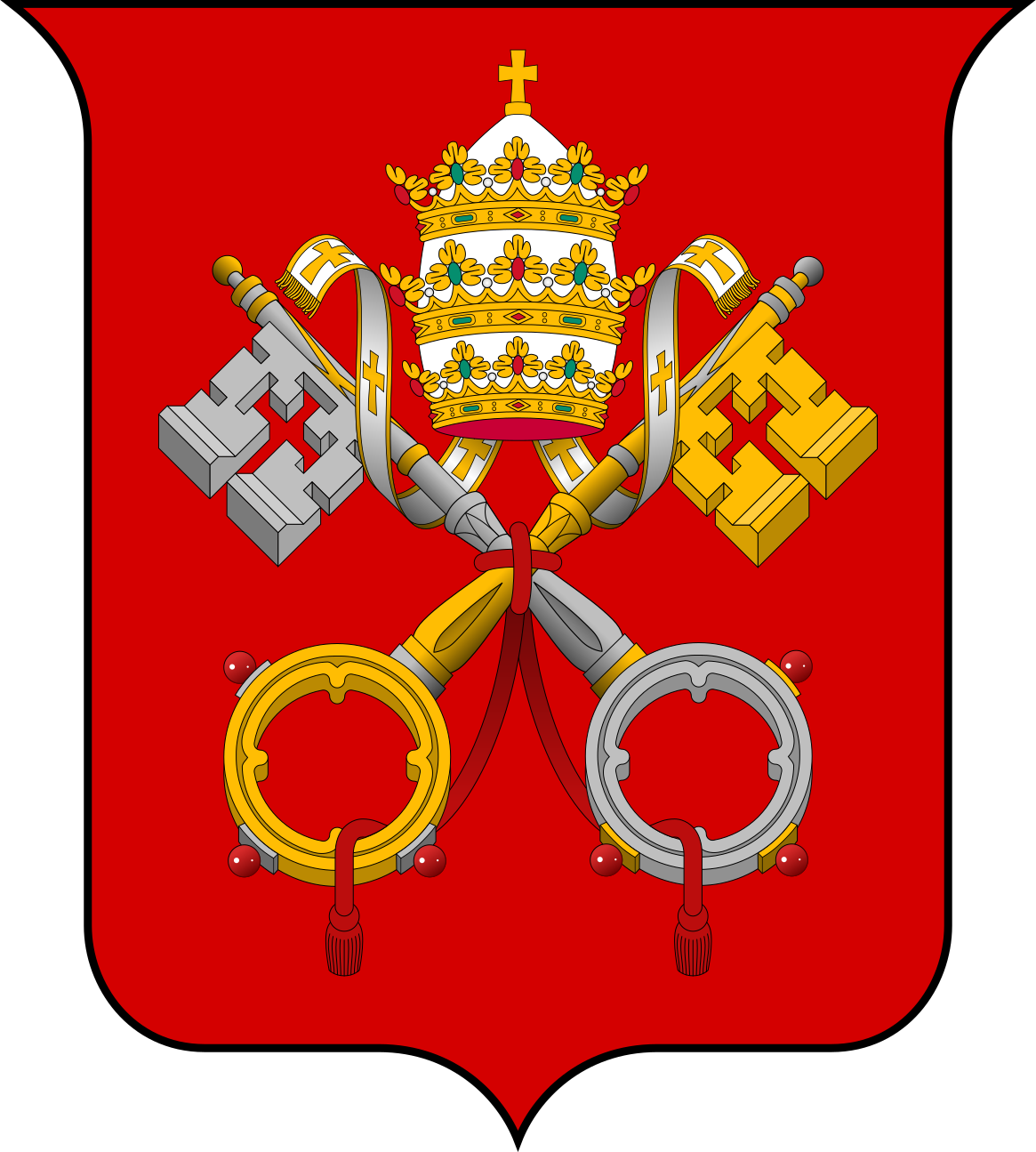
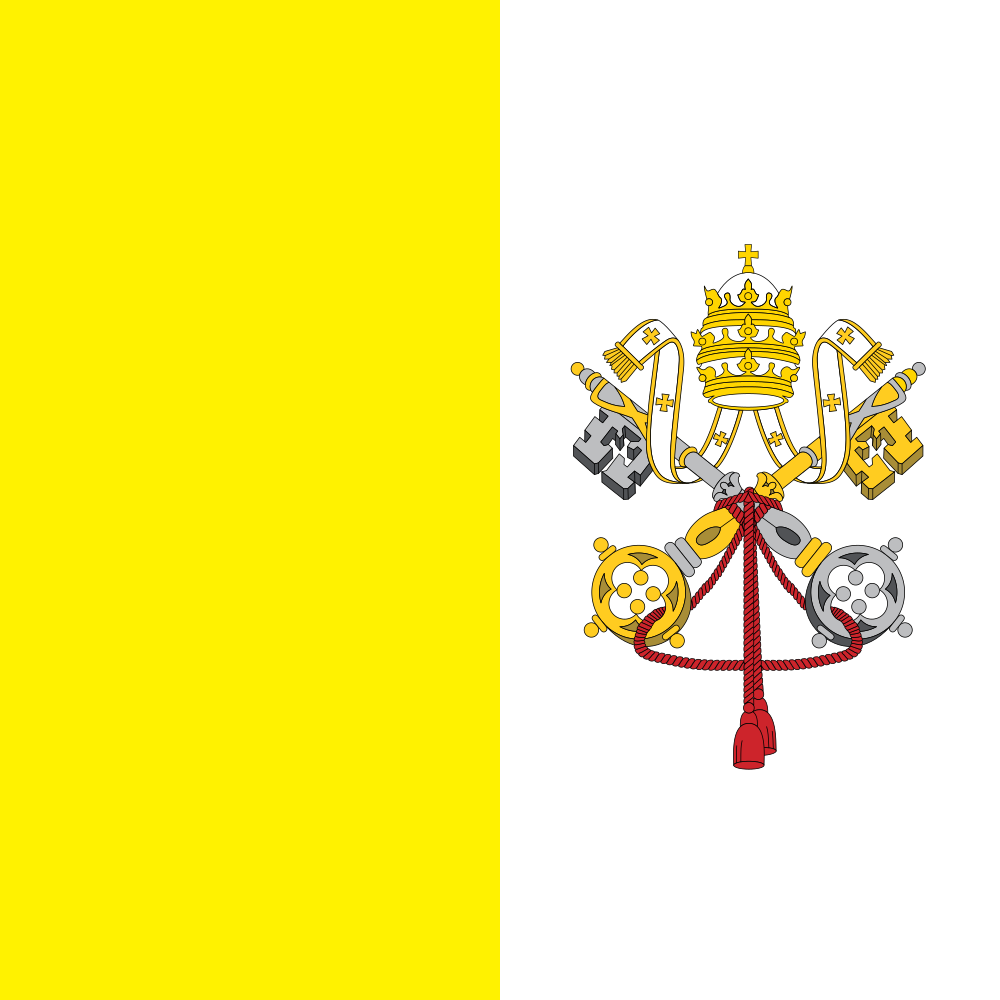
- Capital
- Vatican City
- Population
- 882
- Region
- Europe · Southern Europe
- Demonym
- Vatican
- Currencies
- EUR (€)
- Languages
- Italian, Latin
- Calling code
- +3
- Drives on
- Right
- TLD
- .va
- Timezones
- UTC+01:00
- Borders
- ITA
- Status
- Not a UN member
via REST Countries
Wikipedia views (30d)
149,666 totalvia Wikimedia Pageviews API
Research
364 papers- Vatican City.Department of State publication. Background notes series · 1984United States. Department of State. Bureau of Public Affairs
- β-Lactam Allergy and Cross-Reactivity: A Clinician's Guide to Selecting an Alternative Antibiotic.ReviewJournal of asthma and allergy · 2021Caruso C, Valluzzi RL, Colantuono S et al.DOI: 10.2147/JAA.S242061
- World Health Organization (WHO) guideline on the complementary feeding of infants and young children aged 6-23 months 2023: A multisociety response.Journal of pediatric gastroenterology and nutrition · 2024European Society for Paediatric Gastroenterology, Hepatology & Nutrition (ESPGHAN), European Academy of Paediatrics (EAP), European Society for Paediatric Research (ESPR) et al.DOI: 10.1002/jpn3.12248
- Child healthcare services offered by the Vatican City State in its national territory and in extra-territorial neighboring Italian areas.ReviewTurk pediatri arsivi · 2020Villani A, Giuliani M, Raponi M et al.DOI: 10.14744/TurkPediatriArs.2020.23690
- SARS-CoV-2 seroprevalence in the Vatican City State.European journal of internal medicine · 2021Ralli M, Arcangeli A, Soave PM et al.DOI: 10.1016/j.ejim.2021.01.029
- A New Mediterranean Lifestyle Pyramid for Children and Youth: A Critical Lifestyle Tool for Preventing Obesity and Associated Cardiometabolic Diseases in a Sustainable Context.ReviewAdvances in nutrition (Bethesda, Md.) · 2025Casas R, Ruiz-León AM, Argente J et al.DOI: 10.1016/j.advnut.2025.100381
- White Paper for Global Palliative Care Advocacy: Recommendations from a PAL-LIFE Expert Advisory Group of the Pontifical Academy for Life, Vatican City.Journal of palliative medicine · 2018Centeno C, Sitte T, de Lima L et al.DOI: 10.1089/jpm.2018.0248
- WT(19)F.Nature chemistry · 2024Francl MDOI: 10.1038/s41557-023-01409-5
via PubMed
Official website
Vatican State
Lo Stato della Città del Vaticano è sorto con il Trattato Lateranense, firmato l’11 febbraio 1929 tra la Santa Sede e l’Italia, che ne ha sancito la personalità
vaticanstate.va →Link to the official site · 4,417 chars · not written by Vinony
Wikidata facts
- Instance of
- sacerdotal state
- Named after
- Vatican Hill
- Official name
- Stato della Città del Vaticano
- Demonym
- vategane
- Award
- Ig Nobel Prize
- Country
- Vatican City
- Continent
- Europe
- Capital
- Vatican City
- Official language
- French
- Currency
- Vatican lira
- Population
- 882
- Area
- 0.49
- Head of government
- Raffaella Petrini
- Head of state
- Pope Leo XIV
- Capital of
- Vatican City
- Shares border with
- European Union
- Highest point
- Vatican Hill
- Owned by
- Holy See
- Official website
- www.vaticanstate.va/es.html
- Image
- Vatican City (VA), Petersplatz -- 2013 -- 3895.jpg
- Calling code
- +379
- Licence plate code
- V
Show 54 more facts
- Coat of arms
- Coat of arms of Vatican City
- Significant event
- Bombing of the Vatican
- top-level Internet domain
- .va
- Commons category
- Vatican City
- enclave within
- Italy
- topic's main category
- Category:Vatican City
- category for people who died here
- Category:Deaths in Vatican City
- topic's main Wikimedia portal
- Portal:Vatican City
- category for people buried here
- Category:Burials in Vatican City
- category of associated people
- Category:Vatican City people
- history of topic
- history of Vatican City
- IPA transcription
- vətʲɪˈkan
- postal code
- 00120
- Commons gallery
- Vaticano
- office held by head of state
- Pope
- lowest point
- Saint Peter's Square
- geography of topic
- geography of the Vatican City
- mobile country code
- 225
- described by source
- Wikitólica
- house publication
- Acta Apostolicae Sedis
- driving side
- right
- language used
- Latin
- emergency phone number
- 112
- topic has template
- Template:VAT
- inception
- 1929-02-11
- native label
- Civitas Vaticana
- replaces
- Papal States
- office held by head of government
- President of the Pontifical Commission for the Vatican City State
- diplomatic relation
- Georgia (country)
- executive body
- Governorate of Vatican City State
- maritime identification digits
- 208
- on focus list of Wikimedia project
- Wikipedia:Vital articles/Level/4
- total expenditure
- 235000000
- Unicode character
- 🇻🇦
- different from
- Vatican
- main regulatory text
- Fundamental Law of Vatican City State
- foundational text
- Lateran Treaty
- GS1 country code
- 800-839
- P6413
- Vatican City
- economy of topic
- economy of Vatican City
- social media followers
- 18928385
- demographics of topic
- demographics of the Vatican City
- studied by
- Vaticanology
- official observer status in organization
- United Nations General Assembly
- P11012
- Père Lachaise Cemetery
- hashtag
- VaticanCity
- broadcast by
- Vatican Radio
- present in work
- Civilization V
- P12749
- Magliano de' Marsi
- separated from
- Kingdom of Italy
- official religion
- Catholic Church
- name in native language
- Stato della Città del Vaticano
Sources (15)
via Wikidata · CC0
Travel guide
Understand
The Vatican City is the temporal seat of the Pope, head of the worldwide Catholic Church. Situated within the city of Rome, the Vatican is the world's smallest sovereign state. You may also hear the term Holy See (Italian: Santa Sede; Latin: Sancta Sedes), which is used to refer to the Diocese of Rome—that is, the ecclesiastical and administrative authority of the Pope, rather than the sovereign governmental entity that is the Vatican City State.
Whenever a Pope dies or resigns, a new Pope is elected by the Papal Conclave, which is comprised of a group of senior clergy known as cardinals. The election takes place inside the Sistine Chapel, whose doors are locked during the proceedings. The ballot papers are burnt after each round of voting, with black smoke coming from the Sistine Chapel chimney indicating that the previous round of voting was inconclusive and white smoke indicating that a new Pope has been chosen. After changing into his Papal vestments, the new Pope is then presented to the public from the central balcony of St. Peter's Basilica.
Get in
thumb|600px|Map of the Vatican District
Although the Vatican City is an independent country, it does not issue visas or residency permits to visitors; it has open borders with Italy.
Since Italy is a part of the Schengen area, its common visa policy applies.
See
There is a lot of artwork to see in Vatican City.
Do
While guidebooks do their best to provide an aid for viewing the collections inside the Vatican, a guided tour is a far better way to make sure you get the most out of your visit.
Buy
The Vatican has a unique, non-commercial economy supported financially by contributions (known as Peter's Pence) from Roman Catholics worldwide. It also sells postage stamps, tourist mementoes, and publications. Fees for admission to museums also go into church coffers.
The Vatican euro coins are the rarest in circulation among European countries, so don't spend them! They are worth a lot more than their face value. Collecting Vatican coins is a popular hobby among numismatists, as the coins of the Vatican City carry a great deal of historical and religious significance. Vatican coins often depict images of popes, saints, and scenes from the Bible and can be a great way to commemorate a special event or admire the coins' beauty. Collecting Vatican coins also offers the chance to learn more about the history of the Vatican and the Catholic faith.
Sleep
Unless you count the Pope as a good friend (and he concurs), there are no lodging opportunities in the Vatican City itself. However, there are many hotels in the surrounding Vaticano neighbourhood of Rome.
Stay safe
You should not assume that the Vatican only attracts the honest. Since the Vatican receives so many people from around the world, there are also those who try to deprive people of their personal property. Keep an eye on your belongings at all times.
The Vatican City has its own laws and the Vatican legal system is based on canon law, which means you can expect to be treated with a degree of leniency in the unlikely event you are arrested. In October 2012, the Pope's former butler was arrested and sentenced to 18 months imprisonment, but was pardoned by the pope two months later. Do not let the highly forgiving nature of Vatican law fool you; Vatican authorities regularly collaborate with Italian authorities and you can also expect to be prosecuted under Italian laws.
The Vatican can get overcrowded at times. If you're travelling with family members or with a friend, stick together. Supervise your children (if you have any) closely to make sure they are not lost among the crowd.
As is the case throughout Europe, the local emergency number here is 112.
All Vatican law enforcement officials (known as the Gendarmerie) are male and are between the ages of 21 and 25 (as required by Vatican law). They are generally courteous, professional, and helpful. Don't be afraid to ask them for any help.
Stay healthy
There are no hospitals or medical clinics in the Vatican. If you require urgent medical attention or health services of any kind, it is strongly recommended that you go to a hospital or a clinic in Rome.
Respect
Many tips in the Christianity article will come in handy when visiting. Respect the Catholic Church, its practices and its doctrine. You don't have to praise the Pope or the Catholic Church; as long as you are polite and refrain from discussing controversial subjects (e.g. birth control and contraceptives), you will be fine.
While everyone is welcome to attend Mass in the Vatican – as in any Catholic church around the world – if you are not a baptized and confirmed Catholic, you should not receive Holy Communion. It is a serious matter for practising Catholics. Depending on the church, you may be able to receive a blessing from the priest instead.
Dress appropriately — no sleeveless shirts, shorts, flip-flops, trainers, or skirts that do not cover the knee — or else you will be refused entry to various places around the Vatican.
The Vatican is a holy place for millions of Christians around the world. Be open to new experiences, and don't feel afraid of communicating with anyone.
Photography and filming in the Vatican are permitted, except in the Sistine Chapel. You are not allowed to use your flash or to bring selfie sticks, professional photography equipment or tripods. If you want to take photographs of Swiss guards, ask respectfully.
Smoking has been banned by the Vatican since 2002; anyone caught smoking risks being fined or disciplined by the Vatican authorities.
Go next
Right outside the borders, the amazing attractions of the global city of Rome await you. If you're up for some more historic sightseeing, visit the beautiful piazzas and palazzos of Old Rome or head to the ancient Roman ruins in the Colosseo district. If not, the hustle and bustle of the Modern Centre with all its shopping opportunities and colourful nightlife might be just what you are looking for.
If you can't get enough of the papal atmosphere, head to the San Giovanni neighbourhood to visit San Giovanni in Laterano, the Pope's cathedral in his role as Bishop of Rome. The small city of Viterbo also makes a good next stop. This is where popes took refuge when they were driven out of Rome and where six of the 13th-century popes had their seat. Castel Gandolfo, overlooking Lake Albano, is another location where the pope's summer residence is.
Travel guide from Wikivoyage (CC BY-SA 4.0)
~40 min read
Encyclopedic overview
Vatican City, officially the Vatican City State (Italian: Stato della Città del Vaticano; Latin: Status Civitatis Vaticanae), often shortened as the Vatican, is a landlocked sovereign city-state. Ruled by the pope, it is an enclave within the city of Rome, Italy, and serves as the administrative centre of the Catholic Church. Vatican City is governed by the See of Rome, commonly known as the Holy See, itself a sovereign entity under international law, which maintains its temporal power, governance, diplomacy, and spiritual independence. Vatican is also used as a metonym for the Holy See, which is the central governing body of the Catholic Church and Vatican City, comprising the pope and the Roman Curia. The independent state of Vatican City came into existence in 1929 via the Lateran Treaty between the Holy See and the Kingdom of Italy, which spoke of it as a creation, not as a vestige of the much larger Papal States (756–1870), which had previously encompassed much of Central Italy.
With an area of 43.9 hectares (108 acres) and a population of about 882 in 2024, it is the smallest sovereign state in the world both by area and by population. It is the only country in the world with a population of under 1,000 people. It is among the least populated capitals in the world. As governed by the Holy See, Vatican City State is an ecclesiastical or sacerdotal-monarchical state ruled by the pope, who is the bishop of Rome and head of the Catholic Church; the highest state functionaries are all Catholic clergy of various origins. The Holy See dates to early Christianity and is the principal episcopal see of the Catholic Church, which in 2018 had about 1.329 billion baptized Catholics in the world, in the Latin Church and 23 Eastern Catholic Churches. After the Avignon Papacy (1309–1377) the popes have mainly resided at the Apostolic Palace within what is now Vatican City, although at times residing instead in the Quirinal Palace in Rome or elsewhere.
Excerpted from Wikipedia’s “Vatican City” article, available under the CC BY-SA 4.0 licence.
Gallery (16)
On the map
2 mapped locations
Available in 270 languages
- Español
- Français
- Deutsch
- 中文
- 日本語
- Русский
- Português
- Italiano
- العربية
- हिन्दी
- Abkhazian
- abstract
- Achinese
- Afrikaans
- Albanian
- Albanian
- Amharic
- Angika
Show 251 more
- Aragonese
- Aramaic
- Armenian
- Arpitan
- Assamese
- Asturian
- Avaric
- azb
- Azerbaijani
- Bahasa Indonesia
- Balinese
- Bangla
- Bashkir
- Basque
- bat_smg
- Bavarian
- be_x_old
- Belarusian
- Betawi
- Bhojpuri
- Bikol
- Bishnupriya
- Bislama
- blk
- Bosnian
- Breton
- Bulgarian
- Buriat
- Burmese
- Catalan
- cbk_zam
- cdo
- Cebuano
- Central Dusun
- Central Kurdish
- Chechen
- Cherokee
- Church Slavic
- Chuvash
- Colognian
- Cornish
- Corsican
- Crimean Tatar
- Croatian
- Czech
- Danish
- Divehi
- dty
- Dzongkha
- Egyptian Arabic
- eml
- Erzya
- Esperanto
- Estonian
- Ewe
- Extremaduran
- Faroese
- Fiji Hindi
- Filipino
- Finnish
- fiu_vro
- Friulian
- Fula
- Gagauz
- Galician
- Ganda
- gcr
- Georgian
- Goan Konkani
- Gothic
- Greek
- Guarani
- Haitian Creole
- Hakka Chinese
- Hausa
- Hawaiian
- Hebrew
- Hungarian
- hyw
- Iban
- Icelandic
- Ido
- Igbo
- Iloko
- Inari Sami
- Ingush
- Interlingua
- Interlingue
- Inupiaq
- Irish
- Jamaican Creole English
- Javanese
- Kabardian
- Kabyle
- Kannada
- Kanuri
- Kara-Kalpak
- Karachay-Balkar
- Kashmiri
- Kashubian
- Kazakh
- kbp
- Khmer
- Kinyarwanda
- Komi
- Komi-Permyak
- Kongo
- Kotava
- Kurdish
- Kyrgyz
- Ladino
- Lao
- Latgalian
- Latin
- Latvian
- Lezghian
- Ligurian
- Limburgish
- Lingala
- Lingua Franca Nova
- Lithuanian
- lld
- Lombard
- Low German
- Lower Sorbian
- Luxembourgish
- Macedonian
- Madurese
- Maithili
- Malagasy
- Malay
- Malayalam
- Maltese
- Manipuri
- Manx
- Māori
- map_bms
- Marathi
- Mari
- Mazanderani
- Minangkabau
- Mingrelian
- Mirandese
- Moksha
- Mongolian
- Moroccan Arabic
- Navajo
- nds_nl
- Neapolitan
- Nederlands
- Nepali
- Northern Frisian
- Northern Sami
- Norwegian
- Norwegian Nynorsk
- Novial
- nrm
- Obolo
- Occitan
- Old English
- olo
- Oromo
- Ossetic
- Palatine German
- Pampanga
- Pangasinan
- Papiamento
- Pashto
- Picard
- Piedmontese
- Polski
- Pontic
- Punjabi
- Quechua
- roa_rup
- roa_tara
- Romanian
- Romansh
- Romany
- Rusyn
- Samoan
- Sanskrit
- Santali
- Sardinian
- Saterland Frisian
- Scots
- Scottish Gaelic
- Serbian
- Serbian (Latin)
- Shan
- Shona
- Sicilian
- Silesian
- simple
- Sindhi
- Sinhala
- skr
- Slovak
- Slovenian
- Somali
- Southern Sotho
- Sranan Tongo
- Sundanese
- Svenska
- Swahili
- Swati
- szy
- Tachelhit
- Tajik
- Talysh
- Tamil
- Tatar
- Telugu
- Tetum
- Tibetan
- Tiếng Việt
- Toki Pona
- Tongan
- Tsonga
- Türkçe
- Turkmen
- Udmurt
- Ukrainian
- Upper Sorbian
- Urdu
- Uyghur
- Uzbek
- Venetian
- Veps
- Volapük
- Waray
- Welsh
- West Flemish
- Western Frisian
- Western Panjabi
- Wolof
- Wu Chinese
- Xhosa
- Yakut
- Yiddish
- Yoruba
- Zaza
- Zeelandic
- zh_classical
- zh_min_nan
- zh_yue
- Zhuang
- Zulu
- فارسی
- ไทย
- 한국어
via Wikidata sitelinks · CC0