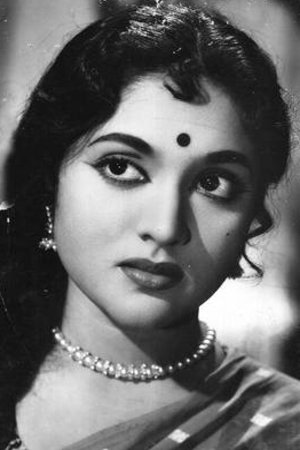
Profile via TMDB · Courtesy of TMDB
Vyjayanthimala
Sign in to saveAlso known as Vyjayanthimala Bali
Vyjayanthimala Bali ( Raman; born 13 August 1933), known mononymously as Vyjayanthimala, is an Indian parliamentarian, dancer and former actress. Regarded as one of Hindi cinema's finest actresses and dancers, she is the recipient of several accolades, including four Filmfare Awards and two BFJA Awards. Considered the first female superstar of Indian Cinema, she made her screen debut at the age of 16 with the Tamil film Vaazhkai (1949), and followed this with a role in the Telugu film Jeevitham (1950). Her first work in Hindi cinema was the social guidance film Bahar (1951), which she headline
OverviewAI-generated
Vyjayanthimala is a female film actor, politician, and choreographer who began her work period in 1949 and ended it in 1969. She was born in 1933 in Madras, Madras State, British India, which is now Chennai, Tamil Nadu, India. Her mother is Vasundhara Devi. She speaks and writes Bangla and Tamil.
She has been a member of the Indian National Congress and the Bharatiya Janata Party. She held the positions of Member of the Lok Sabha and member of the Rajya Sabha. Her country of citizenship includes the British Raj and India. She received the Sangeet Natak Akademi Award and the Padma Vibhushan.
Synthesized by Vinony from 16 facts across 2 sources: Wikidata, TMDb. Generated from structured data (not the Wikipedia text) and checked against those facts — may still contain errors.
Film & TV
Madras, Madras State, British India [now Chennai, Tamil Nadu, India]
Vyjayanthimala Bali (née Raman; born August 13, 1933), known mononymously as Vyjayanthimala, an Indian parliamentarian, dancer and former actress. Born to actress and dancer Vasundhara Devi in a Tamil-speaking family, she had a rare opportunity of performing a dance before the Pope at the age of 7. This cemented her interest in film and she became the one of the highest paid Indian actress of the…
Known for
- Jeena Isi Ka Naam Hai — Herself2002
- Ganwaar — Parvati 'Paro'1970
- Vidhi Vilasam1970
- Pyar Hi Pyar — Kavita (as Vyjayantimala)1969
- Prince — Princess Amrita1969
- Sunghursh — Munni / Laila-E-Aasmaan1968
- Duniya — Mala1968
- Saathi — Shanti1968
- Chhoti Si Mulaqat — Roopa Choudhury1967
- Jewel Thief — Shalini Singh1967
via TMDB
Key facts
- Officeholder.embed
- yes
- Person.birth_name
- Vyjayanthimala Raman
- Person.image
- Vyjayantimala profile.jpg
- Person.caption
- Vyjayanthimala in 2024
- Person.birth_place
- Triplicane, Madras, Madras Presidency, British India
- Person.occupation
- Actress, Indian classical dancer, Carnatic singer, politician
- Person.works
- Full list
- Person.awards
- Full list
- Person.years_active
- 1949–1970
- Person.mother
- Vasundhara Devi
- Person.children
- Suchindra Bali
- Person.signature
- M 215124a.jpg
- Person.signature_alt
- "Vyjayanthimala Bali"
- Officeholder.office
- Member of Parliament Lok Sabha
- Officeholder.termstart
- 1984
- Officeholder.termend
- 1991
- Officeholder.constituency
- Chennai South
- Officeholder.predecessor
- Ramaswamy Venkataraman
via Wikipedia infobox
Wikidata facts
- Instance of
- human
- Gender
- female
- Citizenship
- India
- Place of birth
- Chennai
- Mother
- Vasundhara Devi
- Occupation
- actor
- Political party
- Indian National Congress
- Languages spoken
- Tamil
- Award
- Padma Vibhushan
- Image
- Padma Vibhushan Dr Vyjayanthimala Bali.jpg
Show 6 more facts
- date of birth
- 1933-08-13
- Commons category
- Vyjayanthimala
- start of work period
- 1949-00-00
- name in native language
- வைஜெயந்திமாலா
- end of work period
- 1969-00-00
- P10632
- Vyjayanthimala
Sources (8)
via Wikidata · CC0
~53 min read
Encyclopedic overview
16 sectionsContents
- Background and personal life
- Relationships
- Religious views
- Acting career
- 1949–1954: Early success in South Indian films
- 1955–1957: ''Devdas'' and breakthrough
- 1958–1959: ''Madhumati'', ''Sadhna'' and continued acclaim
- 1960–1964: Return to South Indian cinema and fluctuations
- 1965–1970: Later successes and retirement
- Political career
- Legacy
- Filmography
- Accolades
- See also
- References
- External links
Vyjayanthimala Bali ( Raman; born 13 August 1933), known mononymously as Vyjayanthimala, is an Indian parliamentarian, dancer and former actress. Regarded as one of Hindi cinema's finest actresses and dancers, she is the recipient of several accolades, including four Filmfare Awards and two BFJA Awards. Considered the first female superstar of Indian Cinema, she made her screen debut at the age of 16 with the Tamil film Vaazhkai (1949), and followed this with a role in the Telugu film Jeevitham (1950). Her first work in Hindi cinema was the social guidance film Bahar (1951), which she headlined, and achieved her breakthrough with the romance Nagin (1954).
She garnered widespread critical acclaim for her role in the period drama Devdas (1955), where she played Chandramukhi, a tawaif with a heart of gold. The film and her acting were highly praised, later considered to be her magnum opus. For Devdas, she won the Filmfare Award for Best Supporting Actress which she refused, stating that she played a leading role equal to that of Suchitra Sen, her co-star, and so she could not accept the award for a supporting role. She went on to star in series of commercial successes, which include the romance New Delhi (1956), the social drama Naya Daur (1957) and the comedy Aasha (1957). Her roles in the social drama Sadhna (1958) and the paranormal romance Madhumati (1958), each earned her a nomination for the Filmfare Awards for Best Actress, winning for the former which makes her the first ever actor to receive dual nominations in an acting category in the same year. The nominations also makes her the first-ever multi-nominee across all categories. This win makes her the first performer in Filmfare history to win in both leading and supporting categories.
Excerpted from Wikipedia’s “Vyjayanthimala” article, available under the CC BY-SA 4.0 licence.