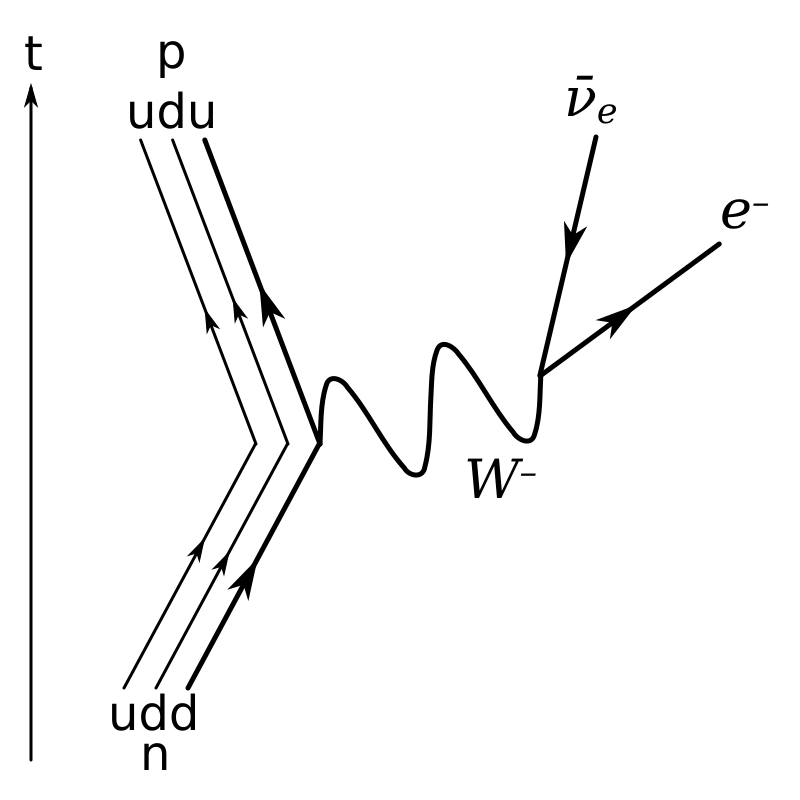
File:Beta_Negative_Decay.svg · Wikimedia Commons · See Wikimedia Commons
weak interaction
Sign in to saveAlso known as weak force, weak nuclear force, weak nuclear interaction
fundamental interaction responsible for beta decay and nuclear fission
The weak interaction is one of nature's fundamental forces that causes certain types of radioactive decay, most notably beta decay where a neutron transforms into a proton. It matters because it's essential to understanding nuclear fission and radioactivity, processes that power nuclear energy and occur naturally throughout the universe.
AI-generated from the Wikipedia summary — may contain errors.
Wikidata facts
- Instance of
- fundamental interaction
- Subclass of
- electroweak interaction
- Image
- PiPlus muon decay.svg
Show 4 more facts
- topic's main category
- Category:Weak interaction
- on focus list of Wikimedia project
- Wikipedia:Vital articles/Level/4
- Stack Exchange tag
- physics.stackexchange.com/tags/weak-interaction
- Commons category
- Weak nuclear force
Sources (3)
via Wikidata · CC0
~21 min read
Encyclopedic overview
The radioactive beta decay is due to the weak interaction, which transforms a neutron into a proton, an electron, and an electron antineutrino.
In nuclear physics and particle physics, the weak interaction, weak force or weak nuclear force, is one of the four known fundamental interactions, with the others being electromagnetism, the strong interaction, and gravitation. It is the mechanism of interaction between subatomic particles that is responsible for the radioactive decay of atoms: The weak interaction participates in nuclear fission and nuclear fusion. The theory describing its behaviour and effects is sometimes called quantum flavordynamics (QFD); however, the term QFD is rarely used, because the weak force is better understood by electroweak theory (EWT).
Excerpted from Wikipedia’s “weak interaction” article, available under the CC BY-SA 4.0 licence.
Gallery (6)
Available in 100 languages
- Español
- Français
- Deutsch
- 中文
- 日本語
- Русский
- Português
- Italiano
- العربية
- हिन्दी
- Afrikaans
- Albanian
- Albanian
- Aragonese
- Armenian
- Assamese
- Asturian
- Bahasa Indonesia
Show 81 more
- Bangla
- Bashkir
- Basque
- bat_smg
- be_x_old
- Belarusian
- Bosnian
- Bulgarian
- Burmese
- Catalan
- Central Kurdish
- Chuvash
- Croatian
- Czech
- Danish
- Egyptian Arabic
- Esperanto
- Estonian
- Fiji Hindi
- Filipino
- Finnish
- Galician
- gcr
- Georgian
- Greek
- Hebrew
- Hungarian
- Icelandic
- Ido
- Interlingua
- Interlingue
- Irish
- Jamaican Creole English
- Kazakh
- Kyrgyz
- Latin
- Latvian
- Lithuanian
- Low German
- Macedonian
- Malay
- Malayalam
- Mongolian
- Nederlands
- Norwegian
- Norwegian Nynorsk
- Occitan
- Piedmontese
- Polski
- Punjabi
- Romanian
- Scots
- Serbian
- Serbian (Latin)
- simple
- Sindhi
- Slovak
- Slovenian
- Sundanese
- Svenska
- Swahili
- Tamil
- Tatar
- Tiếng Việt
- Türkçe
- Tuvinian
- Ukrainian
- Urdu
- Uzbek
- Veps
- Waray
- Welsh
- Western Frisian
- Western Panjabi
- Wu Chinese
- Yiddish
- zh_min_nan
- zh_yue
- فارسی
- ไทย
- 한국어
via Wikidata sitelinks · CC0