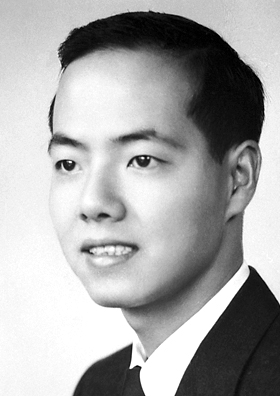
File:TD_Lee.jpg · Wikimedia Commons · See Wikimedia Commons
Tsung-Dao Lee
Sign in to saveAlso known as T. D. Lee, Tsung Dao Lee, Li Zhengdao
Chinese-American physicist (1926–2024)
OverviewAI-generated
Tsung-Dao Lee was a male theoretical physicist and university teacher born in Shanghai in 1926. He held citizenship in the United States, the Republic of China, and Taiwan. Lee worked at Columbia University, the University of California, Berkeley, and Zhejiang University. He was affiliated with CERN and served as a member of the Accademia Nazionale dei Lincei, the Pontifical Academy of Sciences, the National Academy of Sciences, and the Chinese Academy of Sciences.
Lee received the Nobel Prize in Physics, the Guggenheim Fellowship, the Oskar Klein Medal, and the Matteucci Medal. He was educated at Zhejiang University, National Southwestern Associated University, the University of Chicago, and Tsinghua University. His doctoral advisor was Enrico Fermi, and his doctoral students included Norman Christ and Gerald Feinberg. He spoke English and Chinese. Lee died in San Francisco on August 4, 2024.
Synthesized by Vinony from 27 facts across 3 sources: Wikidata, Nobel Prize, Vinony collections. Generated from structured data (not the Wikipedia text) and checked against those facts — may still contain errors.
Nobel Prize
- The Nobel Prize in Physics1957
“for their penetrating investigation of the so-called parity laws which has led to important discoveries regarding the elementary particles”
Shared · 1/2 portion
Wikidata facts
- Instance of
- human
- Family name
- Li
- Gender
- male
- Citizenship
- Taiwan
- Place of birth
- Shanghai
- Place of death
- San Francisco
- Occupation
- theoretical physicist
- Educated at
- Nankai University
- Employer
- Zhejiang University
- Languages spoken
- Chinese
- Doctoral advisor
- Enrico Fermi
- Doctoral student
- Gerald Feinberg
- Field of work
- theoretical physics
- Image
- TD Lee.jpg
- Work location
- China
Show 12 more facts
- Commons category
- Tsung-Dao Lee
- date of birth
- 1926-11-25
- member of
- American Philosophical Society
- Erdős number
- 5
- nominated for
- Nobel Prize in Physics
- ancestral home
- Suzhou
- affiliation
- CERN
- maintained by WikiProject
- WikiProject Mathematics
- date of death
- 2024-08-04
- manner of death
- natural causes
- name in native language
- 李政道
- interested in
- physics
Sources (7)
via Wikidata · CC0
~12 min read
Encyclopedic overview
Signature
Tsung-Dao Lee (Chinese: 李政道; pinyin: Lǐ Zhèngdào; November 24, 1926 – August 4, 2024) was a Chinese-American physicist known for his work on parity violation, the Lee–Yang theorem, particle physics, relativistic heavy ion (RHIC) physics, nontopological solitons, and soliton stars. He was a university professor emeritus at Columbia University in New York City, where he taught from 1953 until his retirement in 2012.
Excerpted from Wikipedia’s “Tsung-Dao Lee” article, available under the CC BY-SA 4.0 licence.
Gallery (7)
Available in 73 languages
- Español
- Français
- Deutsch
- 中文
- 日本語
- Русский
- Português
- Italiano
- العربية
- हिन्दी
- Armenian
- azb
- Azerbaijani
- Bahasa Indonesia
- Bangla
- Basque
- Belarusian
- Bulgarian
Show 54 more
- Catalan
- Croatian
- Czech
- Danish
- Egyptian Arabic
- Esperanto
- Estonian
- Finnish
- Galician
- Georgian
- Greek
- Haitian Creole
- Hakka Chinese
- Hebrew
- Hungarian
- Ido
- Irish
- Kannada
- Kazakh
- Kurdish
- Latin
- Latvian
- Macedonian
- Malay
- Marathi
- Mazanderani
- Mingrelian
- Nederlands
- Newari
- Norwegian
- Norwegian Nynorsk
- Polski
- Romanian
- Scots
- Serbian
- simple
- Slovak
- Slovenian
- Svenska
- Swahili
- Tatar
- Tiếng Việt
- Türkçe
- Ukrainian
- Urdu
- Uyghur
- Uzbek
- Western Panjabi
- Wu Chinese
- Yoruba
- zh_min_nan
- zh_yue
- فارسی
- 한국어
via Wikidata sitelinks · CC0