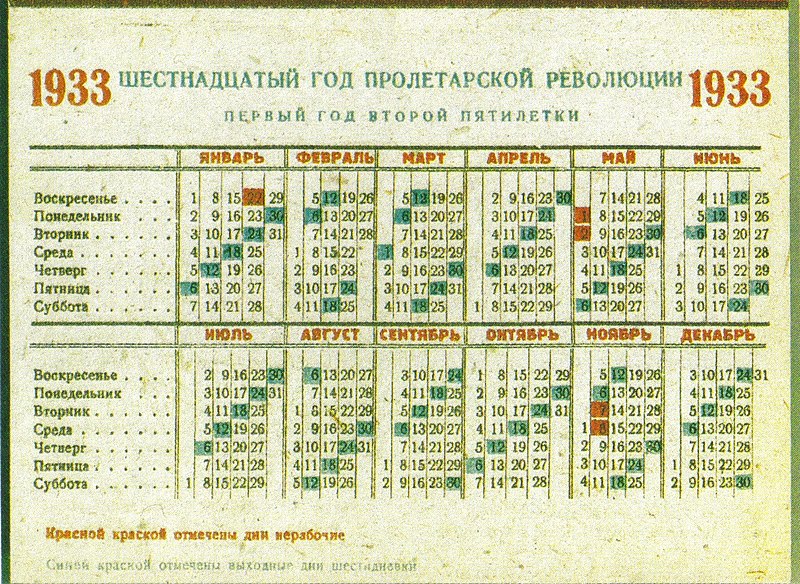
File:Soviet_calendar_1933_color.jpg · Wikimedia Commons · See Wikimedia Commons
Also known as weeks, weekly, week duration, 7 days
A week, in the Western and international context, is a unit of time equal to seven days. It is the standard calendrical period between a day and a month in most parts of the world. There are just over 52 weeks in a year, or on average weeks in a month. The days of the week are often used to set work days, rest days, and holy days. The term "week" may also be used to refer to a sub-section of the week, such as the workweek and weekend. Certain weeks within a year may be designated for a particular purpose, such as Golden Week in China and Japan. More informally, certain groups may advocate awar
A week is a unit of time consisting of seven days that serves as the standard calendrical period between a day and a month in most parts of the world. Weeks matter because they organize how people structure their time—determining work schedules, rest days, and religious observances—and certain weeks throughout the year may be designated for specific purposes.
AI-generated from the Wikipedia summary — may contain errors.
Wikidata facts
- Subclass of
- time interval
- Part of
- month
- Has part
- Friday
- Duration
- 7
- Image
- First Day of Week World Map.svg
- Has parts of class
- weekend
Show 11 more facts
- Commons category
- Weeks
- topic's main category
- Category:Weeks
- Commons gallery
- Week
- conversion to SI unit
- 604800
- conversion to standard unit
- 7
- exact match
- dati.beniculturali.it/cis/Week
- Wikidata SPARQL query equivalent
- wd:Q23387 p:P2370/psn:P2370 [wikibase:quantityAmount ?source; wikibase:quantityUnit ?base]. ?item p:P2370/psn:P2370 [wikibase:quantityAmount ?target; wikibase:quantityUnit ?base]. BIND(?source / ?target as ?value)
- described by source
- Pauly–Wissowa
- subdivision of this unit
- day
- unit symbol
- u
- on focus list of Wikimedia project
- Wikipedia:Vital articles/Level/4
Sources (1)
via Wikidata · CC0
Article · 中文
星期又作週或者礼拜,是一个时间单位,每星期有7日。 中國古代七曜一詞,起源於先秦時代的天文占星學,又稱七政;漢朝的數學家劉洪著作七曜術講述天文算學,《後漢書志二律历》:「正月甲子朔旦冬至,七曜之起,始於牛初。」;東晉范甯的《春秋穀梁傳序》:“陰陽為之愆度,七曜爲之盈縮。”疏:“謂之七曜者,日月五星皆照天下,故謂之曜。”五星指火、水、木、金、土。在唐代以前還未有使用七星指代輪回的7日或一週;古巴比伦人首先使用7日為一週的时间单位,后来犹太人把它传到古埃及,又由古埃及传到罗马,公元3世纪以后,就广泛地传播到欧洲各国。唐朝时期在西域和中国的交流中传入了中土獲得發展,再传入朝鮮半島、日本。光緒三十一年(1905年)由袁嘉穀所定用「星期」代替「曜日」,到了民国以後星期被廣泛使用。
Abstract from DBpedia / Wikipedia · CC BY-SA
Gallery (14)
Available in 206 languages
- Español
- Français
- Deutsch
- 中文
- 日本語
- Русский
- Português
- Italiano
- العربية
- हिन्दी
- Afrikaans
- Albanian
- Albanian
- Amharic
- Angika
- Aragonese
- Aramaic
- Armenian
Show 187 more
- Arpitan
- Assamese
- Asturian
- Avaric
- Aymara
- azb
- Azerbaijani
- Bahasa Indonesia
- Bangla
- Bashkir
- Basque
- bat_smg
- be_x_old
- Belarusian
- Bhojpuri
- Bosnian
- Breton
- Bulgarian
- Buriat
- Catalan
- cdo
- Central Kurdish
- Chechen
- Church Slavic
- Chuvash
- Cornish
- Corsican
- Crimean Tatar
- Croatian
- Czech
- dag
- Danish
- dty
- Dzongkha
- Egyptian Arabic
- eml
- Erzya
- Esperanto
- Estonian
- Extremaduran
- Faroese
- Fiji Hindi
- Fijian
- Filipino
- Finnish
- fiu_vro
- Friulian
- Fula
- Galician
- Gan Chinese
- gcr
- Georgian
- Gilaki
- Gothic
- Greek
- Guarani
- Gujarati
- Haitian Creole
- Hakka Chinese
- Hausa
- Hebrew
- Hungarian
- Icelandic
- Ido
- Iloko
- Ingush
- Interlingua
- Interlingue
- Irish
- Javanese
- Jju
- Kabardian
- Kabyle
- Kannada
- Karachay-Balkar
- Kazakh
- kbp
- kge
- Kinyarwanda
- Komi
- Kongo
- Kyrgyz
- Ladino
- Lao
- Latin
- Latvian
- lbe
- Lezghian
- Lingala
- Lithuanian
- Lombard
- Low German
- Lower Sorbian
- Macedonian
- Maithili
- Malagasy
- Malay
- Malayalam
- Manipuri
- Marathi
- Mazanderani
- Mingrelian
- mnw
- Mongolian
- Moroccan Arabic
- nah
- nds_nl
- Nederlands
- Nepali
- Newari
- Northern Frisian
- Northern Sami
- Northern Sotho
- Norwegian
- Norwegian Nynorsk
- nrm
- Occitan
- Odia
- olo
- Ossetic
- Pashto
- Pennsylvania German
- Picard
- Piedmontese
- Polski
- Punjabi
- Quechua
- roa_rup
- Romanian
- Rusyn
- Sanskrit
- Santali
- Sardinian
- Saterland Frisian
- Scots
- Serbian
- Serbian (Latin)
- Shona
- Silesian
- simple
- Sindhi
- Sinhala
- Slovak
- Slovenian
- Somali
- Standard Moroccan Tamazight
- Svenska
- Swahili
- Tajik
- Talysh
- Tamil
- Tatar
- Telugu
- Tibetan
- Tiếng Việt
- Tok Pisin
- Toki Pona
- Tulu
- Türkçe
- Turkmen
- Tuvinian
- Tyap
- Ukrainian
- Upper Sorbian
- Urdu
- Uyghur
- Uzbek
- Veps
- Volapük
- Walloon
- Waray
- Welsh
- Western Frisian
- Western Panjabi
- Wolof
- Wu Chinese
- Yakut
- Yiddish
- Yoruba
- Zaza
- Zeelandic
- zh_classical
- zh_min_nan
- zh_yue
- فارسی
- ไทย
- 한국어
via Wikidata sitelinks · CC0