File:Foale_ZeroG.jpg · Wikimedia Commons · See Wikimedia Commons
gewichtloosheid
Sign in to saveAlso known as absence of weight
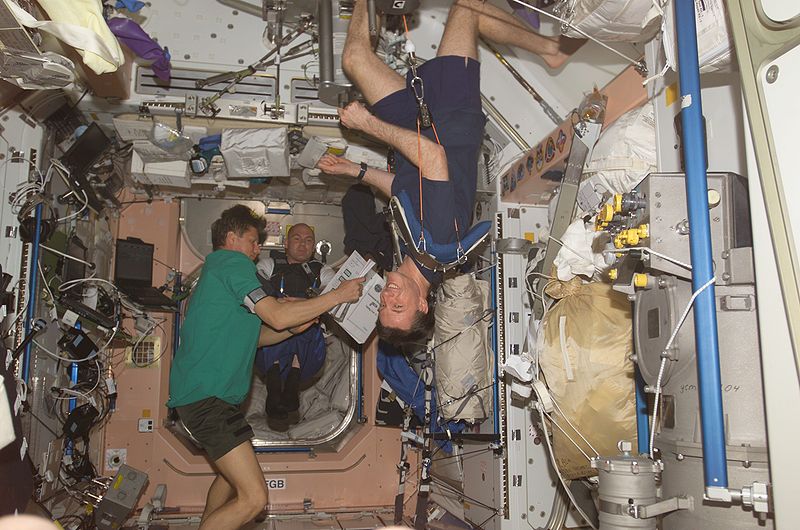
thumb|upright=1.35|Astronauts on the International Space Station experience only microgravity and thus display an example of weightlessness. [[Michael Foale can be seen exercising in the foreground.]]
Weightlessness, or microgravity, is the condition astronauts experience in space where they float freely because they are in continuous free fall around Earth rather than being supported by a surface. It matters because understanding and adapting to weightlessness is essential for astronauts working on space stations like the International Space Station.
AI-generated from the Wikipedia summary — may contain errors.
Research
10,501 papers- Physiological effects of weightlessness: countermeasure system development for a long-term Chinese manned spaceflight.ReviewFrontiers of medicine · 2019Wang L, Li Z, Tan C et al.DOI: 10.1007/s11684-017-0587-7
- Weightlessness simulations for cardiovascular and muscle systems: validity of rat models.ReviewJournal of gravitational physiology : a journal of the International Society for Gravitational Physiology · 1997Musacchia XJ, Fagette S, New Collective Author
- Limb position sense and sensorimotor performance under conditions of weightlessness.ReviewLife sciences in space research · 2022Weber B, Proske UDOI: 10.1016/j.lssr.2021.11.003
- Simulated weightlessness induces hippocampal insulin resistance and cognitive impairment.Life sciences · 2023Li J, Xue C, Yang H et al.DOI: 10.1016/j.lfs.2023.122112
- hBMSC-EVs alleviate weightlessness-induced skeletal muscle atrophy by suppressing oxidative stress and inflammation.Stem cell research & therapy · 2025Chang M, Liu R, Chen B et al.DOI: 10.1186/s13287-025-04175-y
- Cerebellar morphology and behavioural correlations of the vestibular function alterations in weightlessness.ReviewNeuroscience and biobehavioral reviews · 2021Kharlamova A, Proshchina A, Gulimova V et al.DOI: 10.1016/j.neubiorev.2021.03.011
- Otolith functions in weightlessness.ReviewLife sciences and space research · 1975Gerathewohl SJ
- Brain potential responses involved in decision-making in weightlessness.Scientific reports · 2022Cebolla AM, Petieau M, Palmero-Soler E et al.DOI: 10.1038/s41598-022-17234-8
via PubMed
Wikidata facts
- Subclass of
- microgravity
- Image
- Space Fire.jpg
Show 3 more facts
- Commons category
- Weightlessness
- topic's main category
- Category:Weightlessness
- facet of
- g-force
Sources (2)
via Wikidata · CC0
Article · Nederlands
Gewichtloosheid is een toestand waarin een voorwerp geen gewicht ervaart, omdat dat voorwerp geen ophanging of ondersteuning heeft in die specifieke toestand. Dit is het geval tijdens een vrije val, dat wil zeggen wanneer op het voorwerp geen enkele kracht wordt uitgeoefend, behalve de zwaartekracht. Men voelt dan niet de gevolgen van de zwaartekracht. De g-kracht is nul. Staande op de grond of zittend op een stoel word je door de zwaartekracht van de aarde aangetrokken. Wat je ervaart als een gevoel van gewicht is de reactiekracht die opgewekt is waar je staat of onder je zitvlak. Zonder ondergrond is er geen gewicht en zou je je gewichtloos voelen. Zodra er weer sprake is van een ondergrond houdt de toestand van gewichtloosheid weer op. In het dagelijks taalgebruik worden gewicht en massa door elkaar gebruikt, hoewel gewicht het gevolg is van de combinatie van massa, zwaartekracht en de aanwezigheid van een ondergrond die dingen tegenhoudt. Gewicht wordt uitgedrukt in newton, de eenheid van kracht, terwijl massa wordt uitgedrukt in kilogram. Gewichtloosheid betekent niet dat je geen massa meer bezit. Het opwekken van gewichtloosheid wordt in de wetenschap gebruikt om te zien wat de invloed is van de zwaartekracht op bepaalde processen. Zo voerde André Kuipers tijdens zijn verblijf in het Internationaal ruimtestation experimenten uit op de invloed van gewichtloosheid op ontkiemende zaadjes.
Abstract from DBpedia / Wikipedia · CC BY-SA