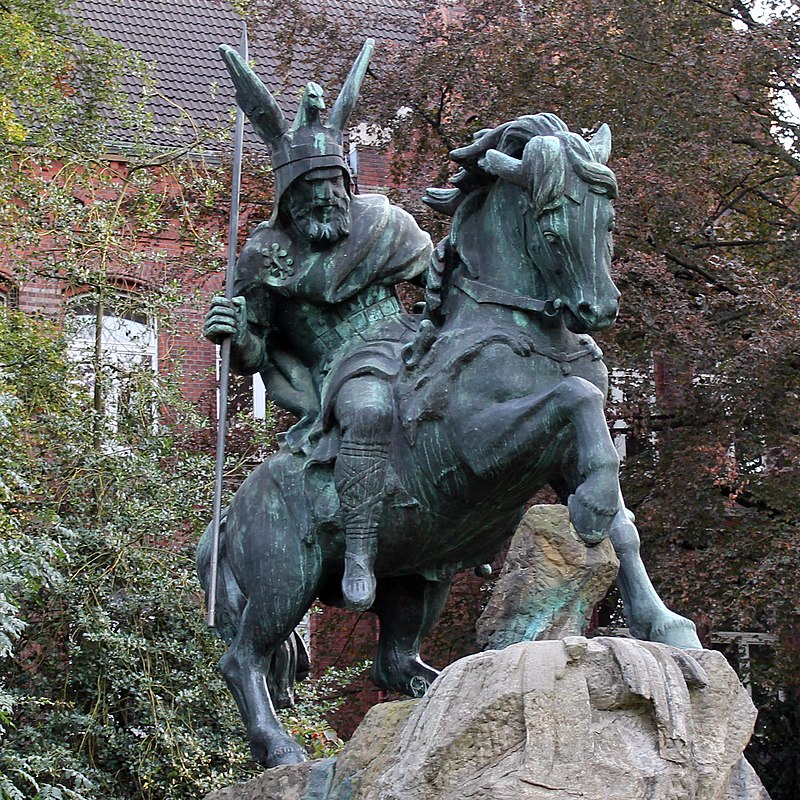
File:Widukind_statue,_Herford.jpg · Wikimedia Commons · See Wikimedia Commons
Viduquindo
Sign in to saveAlso known as Wittekind, Wittekind Herzog von Sachsen
Widukind, also known as Wittekind and Wittikund, was a leader of the Saxons and the chief opponent of the Frankish king Charlemagne during the Saxon Wars from 777 to 785. Charlemagne ultimately prevailed, organized Saxony as a Frankish province, massacred thousands of Saxon nobles, and ordered conversions of the pagan Saxons to Christianity. In later times, Widukind became a symbol of Saxon independence and a figure of legend. He is also venerated as a Blessed in the Catholic Church.
OverviewAI-generated
Widukind was a male military leader born in Westphalia in 0755. He held the noble title of duke and is described in sources including the Nordisk familjebok, Brockhaus and Efron Encyclopedic Dictionary, Allgemeine Deutsche Biographie, and The Nuttall Encyclopædia.
He died in Enger. Widukind is recognized as a blessed figure with a feast day on January 6.
Synthesized by Vinony from 14 facts across 2 sources: Wikidata, VIAF. Generated from structured data (not the Wikipedia text) and checked against those facts — may still contain errors.
Authority record · VIAF
- Nationality
- DE
- Gender
- Male
Recorded by 4 libraries
via VIAF · OCLC
Key facts
- Noble.name
- Widukind
- Noble.noble family
- House of Odon, possibly progenitor of Immedingians
- Noble.title
- dux Saxonum
- Noble.image
- File:Widukind statue, Herford.jpg
- Noble.caption
- Modern statue of Widukind in Herford, North Rhine-Westphalia
- Noble.reign
- ?–785
- Noble.predecessor
- Theoderic
- Noble.successor
- Egbert
- Noble.birth_date
- Unknown
- Noble.death_date
- 807 or 808
- Noble.death_place
- possibly Enger, near Herford
- Noble.place of burial
- Stiftskirche, Enger
via Wikipedia infobox
Wikidata facts
- Instance of
- human
- Given name
- Widukind
- Gender
- male
- Place of birth
- Westphalia
- Place of death
- Enger
- Occupation
- military leader
- Noble title
- duke
- Image
- Widukind statue, Herford.jpg
Show 5 more facts
via Wikidata · CC0
Article · Español
Viduquindo o Vitiquindo (siglo VIII; nombre modernizado Wittekind) fue un caudillo sajón adherido al paganismo. Durante las guerras de Sajonia, fue el principal oponente de Carlomagno, que más tarde sería Emperador del Oeste. En el año 782, cuando Carlomagno organizó Sajonia como una provincia de su reino y ordenó la conversión de los paganos al cristianismo, los sajones iniciaron una violenta revuelta contra los francos. Con el paso del tiempo, Viduquindo se convirtió en un símbolo de la independencia sajona y en una figura legendaria.
Abstract from DBpedia / Wikipedia · CC BY-SA