File:Eso1430a.jpg · Wikimedia Commons · See Wikimedia Commons
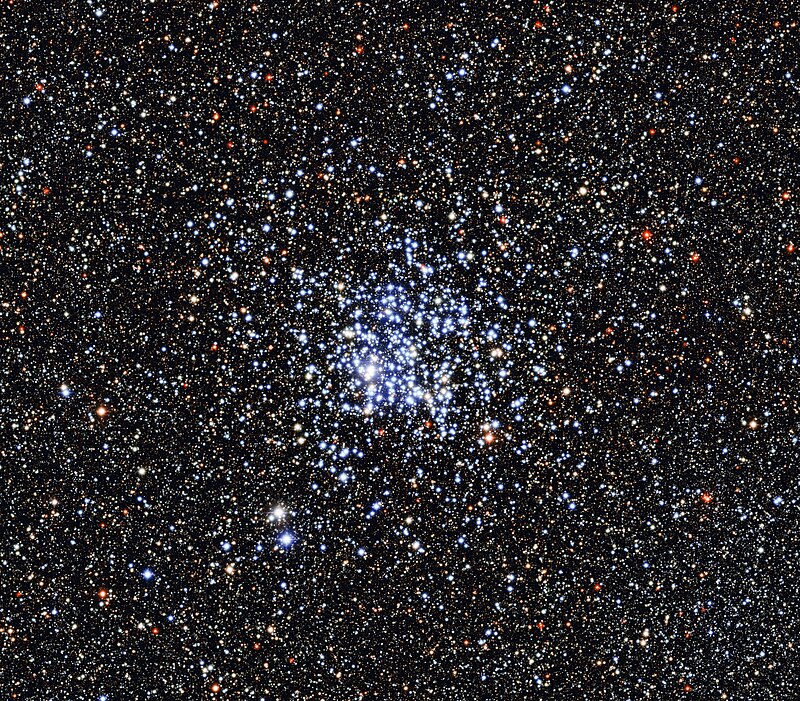
Wild Duck Cluster
Sign in to saveAlso known as Messier 11, M11
Open cluster in the constellation Scutum
The Wild Duck Cluster is a group of stars located in the constellation Scutum that are all roughly the same age and distance from Earth. It's a popular target for amateur astronomers and telescope users because of its distinctive V-shaped pattern of bright stars that resembles a flying flock of ducks.
AI-generated from the Wikipedia summary — may contain errors.
Wikidata facts
- Instance of
- open cluster
- Part of
- Milky Way
- Constellation
- Scutum
- Distance from Earth
- 1877
- Image
- Messier11.jpg
Show 14 more facts
- right ascension
- 282.7708
- catalog code
- [KPS2012] MWSC 3008
- time of discovery or invention
- 1681-01-01
- Commons category
- Wild Duck Cluster
- discoverer or inventor
- Gottfried Kirch
- Commons gallery
- Messier 11
- apparent magnitude
- 5.8
- spectral class
- II
- declination
- -6.2700
- radial velocity
- 31.7
- epoch
- J2000.0
- metallicity
- 0.16
- right ascension component of proper motion
- -6.55
- declination component of proper motion
- -0.04
Sources (2)
via Wikidata · CC0
~2 min read
Encyclopedic overview
The Wild Duck Cluster (also known as Messier 11, or NGC 6705) is an open cluster of stars in the constellation Scutum (the Shield). It was discovered by Gottfried Kirch in 1681. Charles Messier included it in his catalogue of diffuse objects in 1764. Its popular name derives from the brighter stars forming a triangle which could resemble a flying flock of ducks (or, from other angles, one swimming duck). The cluster is located just to the east of the Scutum Star Cloud midpoint.
The Wild Duck Cluster is one of the richest and most compact of the known open clusters. It is one of the most massive open clusters known, and it has been extensively studied. Its age has been estimated to about 316 million years. The core radius is 1.23 pc (4.0 ly) while the tidal radius is 29 pc (95 ly). Estimates for the cluster's mass range from 3,700 M☉ to 11,000 M☉, depending on the method chosen. The brightest cluster member is visual magnitude 8, and it has 870 members of at least magnitude 16.5. It has an integrated absolute magnitude of –6.5, and a visual extinction of 1.3.
Excerpted from Wikipedia’s “Wild Duck Cluster” article, available under the CC BY-SA 4.0 licence.