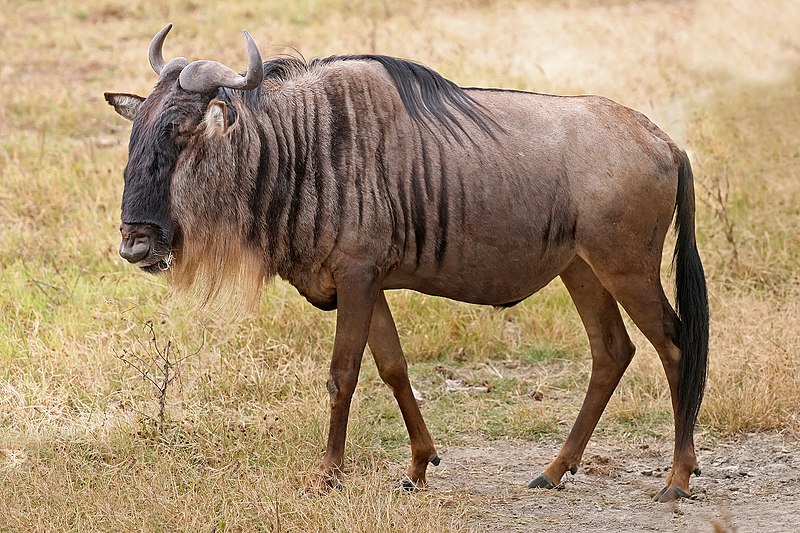
File:Blue_Wildebeest,_Ngorongoro.jpg · Wikimedia Commons · See Wikimedia Commons
wildebeest
Sign in to saveAlso known as gnu, Connochaetes
Wildebeest (, ; , ,), also called gnu (, or , ), are antelopes of the genus Connochaetes and native to Eastern and Southern Africa. They belong to the family Bovidae, which includes true antelopes, cattle, goats, sheep, and other even-toed horned ungulates. There are two species of wildebeest: the black wildebeest or white-tailed gnu (C. gnou), and the blue wildebeest or brindled gnu (C. taurinus).
Wildebeest, also known as gnu, are large African antelopes belonging to the same family as cattle and sheep, with two species found in Eastern and Southern Africa. They are notable members of their ecosystem as part of the diverse group of horned, even-toed mammals native to the continent.
AI-generated from the Wikipedia summary — may contain errors.
Species
Common Wildebeest
species
via
Wikidata facts
- Instance of
- taxon
- Parent taxon
- Alcelaphinae
- Image
- Blue Wildebeest, Ngorongoro.jpg
Show 12 more facts
- Commons category
- Connochaetes
- taxon name
- Connochaetes
- taxon rank
- genus
- topic's main category
- Category:Connochaetes
- longest observed lifespan
- 20
- period of lactation
- 7.5
- gestation period
- 8.5
- litter size
- 1.5
- taxon common name
- ñu
- endemic to
- Africa
- start time
- 2500000-00
- on focus list of Wikimedia project
- Wikipedia:Vital articles/Level/4
via Wikidata · CC0
~23 min read
Encyclopedic overview
18 sectionsContents
- Etymology
- Classification
- Taxonomy and evolution
- Genetics and hybrids
- Characteristics of the species
- Interdigital glands
- Distribution and habitat
- Migration
- Ecology
- Predators
- Interactions with nonpredators
- Breeding and reproduction
- Threats and conservation
- Uses and interaction with humans
- Cultural depictions
- See also
- References
- External links
Wildebeest (, ; , ,), also called gnu (, or , ), are antelopes of the genus Connochaetes and native to Eastern and Southern Africa. They belong to the family Bovidae, which includes true antelopes, cattle, goats, sheep, and other even-toed horned ungulates. There are two species of wildebeest: the black wildebeest or white-tailed gnu (C. gnou), and the blue wildebeest or brindled gnu (C. taurinus).
Fossil records suggest these two species diverged about one million years ago, resulting in a northern and a southern species. The blue wildebeest remained in its original range and changed very little from the ancestral species, while the black wildebeest changed more as adaptation to its open grassland habitat in the south. The most obvious ways of telling the two species apart are the differences in their colouring and in the way their horns are oriented.
Excerpted from Wikipedia’s “wildebeest” article, available under the CC BY-SA 4.0 licence.
Gallery (20)
Available in 91 languages
- Español
- Français
- Deutsch
- 中文
- 日本語
- Русский
- Português
- Italiano
- العربية
- हिन्दी
- Afrikaans
- Asturian
- Avaric
- Azerbaijani
- Bahasa Indonesia
- Balinese
- Bashkir
- Basque
Show 72 more
- Breton
- Bulgarian
- Burmese
- Catalan
- Cebuano
- Central Kurdish
- Cornish
- Croatian
- Czech
- Danish
- Egyptian Arabic
- Esperanto
- Filipino
- Finnish
- Galician
- Georgian
- Greek
- Guarani
- Hebrew
- Hungarian
- Ido
- Interlingua
- Irish
- Javanese
- Kabyle
- Kazakh
- Kotava
- Kyrgyz
- Latin
- Latvian
- Lezghian
- Lithuanian
- Malagasy
- Malay
- Malayalam
- Mari
- Mirandese
- Navajo
- Nederlands
- Northern Frisian
- Northern Sotho
- Norwegian
- Norwegian Nynorsk
- Occitan
- Polski
- Punjabi
- Quechua
- Romanian
- Scottish Gaelic
- Serbian
- Serbian (Latin)
- Shona
- simple
- Slovak
- Slovenian
- Svenska
- Swahili
- Tatar
- Telugu
- Tiếng Việt
- Türkçe
- Udmurt
- Ukrainian
- Urdu
- Uzbek
- Waray
- Western Panjabi
- Wu Chinese
- zh_yue
- فارسی
- ไทย
- 한국어
via Wikidata sitelinks · CC0