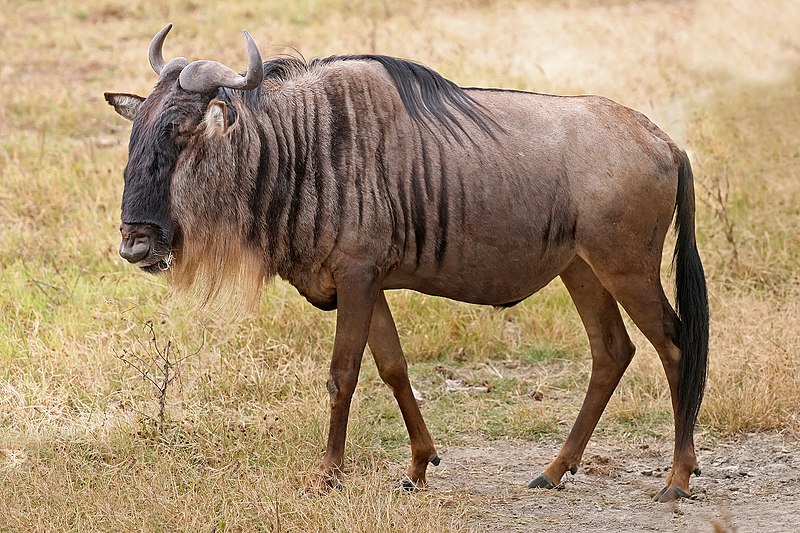
File:Blue_Wildebeest,_Ngorongoro.jpg · Wikimedia Commons · See Wikimedia Commons
blue wildebeest
Sign in to saveAlso known as Connochaetes taurinus, white-bearded wildebeest
species of mammal
A blue wildebeest is a large African hoofed mammal known for its distinctive dark coloring and curved horns. It plays an important ecological role in African grasslands and savannas, where it grazes and migrates in large herds.
AI-generated from the Wikipedia summary — may contain errors.
Species
Least Concern二名法 Connochaetes taurinus(Burchell,1823) C. t. taurinus C. t. cooksoni C. t. johnstoni C. t. albojubatus C. t. mearnsi 亚种 C. t. taurinus C. t. albojubatus C. t. cooksoni C. t. johnstoni C. t. mearnsi 斑纹角马(学名:Connochaetes taurinus)也称黑斑牛羚、蓝角马, 牛科角马属的一种,广布于非洲东部和南部,是非洲原野上最常见的大型动物之一。肩高,颈短,腿细。皮毛蓝灰色至深棕色,身体前部有黑色横纹,额头有黑色斑纹,胡须(其中有两个亚种的胡须为白色)较长。群居。目前记录有五个亚种。在非黑斑牛羚上數量最大記錄量超過150萬頭,而最少則會低於100萬頭,主要的原因是每年的降雨量的不同[2] 参考资料 维基共享资源中相關的多媒體資源:斑纹角马(分類) 维基物种中的分类信息:斑纹角马 ^ IUCN SSC Antelope Specialist Group. Connochaetes taurinus. IUCN Red List of Threatened Species 2010.2. International Union for Conservation of Nature. 2008 [28 August 2010]. Database entry includes a brief justification of why this species is of least concern. ^ www.britannica.com:wildebeest 取自“https://zh.wikipedia.org/w/index.php?title=斑纹角马&oldid=36805262” 分类: IUCN无危物种 角马属 隐藏分类: CS1含有外文文本 TaxoboxLatinName 本地相关图片与维基数据不同
via IUCN
Wikidata facts
- Instance of
- taxon
- Parent taxon
- wildebeest
- Image
- Blue wildebeest (Connochaetes taurinus taurinus) female and calf.jpg
Show 11 more facts
- taxon rank
- species
- IUCN conservation status
- Least Concern
- Commons category
- Connochaetes taurinus
- taxon name
- Connochaetes taurinus
- Commons gallery
- Connochaetes taurinus
- taxon common name
- オグロヌー
- gestation period
- 8.25
- longest observed lifespan
- 24.3
- start time
- 1000000-00
- sequenced genome URL
- www.dnazoo.org/assemblies/Connochaetes_taurinus
- described by source
- Brockhaus and Efron Encyclopedic Dictionary
Sources (2)
via Wikidata · CC0
~24 min read
Encyclopedic overview
The blue wildebeest (Connochaetes taurinus), also called the common wildebeest, white-bearded gnu or brindled gnu, is a large antelope and one of the two species of wildebeest. It is placed in the genus Connochaetes and family Bovidae, and has a close taxonomic relationship with the black wildebeest. The blue wildebeest is known to have five subspecies. This broad-shouldered antelope has a muscular, front-heavy appearance, with a distinctive, robust muzzle. Young blue wildebeest are born tawny brown, and begin to take on their adult coloration at the age of 2 months. The adults' hues range from a deep slate or bluish-gray to light gray or even grayish-brown. Both sexes possess a pair of large curved horns.
The blue wildebeest is an herbivore, feeding primarily on short grasses. It forms herds which move about in loose aggregations, the animals being fast runners and extremely wary. The mating season begins at the end of the rainy season and a single calf is usually born after a gestational period of about 8.5 months. The calf remains with its mother for 8 months, after which it joins a juvenile herd. Blue wildebeest are found in short-grass plains bordering bush-covered acacia savannas in southern and eastern Africa, thriving in areas that are neither too wet nor too arid. Three African populations of blue wildebeest take part in a long-distance migration, timed to coincide with the annual pattern of rainfall and grass growth on the short-grass plains where they can find the nutrient-rich forage necessary for lactation and calf growth.
Excerpted from Wikipedia’s “blue wildebeest” article, available under the CC BY-SA 4.0 licence.