Encyclopedia of Life · EOL (see source)
Wuchereria bancrofti
Sign in to savespecies of parasitic worm
Species
SPECIES
- KingdomAnimalia
- PhylumNematoda
- ClassChromadorea
- OrderRhabditida
- FamilyOnchocercidae
Нитчатка Банкрофта, или Банкрофтов струнец (лат. Wuchereria bancrofti) — вид круглых червей отряда Spirurida, вызывающий вухерериоз. Видовое название дано в честь английского паразитолога Джозефа Банкрофта[en] (1836—1894).
via GBIF
Museum specimens
- Specimen records
- 126
- With media
- 39
- Family
- Onchocercidae
- Collections
- USNM, QM
- Recorded in
- United States, Australia, Brazil, India, Malaysia, Singapore, Egypt, Madagascar
Research
3,235 papers- Wuchereria bancrofti Lymphatic Filariasis, Barrancabermeja, Colombia, 2023.Emerging infectious diseases · 2024
- Does longevity of adult Wuchereria bancrofti increase with decreasing intensity of parasite transmission? Insights from clinical observations.Transactions of the Royal Society of Tropical Medicine and Hygiene · 2005
- Wuchereria bancrofti antigenaemia in Sri Lanka.Tropical medicine & international health : TM & IH · 1999
- Detection of Wuchereria bancrofti infection in mosquitoes in areas co-endemic with Brugia malayi in Balasore district, Odisha, India.Scientific reports · 2024
- Single-Dose Triple-Drug Therapy for Wuchereria bancrofti - 5-Year Follow-up.The New England journal of medicine · 2020
via PubMed
Wikidata facts
- Instance of
- taxon
- Parent taxon
- Wuchereria
- Image
- Wuchereria bancrofti 1 DPDX.JPG
Show 7 more facts
- taxon rank
- species
- taxon name
- Wuchereria bancrofti
- Commons category
- Wuchereria bancrofti
- studied by
- infectious diseases
- has host
- Homo sapiens
- short name
- W. bancrofti
- taxon common name
- 반크롭트사상충
via Wikidata · CC0
~9 min read
Encyclopedic overview
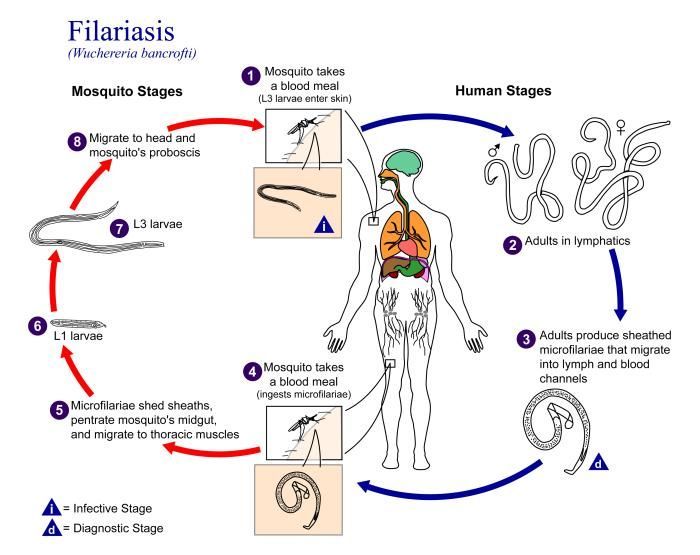
Wuchereria bancrofti is a filarial (arthropod-borne) nematode (roundworm) that is the major cause of lymphatic filariasis. It is one of the three parasitic worms, together with Brugia malayi and B. timori, that infect the lymphatic system to cause lymphatic filariasis. These filarial worms are spread by a variety of mosquito vector species. W. bancrofti is the most prevalent of the three and affects over 120 million people, primarily in Central Africa and the Nile delta, South and Central America, the tropical regions of Asia including southern China, and the Pacific islands. If left untreated, the infection can develop into lymphatic filariasis. In rare conditions, it also causes tropical pulmonary eosinophilia. No vaccine is commercially available, but high rates of cure have been achieved with various antifilarial regimens, and lymphatic filariasis is the target of the World Health Organization Global Program to Eliminate Lymphatic Filariasis with the aim to eradicate the disease as a public-health problem by 2020. This goal was not met.
Morphology
Excerpted from Wikipedia’s “Wuchereria bancrofti” article, available under the CC BY-SA 4.0 licence.