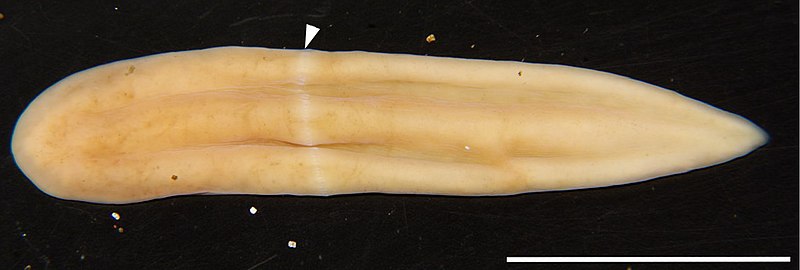
File:Xenoturbella_japonica.jpg · Wikimedia Commons · See Wikimedia Commons
Xenoturbella
Sign in to saveXenoturbella is a genus of very simple bilaterians up to a few centimeters long. It contains a small number of marine benthic worm-like species.
OverviewAI-generated
Xenoturbella is a genus of marine animals classified within the family Xenoturbellidae and the phylum Xenacoelomorpha. The taxon was described by Westblad in 1949 and holds an accepted status. It is a bilaterally symmetrical organism that inhabits the seafloor. The common name for this group is bockadjuret.
The genus is distributed in the Baltic Sea and the eastern Pacific Ocean. Records of the organism have been documented in the United States, Mexico, Costa Rica, Sweden, and Norway. Specimens are held by institutions including USNM, SIO, ALMNH, and NRM. The first species was discovered in 1915.
Synthesized by Vinony from 26 facts across 7 sources: Wikidata, GBIF, Encyclopedia of Life, Gbif Occ, WoRMS, iDigBio, Vinony graph. Generated from structured data (not the Wikipedia text) and checked against those facts — may still contain errors.
Species
bockadjuret
GENUS
- KingdomAnimalia
- PhylumXenacoelomorpha
- FamilyXenoturbellidae
异涡虫(学名:Xenoturbella) 是一类生活在海底極簡單的两侧对称动物,现在仅知1属8种,分布于波罗的海和太平洋東部。第一個物種於1915年首次被發現。
via GBIF
Museum specimens
- Specimen records
- 24
- With media
- 47
- Family
- Xenoturbellidae
- Collections
- USNM, SIO, ALMNH, NRM
- Recorded in
- United States, Mexico, Costa Rica, Sweden, Norway
Wikidata facts
- Instance of
- taxon
- Parent taxon
- Xenoturbellidae
- Image
- Xenoturbella japonica.jpg
Show 4 more facts
- taxon rank
- genus
- taxon name
- Xenoturbella
- topic's main category
- Category:Xenoturbella
- Commons category
- Xenoturbella
Sources (2)
via Wikidata · CC0
~6 min read
Encyclopedic overview
10 sectionsContents
- Description
- Systematics
- Etymology
- Taxonomy
- Phylogeny
- Among species
- Among animals
- References
- Further reading
- External links
Xenoturbella is a genus of very simple bilaterians up to a few centimeters long. It contains a small number of marine benthic worm-like species.
The first known species (Xenoturbella bocki) was collected in 1878 and 1879 in the Gullmar fiord on the Swedish west coast by August Malm and is stored in the collection of the Gothenburg Natural History Museum. A specimen is on display in the exhibition. It was collected again in the Gullmar fiord in 1915 by Sixten Bock, but it was only properly described in 1949 by Einar Westblad. The type specimens are kept at the Swedish Museum of Natural History in Stockholm.
Excerpted from Wikipedia’s “Xenoturbella” article, available under the CC BY-SA 4.0 licence.