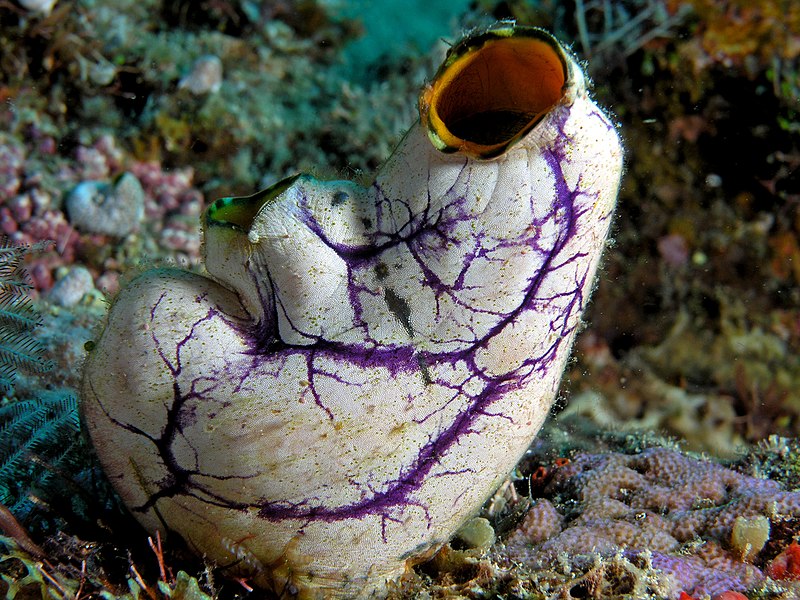
File:Tunicate_komodo.jpg · Wikimedia Commons · See Wikimedia Commons
Tunicata
Sign in to saveAlso known as tunicates, tunicate
Tunicates are marine invertebrates belonging to the subphylum Tunicata ( ). This grouping is part of the Chordata, a phylum which includes all animals with dorsal nerve cords and notochords (including vertebrates). The subphylum was at one time called Urochordata, and the term urochordates is still sometimes used for these animals.
OverviewAI-generated
Tunicata is a taxon with conflicting classifications across different biological databases. The World Register of Marine Species (WoRMS) lists it as an accepted subphylum within the phylum Chordata, with the authority Lamarck, 1816. It includes organisms commonly known as sea squirts that inhabit marine, brackish, and freshwater environments. Conversely, the Global Biodiversity Information Facility (GBIF) classifies Tunicata as a genus within the family Ilictidae of the phylum Cyanobacteria and kingdom Bacteria, citing the authority Sidorov, 1969. iNaturalist identifies it as a species with the common name Black Leather Chiton, associated with the iconic taxon Mollusca.
The taxon has a start time of about 520 million years ago. Records are held by institutions including CMC, CUMV, YPM, SIO, and NCSM. Occurrence data spans the United States, Canada, Costa Rica, and Mexico. The subject is referenced by 918 other encyclopedia articles.
Synthesized by Vinony from 29 facts across 7 sources: Wikidata, GBIF, iNaturalist, Gbif Occ, WoRMS, iDigBio, Vinony graph. Generated from structured data (not the Wikipedia text) and checked against those facts — may still contain errors.
Species
sea squirts
Tunicata
GENUS
- KingdomBacteria
- PhylumCyanobacteria
- FamilyIlictidae
被囊动物亚门(學名:Tunicata),舊稱尾索动物亚门(Urochordata[1][2]),是脊索动物门的一个亚门。本纲动物脊索和背神经管仅存于幼体尾部,成体退化消失。身体表面披有一层棕褐色植物性纤维质的囊包。全部是海洋动物。常见种类有各种海鞘和住囊虫,营自由生活或固着生活。有些种类有世代交替现象。 分类 被囊动物與有頭類(包括盲鰻、七鰓鰻和有下頜的脊椎動物)相比較,與諸如文昌魚、棘皮動物、半索动物(hemichordates)、异涡虫(Xenoturbella)或其他無脊椎動物更密切相關[3][4][5]。 包括有被囊动物亚门和脊索動物的支序叫做嗅球類(Olfactores)支序[6][7]。 被囊动物亚门包括約莫三千個已描述的物種[8],傳統上分成下列三個綱: 海鞘纲(Ascidiacea :Aplousobranchia、Phlebobranchia及Stolidobranchia) 樽海鞘纲(Thaliacea:Pyrosomida、Doliolida及Salpida) 尾海鞘纲(Appendicularia:Larvacea) 在2011年,一項有關濾食性海鞘及捕食性海鞘的分子支序親緣學研究將這些海鞘物種的rDNA進行排序,確認這些物種間的關係,原深水海鞘綱(Sorberacea)的成員都被併入到海鞘綱[9]的Molgulidae(英语:Molgulidae)科中[10][11]。儘管傳統的分類仍然接受,較新的證據認為海鞘綱其實仍然是一個由並系群組成的人造群組[12][13]。 化石物種 有關本分類的化石物種從屬從來都不會沒有爭議:一來這些化石的年代非常久遠,難以保存;二來化石物種沒有現生種可透過分子生物學手段來分析,並借以釐清當中爭議。 山口海鞘綱(Shankouclava†):只有化石種的一個綱,得名與中國雲南省昆明市澂江县山口村的寒武紀早期澄江動物群(日语:澄江動物群)頁岩地層[14]。 Yarnemia(英语:Yarnemia)? 參考文獻 ^ Brusca, R. C.; Brusca, G. J. Invertebrates 2nd Ed. Sunderland, MA (USA): Sinauer. 2002 (英语). 引文格式1维护:冗余文本 (link) ^ Introduction to the Urochordata. [2017-10-27] (英语). ^ Delsuc, F.; Brinkmann, H.; Chourrout, D.; Philippe, H. Tunicates and not cephalochordates are the closest living relatives of vertebrates. Nature. 2006, 439 (7079): 965–968. PMID 1649
via GBIF
Museum specimens
- Specimen records
- 553
- With media
- 47
- Family
- Ilictidae
- Collections
- CMC, CUMV, YPM, SIO, NCSM
- Recorded in
- United States, Canada, Costa Rica, Mexico
Wikidata facts
- Instance of
- taxon
- Parent taxon
- Olfactores
- Image
- Sea-tulip.jpg
Show 6 more facts
- taxon rank
- subphylum
- taxon name
- Tunicata
- Commons category
- Tunicata
- topic's main category
- Category:Tunicates
- start time
- 520000000-
- taxon common name
- plaščarji
Sources (3)
via Wikidata · CC0
~31 min read
Encyclopedic overview
21 sectionsContents
- Etymology
- Taxonomy
- Classification
- Fossil record
- Hybridization studies
- Anatomy
- Body form
- Body structure
- Physiology and internal anatomy
- Feeding
- Life cycle
- Promotion of out-crossing
- A model tunicate
- Invasive species
- Use by humans
- Medical uses
- As food
- Other uses
- See also
- References
- External links
Tunicates are marine invertebrates belonging to the subphylum Tunicata ( ). This grouping is part of the Chordata, a phylum which includes all animals with dorsal nerve cords and notochords (including vertebrates). The subphylum was at one time called Urochordata, and the term urochordates is still sometimes used for these animals.
Despite their simple appearance and very different adult form, their close relationship to the vertebrates is certain. Both groups are chordates, as evidenced by the fact that during their mobile larval stage, tunicates possess a notochord, a hollow dorsal nerve cord, pharyngeal slits, post-anal tail, and an endostyle. They resemble a tadpole.
Excerpted from Wikipedia’s “Tunicata” article, available under the CC BY-SA 4.0 licence.
Gallery (56)
Available in 76 languages
- Español
- Français
- Deutsch
- 中文
- 日本語
- Русский
- Português
- Italiano
- العربية
- हिन्दी
- Afrikaans
- Armenian
- Azerbaijani
- Bahasa Indonesia
- Bangla
- Basque
- be_x_old
- Belarusian
Show 57 more
- Bosnian
- Bulgarian
- Catalan
- Cebuano
- Chuvash
- Cornish
- Croatian
- Czech
- Danish
- Egyptian Arabic
- Esperanto
- Estonian
- Filipino
- Finnish
- Galician
- Georgian
- Greek
- Hebrew
- Hungarian
- Interlingua
- Irish
- Javanese
- Kazakh
- Latin
- Latvian
- Ligurian
- Lingua Franca Nova
- Lithuanian
- Macedonian
- Malay
- Navajo
- Nederlands
- Northern Frisian
- Norwegian
- Norwegian Nynorsk
- Occitan
- Oromo
- Polski
- Romanian
- Scots
- Serbian
- simple
- Slovak
- Slovenian
- Svenska
- Tamil
- Tatar
- Telugu
- Tiếng Việt
- Türkçe
- Ukrainian
- Waray
- Wu Chinese
- zh_yue
- فارسی
- ไทย
- 한국어
via Wikidata sitelinks · CC0