(c) Gezahegne Getaneh, Wim Bert, Wilfrida Decraemer, some rights reserved (CC BY) · cc-by
Xiphinema
Sign in to saveXiphinema is a genus of ectoparasitic root nematodes commonly known as dagger nematodes. The genus is of economic importance on grape, strawberry, hops and a few other crops. Major species include X.americanum, X.diversicaudatum, X.index, X.italiae and X.pachtaicum. They can be easily recognized by their long bodies and stylets which are long enough to reach the vascular tissue of plants. Different members of the genus have been shown to induce moderate to large amounts of root damage through root penetration, which in some species results in the formation of galls. They are of agricultural co
Species
GENUS
- KingdomAnimalia
- PhylumNematoda
- ClassEnoplea
- OrderDorylaimida
- FamilyLongidoridae
劍線蟲屬(學名:Xiphinema),又名匕首線蟲屬[1],是一種棲息於植物根部的潛移性[1]外寄生線蟲動物[2]。本屬物種會對農作物造成巨大經濟損失,能影響葡萄、草莓、酒花及其他經濟作物。主要物種計有:標準劍線蟲(X. index)、美洲劍線蟲(X. americanum)、X. diversicaudatum, X. italiae及X. pachtaicum[3]。其細長的身體及長直的口針(英语:stylet)[4]是其型態特徵,以便於直接刺穿植物的表皮至其维管组织[5]。本屬不同物種會對植物的根部造成中等至大量的傷害:這些線蟲穿透植物的根部,部分物種還會在根部造成蟲癭[3]。 目录 1 型態學 2 系統分類學 2.1 物種列表 3 分佈 4 參考文獻 5 外部連結 型態學 劍線蟲的體型在線蟲動物來說算是比較大,其成蟲的體長有1.5mm – 5.0mm[2]。 系統分類學 本屬現時列有296個物種,當中包括234個已接受物種,49 個異名及13個有待確定的物種[6]。 物種列表 下列為本屬部分物種: Xiphinema abrantinum Roca & Pereira, 1991. Xiphinema aceri Chizhov & al., 1986. Xiphinema aequum Roca & Lamberti, 1988. 美洲劍線蟲 Xiphinema americanum Cobb, 1913[7] Xiphinema artemisiae Chizhov & al., 1986. Xiphinema bakeri Xiphinema barense Lamberti & al., 1986. Xiphinema basilgoodeyi Coomans, 1965. Xiphinema belmontense Roca & Pereira, 1992. Xiphinema brevicolle Lordello & Da Costa, 1961. Xiphinema brevisicum Lamberti & al., 1994. Xiphinema cadavalense Bravo & Roca, 1995. Xiphinema coronatum Roca, 1991. Xiphinema coxi Tarjan, 1964. Xiphinema coxi coxi Tarjan, 1964. Xiphinema coxi europaeum Sturhan, 1985. Xiphinema dentatum Sturhan, 1978. Xiphinema diffusum Lamberti & Bleve-Zacheo, 1979. Xiphin
via GBIF
Wikidata facts
- Instance of
- taxon
- Parent taxon
- Longidoridae
- Image
- Xiphinema parasimile male testis.jpg
Show 4 more facts
- taxon name
- Xiphinema
- taxon rank
- genus
- topic's main category
- Category:Xiphinema
- Commons category
- Xiphinema
Sources (3)
via Wikidata · CC0
~7 min read
Encyclopedic overview
9 sectionsContents
- Morphology
- Taxonomy
- History
- List of species
- Distribution
- Life cycle and reproduction
- Host parasite relationship
- References
- Bibliography
Xiphinema is a genus of ectoparasitic root nematodes commonly known as dagger nematodes. The genus is of economic importance on grape, strawberry, hops and a few other crops. Major species include X.americanum, X.diversicaudatum, X.index, X.italiae and X.pachtaicum. They can be easily recognized by their long bodies and stylets which are long enough to reach the vascular tissue of plants. Different members of the genus have been shown to induce moderate to large amounts of root damage through root penetration, which in some species results in the formation of galls. They are of agricultural concern because they are vectors of nepoviruses, transferring them during feeding. Efforts to study these nematodes in more detail have proved problematic in some species due to difficulties in maintaining populations in a greenhouse environment.
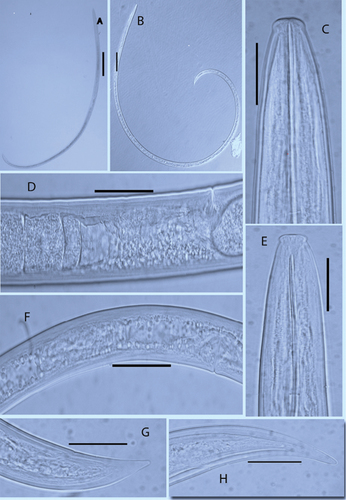
== Morphology == thumb|Mouth section of a Xiphinema sp. juvenile Xiphinema are large nematodes, with an adult length between 1.5mm – 5.0mm. They have a long protrusible odontostyle, with 3 basal flanges at the posterior end of the stylet and a relatively posterior guiding ring when compared to the genus Longidorus. The odontostyle is lined with cuticle and alongside the esophagus serves as a good surface for viruses such as arabis mosaic virus to form a monolayer, which can be vectored to healthy plants. Xiphinema have a two-part esophagus, which does not contain a metacorpus. A modification in the posterior end of the esophagus forms a muscular posterior bulb, which can generate a pumping action similar to that of a metacorpus in other plant parasitic nematodes. The number of males varies from abundant to sparse depending on the species. Males have paired spicules but the gubernaculum and bursa are absent. Males of different species can be characterized using the varying number and arrangement of papillae. Females have 1 or 2 ovaries.
Excerpted from Wikipedia’s “Xiphinema” article, available under the CC BY-SA 4.0 licence.
Gallery (3)
Available in 11 languages
via Wikidata sitelinks · CC0