File:Latin_letter_Z.svg · Wikimedia Commons · See Wikimedia Commons
Also known as Z, z, zed, zee, zad, Zulu, izard, izzard
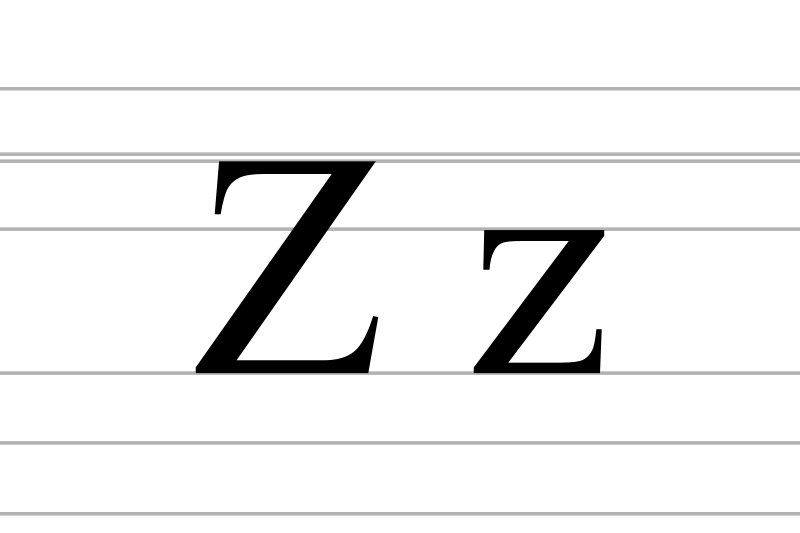
Z, or z, is the twenty-sixth and last letter of the Latin alphabet. It is used in the modern English alphabet, in the alphabets of other Western European languages, and in others worldwide. Its usual names in English are zed (), which is most commonly used in British English, and zee (), most commonly used in American English, with an occasional archaic variant izzard ().
Z is the twenty-sixth and final letter of the Latin alphabet, used in English and many other languages worldwide. The letter's name differs by region, commonly called "zed" in British English and "zee" in American English.
AI-generated from the Wikipedia summary — may contain errors.
Key facts
- Grapheme.name
- Z
- Grapheme.letter
- Z z
- Grapheme.script
- Latin script
- Grapheme.type
- Alphabet
- Grapheme.typedesc
- ic and logographic
- Grapheme.language
- Latin language
- Grapheme.unicode
- U+005A, U+007A
- Grapheme.alphanumber
- 26
- Grapheme.fam1
- Z4
- Grapheme.fam2
- class=skin-invert-image|20px|Proto-Sinaitic Zayin
- Grapheme.fam3
- class=skin-invert-image|20px
- Grapheme.fam4
- class=skin-invert-image|20px|Phoenician Zayin
- Grapheme.fam5
- class=skin-invert-image|30px
- Grapheme.fam6
- Ζ ζ
- Grapheme.fam7
- 𐌆
- Grapheme.usageperiod
- 700 BCE to present
- Grapheme.sisters
- Disputed: ㄷ
- Grapheme.associates
- z(x), cz, dž, dz, sz, dzs, tzsch
via Wikipedia infobox
Wikidata facts
- Part of
- Latin alphabet
- Based on
- Ζ
- Image
- Semaphore Zulu.svg
Show 3 more facts
- Commons category
- Z
- code
- Z
- Commons gallery
- Z
via Wikidata · CC0
~14 min read
Encyclopedic overview
24 sectionsContents
- Name
- History
- Semitic
- Greek
- Etruscan
- Latin
- Old English
- Last letter of the alphabet
- Typographic variants<span class="anchor" id="Variant and derived forms"></span>
- Use in writing systems
- English
- Other languages
- Other systems
- Other uses
- Related characters
- Descendants and related characters in the Latin alphabet
- Ancestors and siblings in other alphabets
- Other representations
- <span class="anchor" id="Computing codes"></span> Unicode
- Other
- See also
- Notes
- References
- External links
Z, or z, is the twenty-sixth and last letter of the Latin alphabet. It is used in the modern English alphabet, in the alphabets of other Western European languages, and in others worldwide. Its usual names in English are zed (), which is most commonly used in British English, and zee (), most commonly used in American English, with an occasional archaic variant izzard ().
==Name== thumb|The Zebra|zebra is sometimes used as a memorization aid in English education. In most English-speaking countries, including Australia, Canada, India, Ireland, New Zealand, South Africa and the United Kingdom, the letter's name is zed , reflecting its derivation from the Greek letter zeta (this dates to Latin, which borrowed Y and Z from Greek), but in American English its name is zee , analogous to the names for B, C, D, etc., and deriving from a late 17th-century English dialectal form.
Excerpted from Wikipedia’s “Z/z” article, available under the CC BY-SA 4.0 licence.
Gallery (25)
Available in 150 languages
- Español
- Français
- Deutsch
- 中文
- 日本語
- Русский
- Português
- Italiano
- العربية
- हिन्दी
- Achinese
- Afrikaans
- Albanian
- Amharic
- Aragonese
- Aramaic
- Armenian
- Asturian
Show 131 more
- azb
- Azerbaijani
- Bahasa Indonesia
- Balinese
- Bangla
- Basque
- bat_smg
- be_x_old
- Belarusian
- Betawi
- Bikol
- Bosnian
- Breton
- Bulgarian
- Burmese
- Catalan
- cdo
- Central Kurdish
- Chuvash
- Cornish
- Corsican
- Crimean Tatar
- Croatian
- Czech
- Danish
- eml
- Esperanto
- Estonian
- Faroese
- Fijian
- Filipino
- Finnish
- Friulian
- Fula
- Galician
- Gan Chinese
- Georgian
- Gorontalo
- Greek
- Guarani
- Haitian Creole
- Hakka Chinese
- Hausa
- Hebrew
- Hungarian
- Icelandic
- Ido
- Igbo
- Iloko
- Inari Sami
- Irish
- Jju
- Kalmyk
- Kara-Kalpak
- Kashmiri
- Kashubian
- Kazakh
- kge
- Komi
- Kurdish
- Latin
- Latvian
- Lithuanian
- Lombard
- Luxembourgish
- Macedonian
- Malagasy
- Malay
- Malayalam
- Manx
- Marathi
- Mari
- Mazanderani
- Mingrelian
- nah
- Nederlands
- Northern Frisian
- Northern Sami
- Norwegian
- Norwegian Nynorsk
- nrm
- nup
- Occitan
- Old English
- Polski
- Punjabi
- Quechua
- Romanian
- Saterland Frisian
- Scots
- Scottish Gaelic
- Serbian
- Serbian (Latin)
- Shona
- Sicilian
- simple
- Slovak
- Slovenian
- Sranan Tongo
- Sundanese
- Svenska
- Swahili
- Tachelhit
- Tatar
- tdd
- Telugu
- Tiếng Việt
- Toki Pona
- Tswana
- Türkçe
- Turkmen
- Tuvinian
- Ukrainian
- Upper Sorbian
- Urdu
- Uzbek
- Venetian
- Veps
- Volapük
- Waray
- Welsh
- Western Frisian
- Wu Chinese
- Yiddish
- Yoruba
- Zaza
- zh_min_nan
- zh_yue
- فارسی
- ไทย
- 한국어
via Wikidata sitelinks · CC0