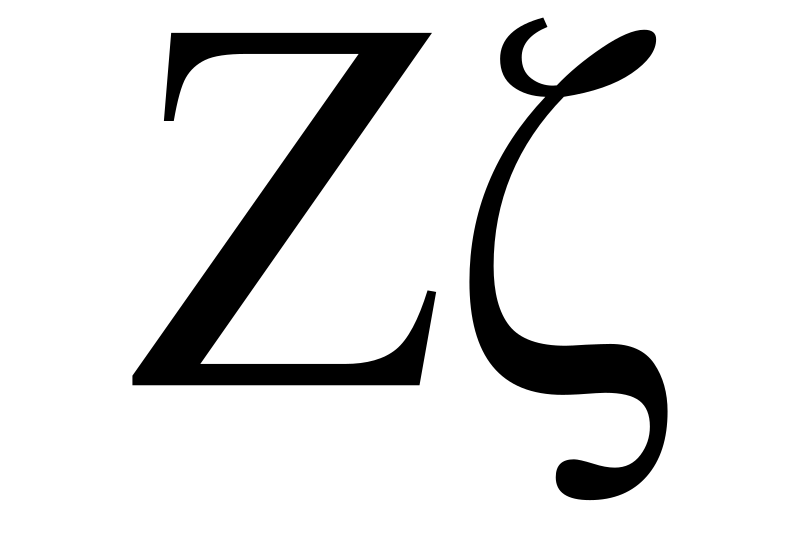
File:Zeta_uc_lc.svg · Wikimedia Commons · See Wikimedia Commons
Also known as zeta
Zeta (, ; uppercase Ζ, lowercase ζ; (Ancient Greek and Katharevousa: ζῆτα, , classical or zē̂ta; zíta) is the sixth letter of the Greek alphabet. In the system of Greek numerals, it has a value of 7. It was derived from the Phoenician letter zayin (𐤆). Letters that arose from zeta include the Roman Z and Cyrillic З.
Ζ (zeta) is the sixth letter of the Greek alphabet, used in ancient and modern Greek writing. It carries a numerical value of 7 in the Greek number system and is the ancestor of the Roman letter Z and the Cyrillic letter З.
AI-generated from the Wikipedia summary — may contain errors.
Wikidata facts
- Part of
- archaic Greek alphabets
- Followed by
- Η
- Follows
- digamma
- Based on
- 𐤆
- Image
- Greek lc zeta.svg
Show 5 more facts
Sources (1)
via Wikidata · CC0
~10 min read
Encyclopedic overview
12 sectionsContents
- Name
- Uses
- Letter {{anchor|Pronunciation}}
- Arguments for {{IPA|[zd]}} {{anchor|Arguments in favor of [zd]}}
- Arguments for [dz] {{anchor|Arguments in favour of [dz]}}
- Summary
- Numeral
- Mathematics and science {{anchor|Symbols}}
- Unicode
- See also
- References
- General references
Zeta (, ; uppercase Ζ, lowercase ζ; (Ancient Greek and Katharevousa: ζῆτα, , classical or zē̂ta; zíta) is the sixth letter of the Greek alphabet. In the system of Greek numerals, it has a value of 7. It was derived from the Phoenician letter zayin (𐤆). Letters that arose from zeta include the Roman Z and Cyrillic З.
==Name== Unlike the other Greek letters, this letter did not take its name from the Phoenician letter from which it was derived; it was given a new name on the pattern of beta, eta and theta.
Excerpted from Wikipedia’s “Ζ” article, available under the CC BY-SA 4.0 licence.
Gallery (4)
Available in 90 languages
- Español
- Français
- Deutsch
- 中文
- 日本語
- Русский
- Português
- Italiano
- العربية
- Abkhazian
- Afrikaans
- Albanian
- Aragonese
- Aramaic
- Armenian
- Asturian
- Bahasa Indonesia
- Bangla
Show 71 more
- Basque
- Bavarian
- be_x_old
- Belarusian
- Breton
- Bulgarian
- Catalan
- Central Kurdish
- Croatian
- Czech
- Danish
- Esperanto
- Estonian
- Extremaduran
- Faroese
- Finnish
- Galician
- Georgian
- Greek
- Haitian Creole
- Hakka Chinese
- Hebrew
- Hungarian
- Icelandic
- Ido
- Irish
- kge
- Komi
- Kurdish
- Latin
- Latvian
- Lezghian
- Lithuanian
- Low German
- Luxembourgish
- Malay
- Malayalam
- Marathi
- nah
- Nederlands
- Northern Sami
- Norwegian
- Norwegian Nynorsk
- Occitan
- Polski
- Punjabi
- Romanian
- Scottish Gaelic
- Serbian
- Serbian (Latin)
- simple
- Slovak
- Slovenian
- Svenska
- Swahili
- Tamil
- Tibetan
- Tiếng Việt
- Toki Pona
- Türkçe
- Ukrainian
- Veps
- Waray
- Welsh
- Wu Chinese
- Zaza
- zh_min_nan
- zh_yue
- فارسی
- ไทย
- 한국어
via Wikidata sitelinks · CC0