Category
page 1Alkanes

alkane
right|thumb|Chemical structure of methane, the simplest alkane

kerosene
right|thumb|upright|A kerosene bottle, containing blue-dyed kerosene

ethane
Ethane ( , ) is a naturally occurring organic chemical compound with chemical formula . At standard temperature and pressure, ethane is a colorless, odorless gas. Like many hydrocarbons, ethane is isolated on an industrial scale from natural gas and as a petrochemical by-product of petroleum refining. Its chief use is as feedstock for ethylene production. The ethyl group is formally, although rarely practically, derived from ethane.

butane
Butane () is an alkane with the formula C4H10. Butane exists as two isomers, n-butane, and iso-butane, . Both isomers are highly flammable, colorless, easily liquefied gases that quickly vaporize at room temperature and pressure. Butanes are a trace component of natural gases, which contain higher concentrations of other hydrocarbons such as propane, ethane, and especially methane. Liquefied petroleum gas is a mixture of propane and some butanes.

propane
thumb|A 20 lb () steel propane cylinder. This cylinder is fitted with an overfill prevention device (OPD) valve, as evidenced by the trilobular handwheel.
Propane () is a three-carbon chain alkane with the molecular formula . It is a gas at standard temperature and pressure, but becomes liquid when compressed for transportation and storage. A by-product of natural gas processing and petroleum refining, it is often a constituent of liquefied petroleum gas (LPG), which is commonly used as a fuel in domestic and industrial applications and in low-emissions public transportation; other constituent

n-pentane
Pentane is an organic compound with the formula C5H12—that is, an alkane with five carbon atoms. The term may refer to any of three structural isomers, or to a mixture of them: in the IUPAC nomenclature, however, pentane means exclusively the n-pentane isomer, in which case pentanes refers to a mixture of them; the other two are called isopentane (methylbutane) and neopentane (dimethylpropane). Cyclopentane is not an isomer of pentane because it has only 10 hydrogen atoms where pentane has 12.

octane
Octane is a hydrocarbon and also an alkane with the chemical formula C8H18, and the condensed structural formula CH3(CH2)6CH3. Octane has many structural isomers that differ by the location of branching in the carbon chain. One of these isomers, 2,2,4-trimethylpentane (commonly called iso-octane), is used as one of the standard values in the octane rating scale.

hexane
Hexane () or '''n-hexane''' is an organic compound, a straight-chain alkane with six carbon atoms and the molecular formula C6H14.
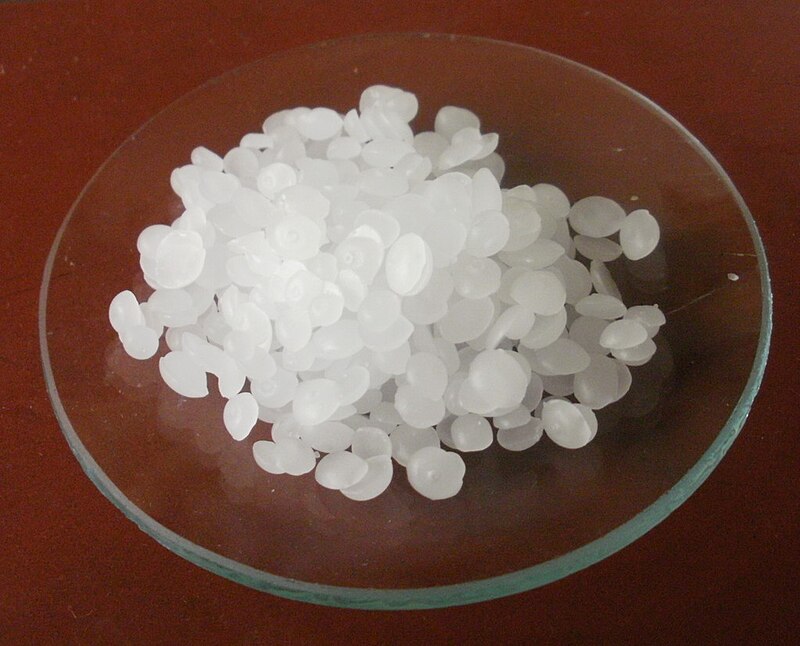
paraffin wax
waxy mixture of higher alkanes

decane
Decane is an alkane hydrocarbon with the chemical formula C10H22. Although 75 structural isomers are possible for decane, the term usually refers to the normal-decane ("n-decane"), with the formula CH3(CH2)8CH3. All isomers, however, exhibit similar properties and little attention is paid to the composition. These isomers are flammable liquids. Decane is present in small quantities (less than 1%) in gasoline (petrol) and kerosene. Like other alkanes, it is a nonpolar solvent, and does not dissolve in water, and is readily combustible. Although it is a component of fuels, it is of little import

nonane
Nonane is a linear alkane hydrocarbon with the chemical formula C9H20. It is a colorless, flammable liquid, occurring primarily in the component of the petroleum distillate fraction commonly called kerosene, which is used as a heating, tractor, and jet fuel. Nonane is also used as a solvent, distillation chaser, fuel additive, and a component in biodegradable detergents. It is also a minor component of diesel fuel.

isobutane
Isobutane, also known as '''i-butane, 2-methylpropane or methylpropane''', is a chemical compound with molecular formula HC(CH3)3. An isomer of butane, it is a colorless, odorless gas. Isobutane is the simplest alkane with a tertiary carbon atom, and is used as a precursor molecule in the petrochemical industry, such as in the synthesis of isooctane.

2,2,4-trimethylpentane
2,2,4-Trimethylpentane, also known as isooctane or iso-octane, is an organic compound with the formula (CH3)3CCH2CH(CH3)2. It is one of several isomers of octane (C8H18). This particular isomer is the standard 100 point on the octane rating scale (the zero point is n-heptane). It is an important component of gasoline, frequently used in relatively large proportions (around 10%) to increase the knock resistance of fuel.
undecane
Undecane (also known as hendecane) is a liquid alkane hydrocarbon with the chemical formula CH3(CH2)9CH3. It is used as a mild sex attractant for various types of moths and cockroaches, and an alert signal for a variety of ants. It has 159 isomers.
dodecane
Dodecane (also known as dihexyl, bihexyl, adakane 12, or duodecane) is an oily liquid n-alkane hydrocarbon with the chemical formula C12H26 (which has 355 isomers).
hexadecane
Hexadecane (also called cetane) is an alkane hydrocarbon with the chemical formula C16H34. Hexadecane consists of a chain of 16 carbon atoms, with three hydrogen atoms bonded to the two end carbon atoms, and two hydrogens bonded to each of the 14 other carbon atoms. Isohexadecane is a branch chained isomer of hexadecane.
tridecane
Tridecane or '''n-tridecane''' is an alkane with the chemical formula CH3(CH2)11CH3. Tridecane is a combustible colourless liquid. In industry, they have no specific value aside from being components of various fuels and solvents. In the research laboratory, tridecane is also used as a distillation chaser.

neopentane
Neopentane, also called 2,2-dimethylpropane, is a double-branched-chain alkane with five carbon atoms, with the chemical formula . Neopentane is a flammable gas at room temperature and pressure which can condense into a highly volatile liquid on a cold day, in an ice bath, or when compressed to a higher pressure.
isopentane
Isopentane, also called methylbutane or 2-methylbutane, is a branched-chain saturated hydrocarbon (an alkane) with five carbon atoms, with formula or .
icosane
Eicosane (alternative spellings icosane and eichosane) is an alkane with the chemical formula C20H42. It has 366,319 constitutional isomers.
tetradecane
Tetradecane is an alkane hydrocarbon with the chemical formula CH3(CH2)12CH3.
pentadecane
Pentadecane is an alkane hydrocarbon with the chemical formula C15H32. It can be monoterminally oxidized to 1-pentadecanol.
2-methylpentane
2-Methylpentane, trivially known as isohexane, is a branched-chain alkane with the molecular formula C6H14. It is a structural isomer of hexane composed of a methyl group bonded to the second carbon atom in a pentane chain.
2,2-dimethylbutane
2,2-Dimethylbutane, trivially known as neohexane at William Odling's 1876 suggestion, is an organic compound with formula C6H14 or (H3C-)3-C-CH2-CH3. It is therefore an alkane, indeed the most compact and branched of the hexane isomers — the only one with a quaternary carbon and a butane (C4) backbone.
heptadecane
Heptadecane is an organic compound, an alkane hydrocarbon with the chemical formula C17H36. The name may refer to any of 24894 theoretically possible structural isomers, or to a mixture thereof.
octadecane
Octadecane is an alkane hydrocarbon with the chemical formula CH3(CH2)16CH3.
3-methylpentane
3-Methylpentane is a branched alkane with the molecular formula C6H14. It is a structural isomer of hexane composed of a methyl group bonded to the third carbon atom in a pentane chain. It is of similar structure to the isomeric 2-methylpentane, which has the methyl group located on the second carbon of the pentane chain.

tetracosane
Tetracosane, also called tetrakosane, is an alkane hydrocarbon with the structural formula H(CH2)24H. As with other alkanes, its name is derived from Greek for the number of carbon atoms, 24, in the molecule. It has 14,490,245 constitutional isomers, and 252,260,276 stereoisomers.
nonadecane
Nonadecane is an alkane hydrocarbon with the chemical formula CH3(CH2)17CH3, simplified to C19H40.
2,3-dimethylbutane
2,3-Dimethylbutane is an isomer of hexane. It has the chemical formula (CH3)2CHCH(CH3)2. It is a colorless liquid which boils at 57.9 °C.
nonacosane
Nonacosane is a straight-chain hydrocarbon with a molecular formula of C29H60, and the structural formula CH3(CH2)27CH3. It has 1,590,507,121 constitutional isomers.
2-methylhexane
2-Methylhexane (C7H16, also known as isoheptane, ethylisobutylmethane) is an isomer of heptane. It is structurally a hexane molecule with a methyl group attached to its second carbon atom. It exists in most commercially available heptane merchandises as an impurity but is usually not considered as impurity in terms of reactions since it has very similar physical and chemical properties when compared to n-heptane (straight-chained heptane).
hentriacontane
Hentriacontane, also called untriacontane, is a solid, long-chain alkane hydrocarbon with the structural formula CH3(CH2)29CH3. It is the main component of paraffin wax.
2,2,3-trimethylbutane
Triptane, or 2,2,3-trimethylbutane, is an organic chemical compound with the molecular formula C7H16 or (H3C-)3C-C(-CH3)2H. It is therefore an alkane, specifically the most compact and heavily branched of the heptane isomers, the only one with a butane (C4) backbone.
3-methylhexane
3-Methylhexane is a branched hydrocarbon with two enantiomers. It is one of the isomers of heptane.
2-methylheptane
2-Methylheptane is a branched-chain alkane and an isomer of octane. It is an heptane molecule with a methyl group attached to its second atom. It is a flammable colorless liquid used as fuel.
heneicosane
Heneicosane is the organic compound with the formula CH3(CH2)19CH3. It is the straight chain, saturated C21 hydrocarbon. It is a white wax.
pristane
Pristane is a natural saturated terpenoid alkane obtained primarily from shark liver oil, from which its name is derived (Latin pristis, "shark"). It is also found in the stomach oil of birds in the order Procellariiformes and in mineral oil and some foods. Pristane and phytane are used in the fields of geology and environmental science as biomarkers to characterize origins and evolution of petroleum hydrocarbons and coal.
heptane
Heptane or '''n-heptane''' is the straight-chain alkane with the chemical formula or . When used as a test fuel component in anti-knock test engines, a 100% heptane fuel is the zero point of the octane rating scale (the 100 point is 100% iso-octane). Octane number equates to the anti-knock qualities of a comparison mixture of heptane and iso-octane which is expressed as the percentage of iso-octane in heptane, and is listed on pumps for gasoline (petrol) dispensed globally.
2-methyl-4-propylnonane
3-Ethylpentane (C7H16) is a branched saturated hydrocarbon. It is an alkane, and one of the many structural isomers of heptane, consisting of a five carbon chain with a two carbon branch at the middle carbon.
Phytane
Phytane is the isoprenoid alkane formed when phytol, a chemical substituent of chlorophyll, loses its hydroxyl group. When phytol loses one carbon atom, it yields pristane. Other sources of phytane and pristane have also been proposed than phytol.
2,2,3,3-tetramethylbutane
Tetramethylbutane, sometimes called hexamethylethane, is a hydrocarbon with formula C8H18 or (H3C-)3C-C(-CH3)3. It is the most heavily branched and most compact of the octane isomers, the only one with a butane (C4) backbone. Because of its highly symmetrical structure, it has a very high melting point and a short liquid range; in fact, it is the smallest saturated acyclic hydrocarbon that appears as a solid at a room temperature of 25 °C. (Among cyclic hydrocarbons, cubane, C8H8, norbornane, C7H12 and norbornene, C7H10 are even smaller and are also solid at room temperature.) It is also
3-methylheptane
3-Methylheptane is a branched alkane isomeric to octane. Its structural formula is CH3CH2CH(CH3)CH2CH2CH2CH3. It has one stereocenter.
2,3,3-trimethylpentane
2,3,3-Trimethylpentane is a chemical compound in the family of hydrocarbons which has a formula of C8H18. It is an isomer of octane. It has a role as a human metabolite, a bacterial metabolite and a mammalian metabolite. It is an alkane and a volatile organic compound.
isocetane
Isocetane (2,2,4,4,6,8,8-heptamethylnonane) is a highly branched alkane used as a reference in determining the cetane number of diesel. It has a cetane number of 15. Isocetane replaced 1-methylnaphthalene in 1962 as the lower reference for cetane number (1-methylnaphthalene has cetane number zero) owing to the oxidation instability and difficulty of use of 1-methylnaphthalene in the reference engine.
list of straight-chain alkanes
Wikimedia list article
2,3-dimethylhexane
2,3-Dimethylhexane is a structural isomer of octane.
tetraethylmethane
Tetraethylmethane is a branched alkane with 9 carbon atoms. It is a highly flammable and volatile liquid at room temperature. It is one of the isomers of nonane.
2,5-dimethylhexane
2,5-Dimethylhexane is a branched alkane used in the aviation industry in low revolutions per minute helicopters. As an isomer of octane, the boiling point is very close to that of octane, but can in pure form be slightly lower. 2,5-Dimethylhexane is moderately toxic.
squalane
Squalane is the organic compound with the formula . A colorless hydrocarbon, it is the hydrogenated derivative of squalene, although commercial samples are derived from nature. In contrast to squalene, due to the complete saturation of squalane, it is not subject to auto-oxidation. This fact, coupled with its lower costs and desirable physical properties, led to its use as an emollient and moisturizer in cosmetics.
2,3,4-trimethylpentane
2,3,4-Trimethylpentane is a branched alkane. It is one of the isomers of octane.
higher alkanes
class of chemical compounds
pentatriacontane
Pentatriacontane is a hydrocarbon from the group of paraffins, an organic chemical compound of the alkane class. The chemical formula is .

tetra-tert-butylmethane
'Tetra-tert-butylmethane' is a hypothetical organic compound with formula C17H36, consisting of four tert-butyl groups bonded to a central carbon atom. It would be an alkane, specifically the most compact branched isomer of heptadecane.
2,3-dimethylpentane
2,3-Dimethylpentane is an organic compound of carbon and hydrogen with formula , more precisely ––––: a molecule of pentane with methyl groups – replacing hydrogen atoms on carbon atoms 2 and 3. It is an alkane ("paraffin" in older nomenclature), a fully saturated hydrocarbon; specifically, one of the isomers of heptane.
nujol
Nujol is a brand of light paraffin oil that was produced by Schering-Plough that was commonly used in infrared spectroscopy. As a paraffin oil it is largely chemically inert and has a relatively uncomplicated IR spectrum, with major peaks between 2950-2800, 1465-1450, and 1380–1300 cm−1. Nujol is primarily a mixture of saturated hydrocarbons, i.e. alkanes with the formula .
2-methyloctane
2-Methyloctane is a branched alkane hydrocarbon with the chemical formula C9H20. It is a colorless, flammable liquid
decacontane
Hectane is an organic compound from the class of straight-chain alkanes, or saturated hydrocarbons. It has 100 carbon atoms in a single chain, without branching. Under normal conditions, it is in a solid state. The chemical formula is . The number of possible structural isomers of hectane is 592,107 × 1034.
2,2-dimethylpentane
2,2-Dimethylpentane is one of the isomers of heptane. It is also called neoheptane as it contains the (CH3)3C grouping. It has the most extreme properties of the isomers of heptane.

3,3-dimethylpentane
3,3-Dimethylpentane is one of the isomers of heptane. 3,3-Dimethylpentane has a boiling point of 86.0 °C and melting point of −134.9 °C. Its density is 0.6934. The refractive index is 1.39092 at 20 °C.