Category
page 1Angle

angle
class=skin-invert-image|alt=two line bent at a point|thumb|upright=1.25|A green angle formed by two red Ray (geometry)|rays on the [[Cartesian coordinate system]]

Pythagorean theorem
relation in Euclidean geometry among the three sides of a right triangle

trigonometric function
function of an angle

azimuth
right|thumb|The azimuth is the angle formed between a reference direction (in this example north) and a sightline|line from the observer to a point of interest projected on the same plane as the reference direction orthogonal to the [[zenith.]]

parallax
thumb|upright=1.4|right|A simplified illustration of the parallax of an object against a distant background due to a perspective shift. When viewed from "Viewpoint A", the object appears to be in front of the blue square. When the viewpoint is changed to "Viewpoint B", the object appears to have moved in front of the red square.
thumb|right|This animation is an example of parallax. As the viewpoint moves side to side, the objects in the distance appear to move more slowly than the objects close to the camera. In this case, the white cube in front appears to move faster than the green cube in t

declination
In astronomy, declination (abbreviated dec; symbol δ) is one of the two angles that locate a point on the celestial sphere in the equatorial coordinate system, the other being hour angle. The declination angle is measured north (positive) or south (negative) of the celestial equator, along the hour circle passing through the point in question.
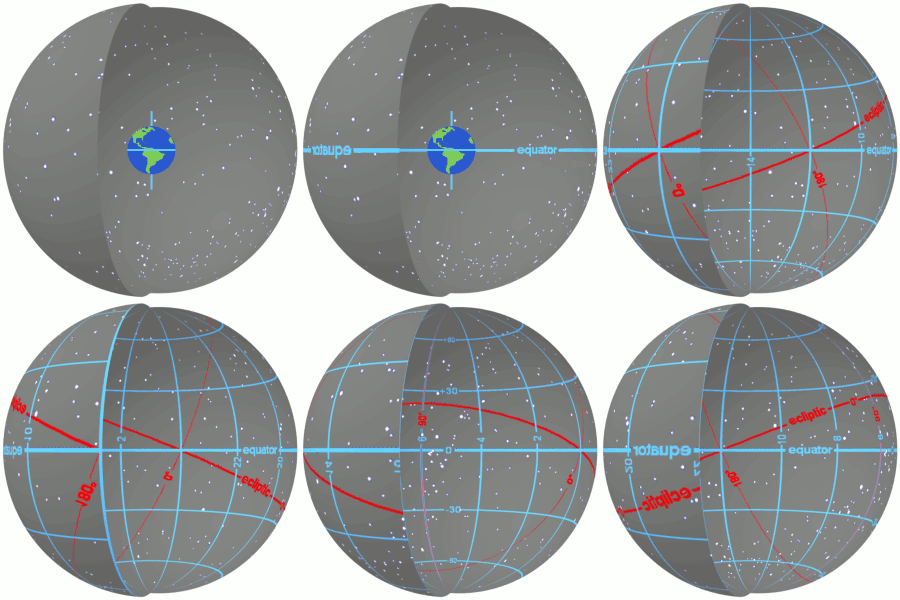
right ascension
astronomical equivalent of longitude

right angle
90° angle (π/2 radians): an angle that bisects the angle formed by two halves of a straight line

angular velocity
physical quantity defined as the rate of change of angular position whose direction is (if regarded as a vector) the axis of rotation

law of sines
property of all triangles on a Euclidean plane
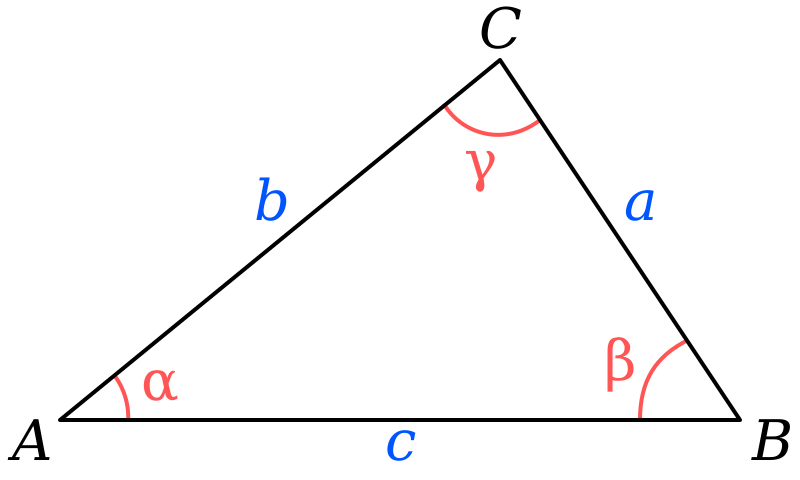
law of cosines
property of all triangles on a Euclidean plane
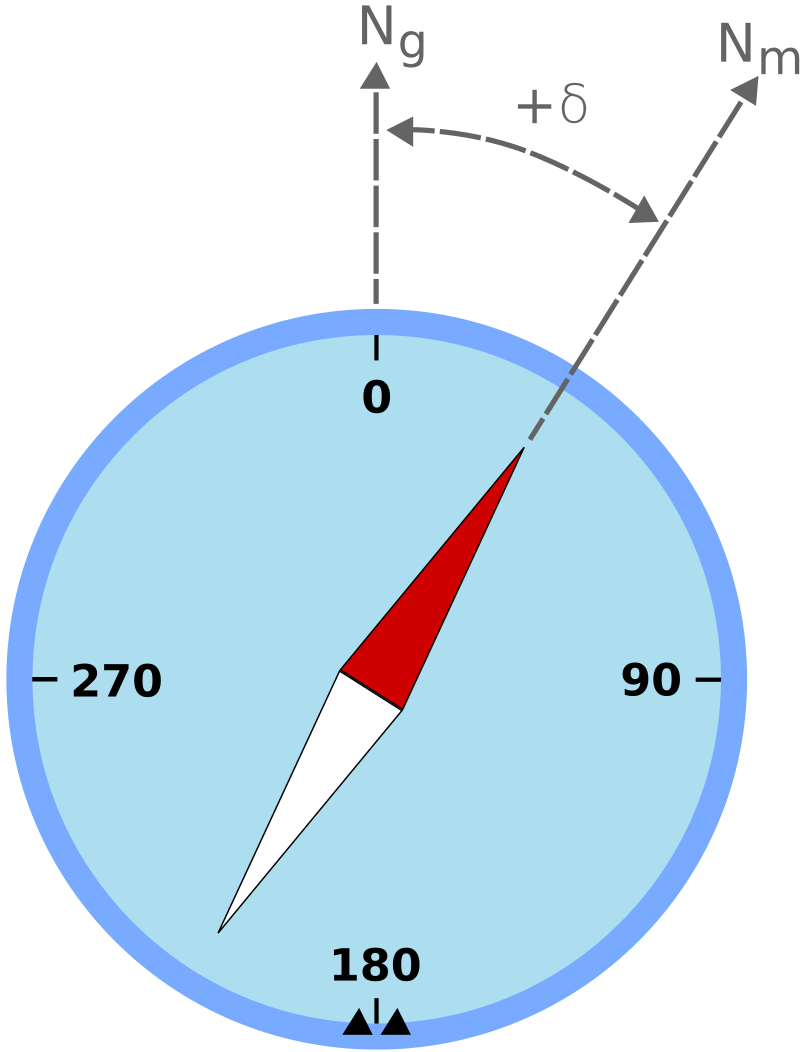
magnetic declination
angle on the horizontal plane between magnetic north and true north

solid angle
measure of a subtended portion of a sphere, used to describe the apparent size of items in a three-dimensional field of view

triangulation
thumb|Estimating the height of a mountain using triangulation
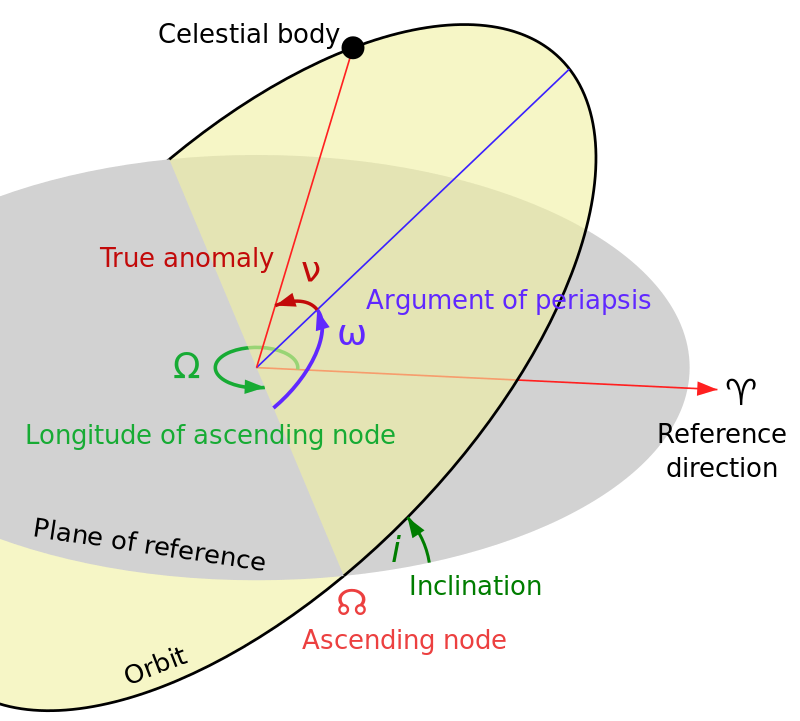
argument of periapsis
one of the orbital elements used to specify the orbit of an object in space

angular frequency
rate of change of the phase angle

angular diameter
angular measurement describing how large a sphere or circle appears from a given point of view
longitude of the ascending node
one of the orbital elements used to specify the orbit of an object in space
angular resolution
ability of any image-forming device to distinguish small details of an object
law of tangents
theorem

inscribed angle
angle formed in the interior of a circle
Brewster's angle
angle of incidence for which all reflected light will be polarized
hour angle
unit of angle
dihedral angle
angle between two planes in space
Euler angles
three angles introduced by Leonhard Euler to describe the orientation of a rigid body with respect to a fixed coordinate system
central angle
measure of two radii meeting
grade
tangent of the angle of a surface to the horizontal
conformal map
mathematical function which preserves angles
radio navigation
navigation using radio signals
angle of view
angular extent of a given scene that is imaged by a camera
angle of list
degree of heel or leaning of vessel, typically a water-going
turn
unit of angle
contact angle
angle between a liquid–vapor interface and a solid surface
selenographic coordinates
coordinate system
internal and external angle
term in geometry
true anomaly
angular parameter of Keplerian orbits
angular measure
measure for how wide an angle is
magnetic deviation
error of a magnetic compass caused by local magnetic fields
angle of incidence
angle between a ray incident on a surface and the line perpendicular to the surface at the point of incidence
law of cotangents
theorem
position angle
measurement relating to observed visual binary stars
golden angle
division of 360° angle into two sub-angles, such that one is 1.618034 times bigger than the other (i.e. the golden ratio or ɸ)
angular displacement
displacement measured angle-wise when a body is showing circular or rotational motion
exterior angle theorem
mathematical theorem, valid in absolute geometry, that the measure of an exterior angle of a triangle is greater than either of the measures of the remote interior angles
sliding T bevel
tool used to mark angles in woodworking
.png)
bevel
right|200px
thumb|200px|Side views of a bevel (above) and a chamfer (below)
A bevelled edge (UK) or beveled edge (US) is an edge of a structure that is not perpendicular to the faces of the piece. The words bevel and chamfer overlap in usage; in general usage, they are often interchanged, while in technical usage, they may be differentiated as shown in the image on the right. A bevel is typically used to soften the edge of a piece for the sake of safety, wear resistance, aesthetics; or to facilitate mating with another piece.
phase angle
angle between incident and reflected light in astronomy
tau
ratio of the circumference of a circle to its radius
elevation
angle in ballistics

sine and cosine
trigonometric functions of an angle

Weinberg angle
electroweak coupling constant describing the position of the electromagnetic U(1) within the electroweak gauge group; the arccosine of the W-boson/Z-boson mass ratio
gimbal lock
hyperbolic angle
argument of the hyperbolic functions
angle of parallelism
in hyperbolic geometry, the angle at one vertex of a right hyperbolic triangle that has two hyperparallel sides
angular aperture
angle of incidence
angle between the chord of the wing and the longitudinal axis of the fuselage
visual angle
Angle an object subtends at the eye
subtended angle
concept in geometry
Polar distance
Celestial coordinate system
Angle of arrival
radio wave analysis method