File:Ra_and_dec_demo_animation_small.gif · Wikimedia Commons · See Wikimedia Commons
right ascension
Sign in to saveastronomical equivalent of longitude
Right ascension is the astronomical equivalent of longitude, used to locate stars and other celestial objects by measuring their position east to west across the sky. Astronomers use it as a key part of coordinate systems for mapping the universe and pinpointing where to find specific objects in the night sky.
AI-generated from the Wikipedia summary — may contain errors.
Wikidata facts
- Subclass of
- angular measure
Show 5 more facts
- opposite of
- declination
- lower limit
- 0
- upper limit
- 24
- topic has template
- Template:RA
- on focus list of Wikimedia project
- Wikipedia:Vital articles/Level/4
Sources (2)
via Wikidata · CC0
~10 min read
Encyclopedic overview
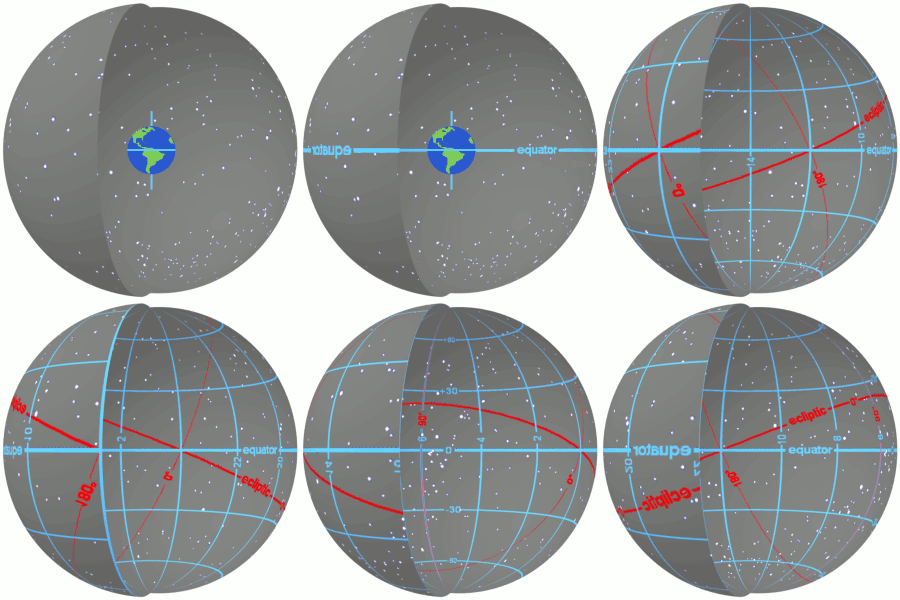
Right ascension and declination as seen on the inside of the celestial sphere. The primary direction of the system is the March equinox, the ascending node of the ecliptic (red) on the celestial equator (blue). Right ascension is measured eastward up to 24 along the celestial equator from the primary direction.
In astronomy, Right ascension (abbreviated RA; symbol α) is the angular distance of a particular point measured eastward along the celestial equator from the Sun at the March equinox to the (hour circle of the) point in question above the Earth. When paired with declination, these astronomical coordinates specify the location of a point on the celestial sphere in the equatorial coordinate system.
Excerpted from Wikipedia’s “right ascension” article, available under the CC BY-SA 4.0 licence.
Gallery (5)
Available in 75 languages
- Español
- Français
- Deutsch
- 中文
- 日本語
- Русский
- Português
- Italiano
- العربية
- हिन्दी
- Afrikaans
- Armenian
- Asturian
- Azerbaijani
- Bahasa Indonesia
- Bangla
- Basque
- be_x_old
Show 56 more
- Belarusian
- Bosnian
- Bulgarian
- Catalan
- Croatian
- Czech
- Danish
- Esperanto
- Estonian
- Filipino
- Finnish
- Galician
- Georgian
- Greek
- Hebrew
- Hungarian
- Icelandic
- Igbo
- Irish
- Kabyle
- Kazakh
- Latin
- Latvian
- Lithuanian
- Low German
- Luxembourgish
- Macedonian
- Malay
- Malayalam
- Marathi
- Nederlands
- Northern Frisian
- Norwegian
- Norwegian Nynorsk
- Occitan
- Polski
- Romanian
- Scots
- Serbian
- Serbian (Latin)
- simple
- Slovak
- Slovenian
- Svenska
- Tatar
- Telugu
- Tiếng Việt
- Türkçe
- Ukrainian
- Urdu
- Western Panjabi
- Wu Chinese
- zh_yue
- فارسی
- ไทย
- 한국어
via Wikidata sitelinks · CC0