Category
page 1Atmospheric optical phenomena

rainbow
thumb|upright=1.35|Double rainbow and supernumerary rainbows on the inside of the primary arc. The shadow of the photographer's head at the bottom of the photograph marks the centre of the rainbow circle (the antisolar point).

aurora
An aurora ( aurorae or auroras) is a natural light display in Earth’s upper atmosphere caused by charged particles from the Sun colliding with atoms in the atmosphere. These collisions excite oxygen and nitrogen, which then emit light of different colors such as green, red, and purple. When observed in high-latitude regions they are called polar lights and aurora polaris. In the Arctic they are called northern lights (aurora borealis); in the Antarctic, the terms southern lights (aurora australis) are used. Auroras display dynamic patterns of radiant light that appear as curtains, rays, spiral

unidentified flying object
unusual apparent anomaly in the sky that is not readily identifiable

mirage
thumb|upright=1.5|Various kinds of mirages in one location taken over the course of six minutes, not shown in chronological order. A mirage is a naturally occurring optical phenomenon in which light rays bend via refraction to produce a displaced image of distant objects or the sky. The word comes to English via the French (se) mirer, from the Latin mirari, meaning "to look at, to wonder at".

halo
optical phenomenon
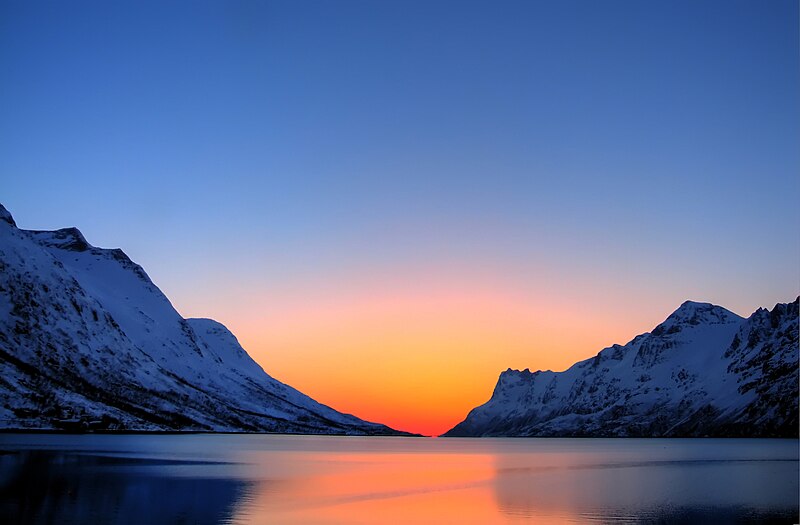
Rayleigh scattering
elastic scattering of light, or other electromagnetic radiation, by particles of size much smaller than the wavelength of the radiation
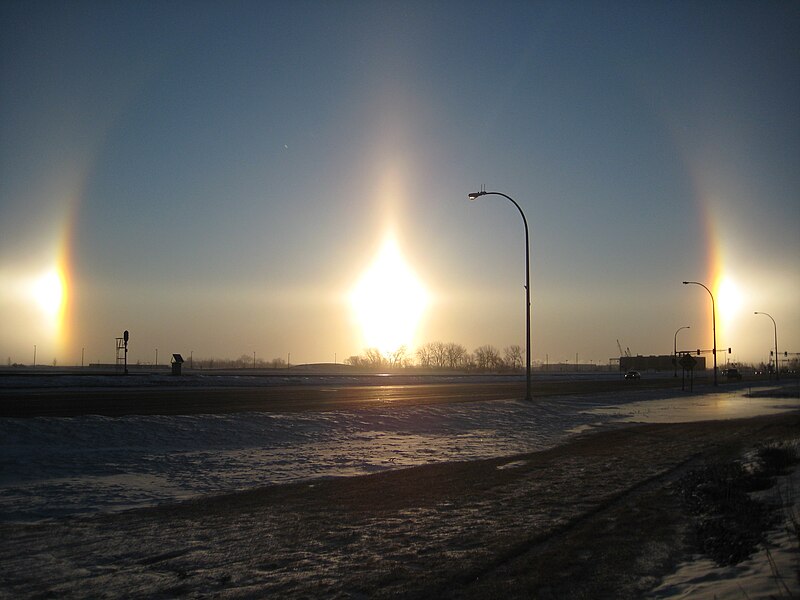
sun dog
atmospheric optical phenomenon

noctilucent cloud
highly-elevated cloud-like ice crystals in the upper atmosphere of Earth visible during astronomical twilight

daylight
thumb|upright=1.2|World map showing the areas of Earth receiving daylight around 1:00 pm UTC in April

haze
thumb|Harmattan Haze in [[Abuja]]
thumb|right|Haze over the Mojave Desert from a [[brush fire in Santa Barbara, California, seen as the Sun descends on the 2016 June solstice, allows the Sun to be photographed without a filter.]]
thumb|Haze as smoke pollution over the Mojave from fires in the Inland Empire, June 2016, demonstrates the loss of contrast to the [[Sun, and the landscape in general.]]

green flash
meteorological optical phenomena
blue hour
period of twilight in the morning or evening

Fata Morgana
optical phenomenon
golden hour
first and last hour of sunlight during the day
light pillar
atmospheric optical phenomenon in the form of a vertical band of light which appears to extend above and/or below a light source
glory
optical phenomenon that resembles an iconic saint's halo about the shadow of the observer's head

moonbow
A moonbow (also known as a moon rainbow or lunar rainbow) is a rainbow produced by moonlight rather than direct sunlight. Other than the difference in the light source, its formation is the same as for a solar rainbow: It is caused by the refraction of light in many water droplets, such as a rain shower or a waterfall, and is always positioned in the opposite part of the sky from the Moon relative to the observer.
thumbnail|Lunar rainbow over Kihei, Hawaii|Kihei, [[Maui, Hawaii, US]]
Moonbows are much fainter than solar rainbows, due to the smaller amount of light reflected from the surface of
%20on%2013th%20of%20August%202015.jpg)
airglow
thumb|Airglow over Auvergne, France
thumb|Yellow, green and red bands of airglow along Earth's limb as seen from space.
fog bow
type of rainbow formed by airborne water droplets
crepuscular ray
rays of sunlight that appear to radiate from the point in the sky where the sun is located
Belt of Venus
pinkish glow seen before sunrise or after sunset extending roughly 10–20° above the horizon
atmospheric refraction
deviation of light or other electromagnetic wave from a straight line as it passes through the atmosphere

afterglow
thumb|Afterglow with its bright segment and purple light above, interrupted by crepuscular rays
diamond dust
ground-level cloud of ice crystals
scintillation
thumb|The twinkling of the brightest star in the [[night sky Sirius (apparent magnitude of −1.1), shortly before upper culmination at the meridian, at 20° above the southern horizon. In 29 seconds, Sirius appears to move 7.5 arcminutes from left to right.]]
thumb|Comparison of twinkling of a star (top) and a planet (bottom). The turbulent atmosphere (shaded blue) distorts their wavefronts (cyan lines) differently with time, like caustics on a swimming pool floor. When a dark part hits the observer (white circle), the object appears dark, and vice versa. An object with larger angular size smear
Brocken spectre
magnified shadow of an observer cast upon clouds opposite the Sun's direction
corona
term in meteorology and astronomy
22° halo
optical phenomenon visible around sun and moon in the earth athmosphere
cloud iridescence
optical phenomenon
atmospheric optics
academic discipline
ice crystal
solid frozen water molecules

alpenglow
thumb|top: reflected alpenglow; bottom: direct sunrise alpenglow from Table Mountain to Mount Baker, WA, USA.
Earth's shadow
shadow that the Earth casts on its own atmosphere
moon dog
bright spot on a lunar halo
circumzenithal arc
optical phenomenon arising from refraction of sunlight through ice crystals
diffuse sky radiation
Solar radiation scattered and absorbed in Earth's atmosphere
circumhorizontal arc
optical phenomenon that belongs to the family of ice halos
1561 celestial phenomenon over Nuremberg
uncomprehended phenomenon observed over Nuremberg in 1561
Novaya Zemlya effect
polar mirage caused by high refraction of sunlight between atmospheric thermal layers
anticrepuscular rays
atmospheric optical phenomenon
Bishop's Ring
Optical phenomenon
parhelic circle
halo appearing as a horizontal white line on the same altitude as the Sun or the Moon
tropospheric scatter
method of communicating with microwave radio signals over considerable distances

cyanometer
thumb|right|A cyanometer by Horace-Bénédict de Saussure (from the collection of ''Musée d'histoire des sciences de la Ville de Genève)
thumb|right|An artwork in Ljubljana, Slovenia, inspired by a cyanometer
A cyanometer (from cyan and -meter'') is an instrument for measuring "blueness", specifically the colour intensity of blue sky. It is attributed to Horace-Bénédict de Saussure and Alexander von Humboldt. It consists of squares of paper dyed in graduated shades of blue and arranged in a color circle or square that can be held up and compared to the color of the sky.

heiligenschein
250px|right|thumb|Heiligenschein, or hotspot, around the shadow of a hot-air balloon cast on a field of standing crops ([[Oxfordshire, England)]]

Steve
thumb|A STEVE over Little Bow Resort, [[Alberta, in August 2015]]
thumb|A STEVE over Crossfield, Alberta, in March 2018 (around 12:30 a.m.)
circumscribed halo
halo in the form of an oval ring that circumscribes the circular 22° halo centred on the sun or moon
Alexander's band
optical phenomenon of unlit sky between rainbows

anthelion
200px|right|thumb|Anthelion (bottom) and 120° parhelion (top) depicted in [[Vädersolstavlan ]]
An anthelion (plural anthelia, from late Greek ανθηλιος, "opposite the sun") is a rare optical phenomenon of the halo family. It appears on the parhelic circle opposite to the Sun as a faint white spot, not unlike a sundog, and may be crossed by an X-shaped pair of diffuse arcs.
46° halo
rare member of the family of ice crystal halos
.jpg)
photometeor
thumb | right | alt=Circumzenithal arc, supralateral arc, Parry arc, tangential arc, 22 degree halo, parhelic circle, and sun dogs on right and left intersection of 22 degree halo and parhelic circle. | Various arcs, halos and sun dogsIn atmospheric optics, a photometeor is a bright object or other optical phenomenon appearing in the Earth's atmosphere when sunlight or moonlight creates a reflection, refraction, diffraction or interference under particular circumstances. The most common examples include halos, rainbows, fogbows, cloud iridescences (or irisation), glories, Bishop's rings, coron
air mass
optical path length through Earth’s atmosphere for light from a celestial source
Parry arc
optical phenomenon

1566 celestial phenomenon over Basel
uncomprehended phenomenon observed over Basel in 1566

ice blink
thumb|Ice Islands with ice blink, watercolour by Georg Forster, made 1773 during the [[second voyage of James Cook|alt=Painting of a ship with sails traversing a rough sea with icerbergs. A white glow, the iceblink, fills the sky.]]

subsun
thumb |250px|A subsun seen from an airplane
lithometeor
thumb|Large ash cloud from the Mount Redoubt volcano.
thumb|Lithometeor at sunset in [[Berlin on February 25, 2021, cloudless sky with Saharan dust.]]
space jellyfish
rocket launch phenomenon
Infralateral arc
crown flash
photometeor / cumulonimbus : weather phenomenon consisting of strobes of light which appear to be "dancing"