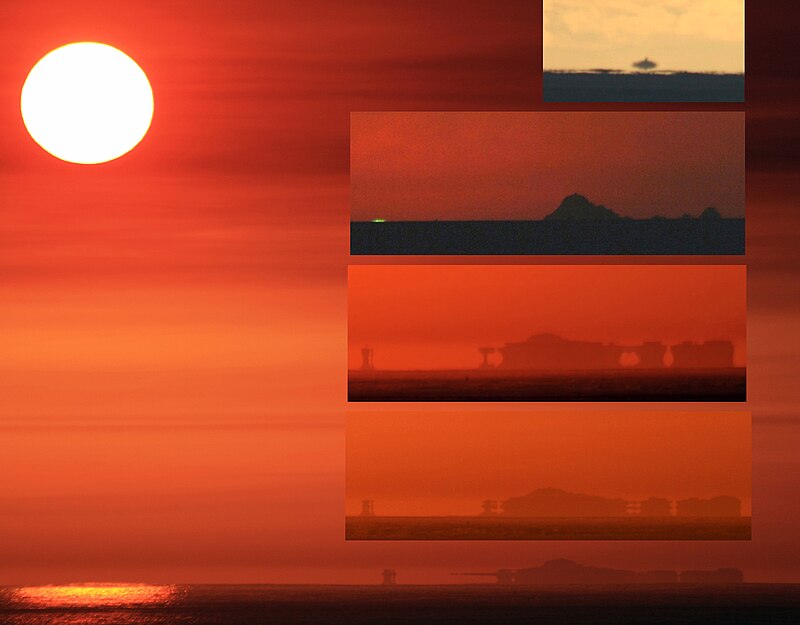
File:Farallon_Islands_at_inferior_mirage_no_mirage_and_superior_mirage.jpg · Wikimedia Commons · See Wikimedia Commons
mirage
Sign in to savethumb|upright=1.5|Various kinds of mirages in one location taken over the course of six minutes, not shown in chronological order. A mirage is a naturally occurring optical phenomenon in which light rays bend via refraction to produce a displaced image of distant objects or the sky. The word comes to English via the French (se) mirer, from the Latin mirari, meaning "to look at, to wonder at".
A mirage is a naturally occurring optical illusion caused by light rays bending as they pass through air of different temperatures, creating a displaced image of distant objects or the sky. Understanding mirages matters because they reveal how light behaves in the atmosphere and help explain a common visual phenomenon that has confused travelers and observers throughout history.
AI-generated from the Wikipedia summary — may contain errors.
Wikidata facts
- Subclass of
- atmospheric optical phenomenon
- Image
- Desertmirage.jpg
Show 3 more facts
- Commons category
- Mirages
- Commons gallery
- Mirage
- on focus list of Wikimedia project
- Wikipedia:Vital articles/Level/4
via Wikidata · CC0
~11 min read
Encyclopedic overview
11 sectionsContents
- Inferior mirage
- Heat haze
- Superior mirage
- Fata Morgana
- Night-time mirages
- Mirage of astronomical objects
- See also
- Notes
- References
- Bibliography
- External links
thumb|upright=1.5|Various kinds of mirages in one location taken over the course of six minutes, not shown in chronological order. A mirage is a naturally occurring optical phenomenon in which light rays bend via refraction to produce a displaced image of distant objects or the sky. The word comes to English via the French (se) mirer, from the Latin mirari, meaning "to look at, to wonder at".
Mirages can be categorized as "inferior" (meaning lower), "superior" (meaning higher) and "Fata Morgana", one kind of superior mirage consisting of a series of unusually elaborate, vertically stacked images, which form one rapidly changing mirage.
Excerpted from Wikipedia’s “mirage” article, available under the CC BY-SA 4.0 licence.
Gallery (19)
Available in 78 languages
- Español
- Français
- 中文
- 日本語
- Русский
- Português
- Italiano
- العربية
- हिन्दी
- Albanian
- Aramaic
- Armenian
- Assamese
- Asturian
- azb
- Azerbaijani
- Bahasa Indonesia
- Bangla
Show 59 more
- Basque
- be_x_old
- Belarusian
- Bulgarian
- Burmese
- Catalan
- Central Kurdish
- Chechen
- Chuvash
- Croatian
- Danish
- Esperanto
- Estonian
- Finnish
- Georgian
- Haitian Creole
- Hebrew
- Hungarian
- hyw
- Icelandic
- Ido
- Interlingua
- Irish
- Kashmiri
- Kazakh
- Kyrgyz
- Latvian
- Lithuanian
- Lombard
- Malay
- Malayalam
- Marathi
- Mingrelian
- Nederlands
- Norwegian
- Norwegian Nynorsk
- Occitan
- Old English
- Polski
- Sanskrit
- Serbian
- Serbian (Latin)
- Shona
- simple
- Somali
- Svenska
- Tamil
- Tatar
- Telugu
- Tiếng Việt
- Türkçe
- Ukrainian
- Uzbek
- Welsh
- Wu Chinese
- zh_yue
- فارسی
- ไทย
- 한국어
via Wikidata sitelinks · CC0