Category
page 1Business terms

credit card
payment card issued to users as a system of payment

barter
thumb|1874 newspaper illustration from ''Harper's Weekly'' showing a man engaging in barter by offering various farm produce in exchange for his yearly newspaper subscription.

logistics
thumb|A warehouse in [[South Jersey, a U.S. East Coast epicenter for logistics and warehouse construction outside Philadelphia, where trucks deliver slabs of granite]]
Logistics is the part of supply chain management that deals with the efficient forward and reverse flow of goods, services, and related information from the point of origin to the point of consumption according to the needs of customers, and a logistician is a professional working in the field of logistics management. Logistics management is a component that holds the supply chain together. The resources managed in logistics may

entrepreneurship
Entrepreneurship is the creation or extraction of economic value by identifying and commercializing opportunities to deliver products or services, a process that typically requires considerable initiative and bears risk. This process may also encompass the pursuit of values that extend beyond mere economic considerations.

product
anything that can be offered to a market
subsidiary company
A subsidiary, subsidiary company, or daughter company is a company completely or partially owned or controlled by another company, called the parent company or holding company, which has legal and financial control over the subsidiary company. Unlike regional branches or divisions, subsidiaries are considered to be distinct entities from their parent companies; they are required to follow the laws of where they are incorporated, and they maintain their own executive leadership. Two or more subsidiaries primarily controlled by the same entity/group are considered to be sister companies of each

sales
Sales are activities related to selling or the number of goods sold in a given targeted time period. The delivery of a service for a cost is also considered a sale. A period during which goods are sold for a reduced price may also be referred to as a "sale".

invoice
An invoice, bill, tab, or bill of costs is a commercial document that includes an itemized list of goods or services furnished by a seller to a buyer relating to a sale transaction, that usually specifies the price and terms of sale, quantities, and agreed-upon prices and terms of sale for products or services the seller had provided the buyer.

payment
250px|thumb|Payment with a bank card in a store in [[Taiwan]]
A payment is the tender of something of value, such as money or its equivalent, by one party (such as a person or company) to another in exchange for goods or services provided by them, or to fulfill a legal obligation or philanthropy desire. The party making the payment is commonly called the payer, while the payee is the party receiving the payment. Whilst payments are often made voluntarily, some payments are compulsory, such as payment of a fine.

holding company
company whose primary business is holding controlling shares of subsidiary companies
shareholder
A shareholder (in the United States often referred to as a stockholder) refers to an individual or legal entity (such as another corporation, a body politic, a trust or partnership) who is registered by the corporation as the legal owner of shares of its share capital. Both public companies and private corporation have shareholders. Shareholders may also be referred to as members of a corporation. A person or legal entity becomes a shareholder in a corporation when they acquire shares and their name and other details are entered in the corporation's register of shareholders or members, and unl
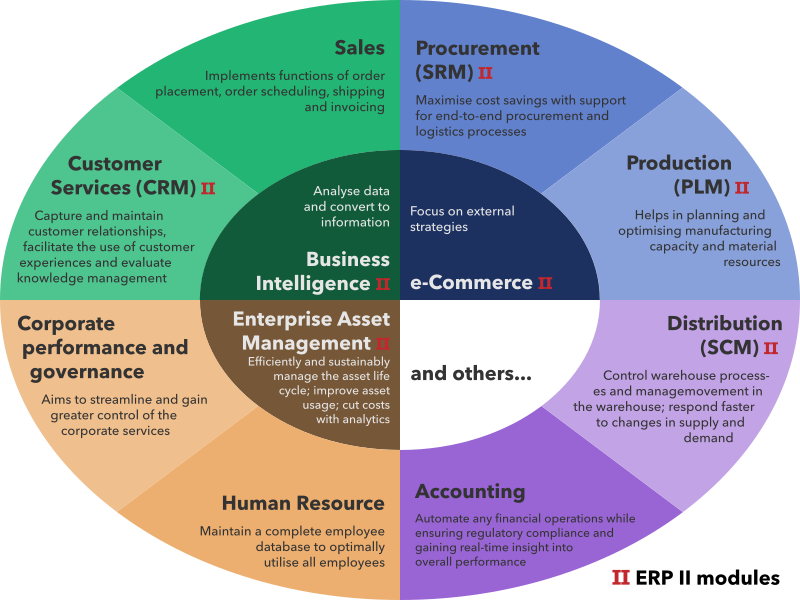
enterprise resource planning
corporate task of optimizing the existing resources in a company

outsourcing

knowledge management
process of creating, sharing, using and managing the knowledge and information of an organization

market capitalization
total value of a public company's outstanding shares

board of directors
group of people who jointly supervise the activities of an organization

corporate tax
tax levied on the profits of companies

employment contract
agreement between employer and employee or labor union on terms of work and compensation
legal person
any entity that is recognised as having privileges and obligations in law
supply chain management
management of the flow of goods and services

Six Sigma
A management and quality control method that uses statistical methods to reduce variability in business processes and minimize defects, thereby improving quality and efficiency.

strategic management
managing a company's responses to external issues, aiming to provide overall organizational direction and objectives, as well as policies and plans for implementation
concern
type of business grouping, particularly in Europe
internationalization and localization
process in which software is made accessible to people in different areas of the world
memorandum
right|thumb|Memo written by a White House staff member during the tenure of [[Jimmy Carter as US president]]
balanced scorecard
strategy performance management tool
sole proprietorship
business legally synonymous with its owner

language localisation
process of adapting a product's translation to a specific country or region

concession
grant of rights, land or property by a government, local authority, corporation, individual or other legal entity

original equipment manufacturer
company that fabricates parts used in another company's products

austerity
In economic policy, austerity is a set of political-economic policies that aim to reduce government budget deficits through spending cuts, tax increases, or a combination of both. There are three primary types of austerity measures: higher taxes to fund spending, raising taxes while cutting spending, and lower taxes and lower government spending. Austerity measures are often used by governments that find it difficult to borrow or meet their existing obligations to pay back loans. The measures are meant to reduce the budget deficit by bringing government revenues closer to expenditures. Propone
total quality management
management philosophy and organization-wide efforts to continuously improve ability for providing quality products and services
business magnate
entrepreneur who has achieved wealth and prominence from a particular industry (or industries)
flag of convenience
the business practice registering a ship under a different sovereign state than that of its owners, to reduce costs or avoid regulations
electronic data interchange
electronic communication method
retail chain
retail outlets that share a brand and central management, and usually have standardized business methods and practices
value added
in business: the difference between the sale price and the production cost of a product is the unit profit. In economics, the sum of the unit profit, the unit depreciation cost, and the unit labor cost is the unit value added.
cabotage
Cabotage () is the transport of goods or passengers between two places in the same country by a carrier registered in a different country. The term originally applied to shipping along coastal routes, port to port, but now applies to aviation, railways, and road transport as well. Most countries do not permit cabotage, and there are strict sanctions against it, for reasons of economic protectionism, national security, or public safety. One notable exception is the European Union, whose member states all grant cabotage rights to each other.
electronic business
the integrated execution of all automatable business processes of a company with the help of information and communication technology
vertical integration
business arrangement in which the supply chain of a company is owned by that company
emerging market
country's economy that was traditionally small, but is currently expanding rapidly

centralisation
thumb|Diagrams of systems in various degrees of centralisation. From left to right: centralisation, decentralisation, distribution, and distributed decentralisation.
Centralisation or centralization (American English) is the process by which the activities of an organisation, particularly those regarding planning, decision-making, and framing strategies and policies, become concentrated within a particular group within that organisation. This creates a power structure where the said group occupies the highest level of hierarchy and has significantly more authority and influence over the other
unicorn
startup company valued at over $1 billion
strategic planning
an organization's process of defining its strategy, direction, and making decisions on allocating its resources to pursue this strategy
chief operating officer
executive position

kanban
Kanban ( meaning signboard) is a scheduling system for lean manufacturing (also called just-in-time manufacturing, abbreviated JIT). Taiichi Ohno, an industrial engineer at Toyota, developed kanban to improve manufacturing efficiency. The system takes its name from the cards that track production within a factory. Kanban is also known as the Toyota nameplate system in the automotive industry.
product distribution
business activity of making products available to end customers
corporate group
collection of parent and subsidiary corporations that function as a single economic entity through a common source of control

offshoring
Offshoring is the relocation of a business process from one country to another—typically an operational process, such as manufacturing, or supporting processes, such as accounting. Usually this refers to a company business, although state governments may also employ offshoring. More recently, technical and administrative services have been offshored.
director
person who leads a particular area of a company or organization
drop shipping
supply chain management method in which the retailer directs their suppliers to ship directly to the retailer's customers
due diligence
investigation or exercise of care that a reasonable business or person is normally expected to take before entering into an agreement or contract with another party or an act with a certain standard of care
collateral
asset pledged to secure fulfillment of a financial obligation (e.g. a loan)
financial capital
money used by entrepreneurs and businesses to buy what they need to make their products or provide their services
direct-to-consumer
Direct-to-consumer (DTC or D2C) is a modern variation of the business-to-consumer (B2C) business model. The DTC is a business model of selling products directly to customers and thereby bypassing any third-party retailers, wholesalers, or intermediaries. Direct-to-consumer sales are usually transacted online, but direct-to-consumer brands may also operate physical retail spaces as a complement to their main e-commerce platform in a clicks-and-mortar business model. In the year 2021, direct-to-consumer e-commerce sales in the United States were over $128 billion. Examples of DTC brands currentl

funding
Funding is the act of providing resources to finance a need, program, or project. While this is usually in the form of money, it can also take the form of effort or time from an organization or company. Generally, this word is used when a firm uses its internal reserves to satisfy its necessity for cash, while the term financing is used when the firm acquires capital from external sources.
critical path method
Scheduling algorithm in project management

self-service
Self-service is a system whereby customers acquire (or serve) themselves goods or services, paying for the items at a point-of-sale, as opposed to a shop assistant or clerk acquiring goods or providing services in addition to taking payment. Common examples include ATMs, coin-operated laundrettes, self-service checkouts, self-service petrol stations, and buffet restaurants.
mission statement
short statement of an organization's values or philosophies, a business's main competitive advantages, or a desired future state

procurement
thumb|alt=SAMINO| Classification of product categories into the central procurement strategies
Procurement is the process of locating and agreeing to terms and purchasing goods, services, or other works from an external source, often with the use of a tendering or competitive bidding process. When a government agency buys goods or services through this practice, it is referred to as government procurement or public procurement. The term "procure" may also refer to a contractual obligation to "procure" something, i.e. to "ensure" that the thing is done.