Category
page 1Cell signaling

apoptotic process
Apoptosis (from ) is a form of programmed cell death that occurs in multicellular organisms and in some eukaryotic, single-celled microorganisms such as yeast. Biochemical events lead to characteristic cell changes (morphology) and death. These changes include blebbing, cell shrinkage, nuclear fragmentation, chromatin condensation, DNA fragmentation, and mRNA decay. The average adult human loses 50 to 70 billion cells each day to apoptosis. For the average human child between 8 and 14 years old, each day the approximate loss is 20 to 30 billion cells.

signaling receptor
protein molecule receiving signals for a cell
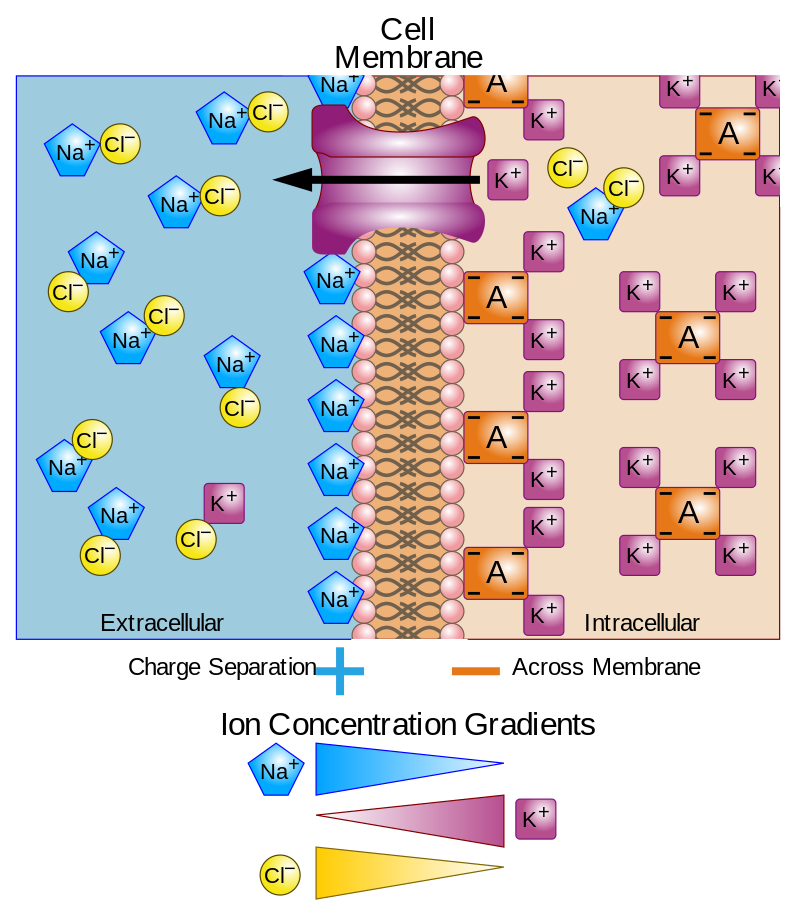
membrane potential
type of physical quantity
cell signaling
complex system of communication that governs basic cellular activities and coordinates cell actions
T helper cell
type of immune cell

phosphorylation
thumb|Serine in an amino acid chain, before and after phosphorylation.
cell junction
a cellular component that forms a specialized region of connection between two or more cells, or between a cell and the extracellular matrix, or between two membrane-bound components of a cell, such as flagella
ligand
substance that forms a complex with a biomolecule
gap junction
cell-cell junction comprised of innexins or connexins, two different families of channel-forming proteins. Other proteins may also be present.
SHH
protein-coding gene in the species Homo sapiens
nicotinic acetylcholine receptor
family of transport proteins
cell-mediated immunity
immune response that does not involve antibodies
NMDA receptor
glutamate receptor and ion channel protein found in nerve cells
T-cell receptor
molecule found on the surface of some immune cells
retinoic acid
group of chemical compounds
cell surface receptor
class of proteins; please use P2789 ("connects with") as qualifier to indicate the main binding partner(s)

phospholipase
thumb|right|Phospholipase cleavage sites. An enzyme that displays both PLA1 and PLA2 activities is called a phospholipase B.
signal recognition particle
protein-RNA complex facilitating translocation of proteins across membranes
glycine receptor
family of transport proteins
Fc receptor
protein
kainate receptor
class of transport proteins
RAN
protein-coding gene in the species Homo sapiens

smoothened signaling pathway
series of molecular signals generated as a consequence of activation of the transmembrane protein Smoothened

Cooperativity
Cooperativity is a phenomenon displayed by systems involving identical or near-identical elements, which act dependently of each other, relative to a hypothetical standard non-interacting system in which the individual elements are acting independently. One manifestation of this is enzymes or receptors that have multiple binding sites where the affinity of the binding sites for a ligand is apparently increased, positive cooperativity, or decreased, negative cooperativity, upon the binding of a ligand to a binding site. For example, when an oxygen atom binds to one of hemoglobin's four binding
Calcium signaling
intracellular communication process
nuclear export signal
amino acid sequence causing a protein to be exported from the nucleus to the cytoplasm
KiSS-1 metastasis suppressor
Kisspeptins (including kisspeptin-54 (KP-54), formerly known as metastin) are proteins encoded by the KISS1 gene in humans. Kisspeptins are ligands of the G-protein coupled receptor, GPR54. Kiss1 was originally identified as a human metastasis suppressor gene that has the ability to suppress melanoma and breast cancer metastasis. Kisspeptin-GPR54 signaling has an important role in initiating secretion of gonadotropin-releasing hormone (GnRH) at puberty, the extent of which is an area of ongoing research. Gonadotropin-releasing hormone is released from the hypothalamus to act on the anterior pi
focal adhesion
small region on the surface of a cell that anchors the cell to the extracellular matrix and that forms a point of termination of actin filaments
5S-HETE
chemical compound. this family of metabolites serve as hormone-like autocrine and paracrine signalling agents that contribute to the up-regulation of acute inflammatory and allergic responses.
effector cell
any cell which responds to stimuli and effects some change
macrophage polarization
process by which macrophages adopt different functional programs in response to signals from their microenvironment
signal transducing adaptor protein
type of protein involved in cell signalling
XIAP
X-linked inhibitor of apoptosis protein (XIAP), also known as inhibitor of apoptosis protein 3 (IAP3) and baculoviral IAP repeat-containing protein 4 (BIRC4), is a protein that stops apoptotic cell death. In humans, this protein (XIAP) is produced by a gene named XIAP gene located on the X chromosome.
GM2 ganglioside activator
GM2 ganglioside activator also known as GM2A is a protein which in humans is encoded by the GM2A gene.
phosphatidylinositol 5-phosphate
chemical compound
N-acyl homoserine lactone
class of chemical compounds
pseudoenzyme
Pseudoenzymes are variants of enzymes that are catalytically-deficient (usually inactive), meaning that they perform little or no enzyme catalysis. They are believed to be represented in all major enzyme families in the kingdoms of life, where they have important signaling and metabolic functions, many of which are only now coming to light. Pseudoenzymes are becoming increasingly important to analyse, especially as the bioinformatic analysis of genomes reveals their ubiquity. Their important regulatory and sometimes disease-associated functions in metabolic and signalling pathways are also she
immunoreceptor tyrosine-based activation motif
activatory protein motif of immune receptors
hepoxilin
Hepoxilins (Hx) are a set of epoxyalcohol metabolites of polyunsaturated fatty acids (PUFA), i.e. they possess both an epoxide and an alcohol (i.e. hydroxyl) residue. HxA3, HxB3, and their non-enzymatically formed isomers are nonclassic eicosanoid derived from acid the (PUFA), arachidonic acid. A second group of less well studied hepoxilins, HxA4, HxB4, and their non-enzymatically formed isomers are nonclassical eicosanoids derived from the PUFA, eicosapentaenoic acid. Recently, 14,15-HxA3 and 14,15-HxB3 have been defined as arachidonic acid derivatives that are produced by a different metabol
protein phosphorylation
process of introducing a phosphate group onto a protein
P2X purinoreceptor
group of ion channel proteins that open in response to the binding of extracellular ATP
PIK3CG
Phosphatidylinositol-4,5-bisphosphate 3-kinase catalytic subunit gamma isoform is an enzyme that in humans is encoded by the PIK3CG gene.
TGF beta signaling pathway
Signaling pathway involving transforming growth factor beta proteins
MAPK phosphatase
class of enzymes
purinergic signalling
signalling complex involving purine nucleosides and their receptors
heteroreceptor
thumb|A generalized neuron containing heteroreceptors showing the release of different neurotransmitters than the heteroreceptor ligand.
A heteroreceptor is a receptor located in the cell membrane of a neuron, regulating the synthesis and/or the release of mediators other than its own ligand. Heteroreceptors play a crucial role in modulating neurotransmitter systems and are often targets for therapeutic drugs. By influencing the activity of other neurotransmitters, the receptors contribute to the complex regulation of neural communication and have been implicated in various physiological and p