Category
page 1Chattian first appearances
Thylacinidae
Thylacinidae is an extinct family of carnivorous marsupials from the order Dasyuromorphia. The only species to survive into modern times was the thylacine (Thylacinus cynocephalus), which became extinct in 1936.
Vombatiformes
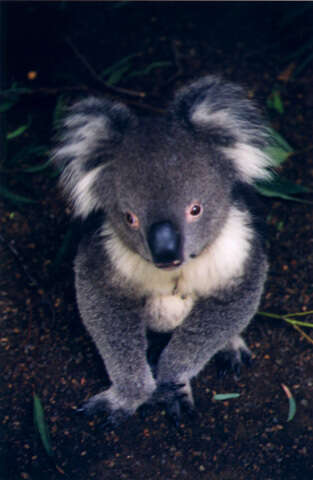
The Vombatiformes are one of the three suborders of the large marsupial order Diprotodontia. Seven of the nine known families within this suborder are extinct; only the families Phascolarctidae, with the koala, and Vombatidae, with three extant species of wombat, survive.
Chattian
The Chattian is, in the geologic timescale, the younger of two ages or upper of two stages of the Oligocene Epoch/Series. It spans the time between . The Chattian is preceded by the Rupelian and is followed by the Aquitanian (the lowest stage of the Miocene).

Thylacoleonidae
Thylacoleonidae is a family of extinct carnivorous diprotodontian marsupials from Australia, referred to as marsupial lions. The best known is Thylacoleo carnifex, also called the marsupial lion. The clade ranged from the Late Oligocene to the Late Pleistocene, with some earlier species the size of a possum, while the youngest members of the family belonging to the genus Thylacoleo reached sizes comparable to living big cats.
.png)
Deinotheriidae
Deinotheriidae is a family of prehistoric elephant-like proboscideans that lived during the Cenozoic era. They first appeared in Africa during the Oligocene then spread across Europe and the lower latitudes of Asia during the Miocene epoch. Their most distinctive features were their lack of upper tusks and downward-curving tusks on the lower jaw.
Diprotodontidae
Diprotodontidae, from Ancient Greek δί- (dí-), meaning "two", πρῶτος (prôtos), meaning "first", and ὀδούς (odoús), meaning "tooth", is an extinct family of large herbivorous marsupials, endemic to Australia and New Guinea during the Oligocene through Pleistocene periods from 28.4 million to 40,000 years ago.

Toxodontidae
thumb|right|Xotodon sp. skull at the Museum für Naturkunde, Berlin
Mylagaulidae
The Mylagaulidae or mylagaulids are an extinct clade of sciuromorph rodents nested within the family Aplodontiidae. They are known from the Neogene of North America and China. The oldest member is the Late Oligocene Trilaccogaulus montanensis that lived some 29 million years ago (Mya), and the youngest was Ceratogaulus hatcheri—formerly in the invalid genus "Epigaulus" —which was found barely into the Pliocene, some 5 Mya.
Squalodontidae
Squalodontidae or the shark-toothed dolphins is an extinct family of large toothed whales who had long narrow jaws. Squalodontids are known from all continents except Antarctica, from the Oligocene to the Neogene, but they had a maximal diversity and global distribution during the Late Oligocene and Early to Middle Miocene ().

Protypotherium
Protypotherium is an extinct genus of notoungulate mammals native to South America during the Oligocene and Miocene epochs. A number of closely related animals date back further, to the Eocene. Fossils of Protypotherium have been found in the Deseadan Fray Bentos Formation of Uruguay, Muyu Huasi and Nazareno Formations of Bolivia, Cura-Mallín and Río Frías Formations of Chile, and Santa Cruz, Salicas, Ituzaingó, Aisol, Cerro Azul, Cerro Bandera, Cerro Boleadoras, Chichinales, Sarmiento and Collón Curá Formations of Argentina.

Palorchestidae
left|thumb|Skull of Palorchestes
Palorchestidae is an extinct family of vombatiform marsupials whose members are sometimes referred to as marsupial tapirs due to the retracted nasal region of their skulls causing them to superficially resemble those of true tapirs. The idea that they had a tapir-like trunk has been contested, with other authors contending that it is more likely that they had a prehensile lip and protrusible tongue instead. While earlier representatives like Propalorchestes had relatively unspecialised forelimbs, the last member of the family, Palorchestes developed unusual cla
Mammalodontidae
Mammalodontidae is a family of extinct whales known from the Oligocene of Australia and New Zealand.
Hemicyoninae
Hemicyoninae is an extinct subfamily of Ursidae, often called dog bears (literally "half dog" (Greek: )). They were bear-like carnivorans living in Europe, North America, Africa and Asia during the Oligocene through Miocene epochs 33.9–5.3 Ma, existing for approximately . They are sometimes classified as a separate family.
Mesotheriidae
Mesotheriidae ("Middle Beasts") is an extinct family of notoungulate mammals known from the Oligocene through the Pleistocene of South America. Mesotheriids were small to medium-sized herbivorous mammals adapted for digging.
Balbaridae
The Balbaridae are an extinct family of basal macropods. The synapomorphies are divided into two areas, the dental and cranial. The dental area of this taxa can be described as having the molar lophodont and brachyodont with a hypolophid formed by lingually displaced component of posthypocristid and linked to a buccal crest from the entoconid. Molars have a hypocingulid, first lower molar compressed with the "forelink" absent. First incisor with lingual and dorsal enamel ridgelets. The third lower premolar of some taxa have a posterobuccal cusp (cusp at the back close to the cheek). The skull
Scelidotheriinae
Scelidotheriidae is a family of extinct ground sloths within the order Pilosa, suborder Folivora and superfamily Mylodontoidea, related to the other extinct mylodontoid family, Mylodontidae, as well as to the living two-toed sloth family Choloepodidae. The only other extant family of the suborder Folivora is the distantly related Bradypodidae. Erected as the family Scelidotheriidae by Ameghino in 1889, the taxon was demoted to a subfamily of Mylodontidae by Gaudin in 1995. However, recent collagen sequence data indicates the group is less closely related to Mylodon and Lestodon than Choloepus
Ilariidae
Ilariidae is a family of extinct vombatiform marsupials. Most ilariids are found in the middle Tertiary faunal assemblages of South Australia. Ilaria illumidens is the best-preserved representative of this extinct clade.
Eomysticetidae
Eomysticetidae is a family of extinct mysticetes belonging to Chaeomysticeti (toothless mysticetes). It is one of two families in the basal chaeomysticete clade Eomysticetoidea (the other being Cetotheriopsidae).
Gryposuchinae
Gryposuchinae is an extinct subfamily of gavialid crocodylians. Gryposuchines lived mainly in the Miocene of South America. However, "Ikanogavialis" papuensis may have survived more recently, into the Late Pleistocene/Holocene. Most were long-snouted coastal forms. The group was named in 2007 and includes genera such as Gryposuchus and Aktiogavialis, although a 2018 study indicates that the group might be paraphyletic and rather an evolutionary grade towards the gharial.