Category
page 1Chess terminology
castling
Castling is a move in chess. It consists of moving the king two squares toward a rook on the same and then moving the rook to the square that the king passed over. Castling is permitted only if neither the king nor the rook has previously moved; the squares between the king and the rook are vacant; and the king does not leave, cross over, or finish on a square attacked by an enemy piece. Castling is the only move in chess in which two pieces are moved at once.
chess opening
series of moves used to start a chess game

checkmate
right|thumb|upright=1.35|White and Black in chess|Black is checkmated and loses the game.
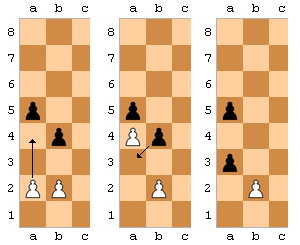
en passant
special move in chess where, immediately after a pawn makes a 2-step move, if it could have been captured by an opposing pawn had it advanced only 1 step, then the opponent can capture the just-moved pawn “as it passes” through the 1st square
stalemate
Stalemate is a situation in chess where the player whose turn it is to move is not in check but has no legal move. Stalemate results in a draw. During the endgame, stalemate is a resource that can enable the player with the inferior position to draw the game rather than lose. In more complex positions, stalemate is much rarer, usually the result of a swindle that succeeds only if the superior side is inattentive. Stalemate is also a common theme in endgame studies and other chess problems.
gambit
A gambit (from Italian , the act of tripping someone with the leg to make them fall) is a chess opening in which a player sacrifices with the aim of achieving a subsequent advantage.
check
chess condition

endgame
final stage of a chess game

promotion
in chess, the mandatory immediate replacement of a pawn reaching its 8th rank by the player's choice of a queen, knight, rook, or bishop of the same color
Zugzwang
Zugzwang (; ) is a situation found in chess and other turn-based games wherein one player is put at a disadvantage because of their obligation to make a move; a player is said to be "in zugzwang" when any legal move will worsen their position.
fool's mate
checkmate delivered by Black on move 2 with the queen; an extraordinary blunder by White
Open Game
chess opening starting with 1. e4 e5
scholar's mate
checkmate position (1. e4 e5 2. Bc4 Nc6 3. Qh5 Nf6 4. Qxf7#)
draw
result of a chess game ending in a tie
fast chess
variation of chess in which each side is given less time to make a move than under normal tournament time controls
fork
chess piece attacking two or more pieces simultaneously
pin
in chess, a situation brought on by an attacking piece in which a defending piece cannot move without exposing a more valuable defending piece on its other side to capture by the attacking piece
fianchetto
In chess, the fianchetto ( or spelling pronunciation ; "little flank") is a pattern of wherein a bishop is developed to the second of the adjacent b- or g-, the having been moved one or two squares forward.
blindfold chess
form of chess play wherein the players do not see the positions of the pieces and do not touch them
sacrifice
chess move that offers material gain in exchange for positional advantage
Closed Game
chess opening 1. d4 d5
Semi-Open Game
chess opening with 1. e4 followed by something other than e5
smothered mate
checkmate delivered by a knight in which the mated king is unable to move because he is surrounded (or smothered) by his own pieces
simultaneous exhibition
exhibition where one player plays multiple chess games simultaneously
skewer
chess tactic in which one attacks a valuable piece, which the opponent is compelled to move at the cost of losing a less valuable piece behind it
glossary of chess
Wikimedia glossary list article
discovered attack
a situation in chess and chess-like games where one piece moves to allow another friendly piece to then attack an enemy piece
combination
in chess, a sequence of moves, often initiated by a sacrifice, which leaves the opponent few options and results in tangible gain
double check
in chess, a check delivered by two pieces simultaneously
doubled pawns
two pawns of the same color residing on the same file
perpetual check
situation in the game of chess
back-rank checkmate
checkmate delivered by a rook or queen along a back rank in which the mated king is unable to move up the board because the king is blocked by friendly pieces (usually pawns) on the second rank
passed pawn
in chess, a pawn with no opposing pawns to prevent it from advancing to the eighth rank, either on the same file or adjacent files
isolated pawn
pawn which has no friendly pawn on an adjacent file
tempo
turn or single move in chess
Zwischenzug
The zwischenzug (German: , "intermediate move"; also called an in-between move or intermezzo) is a chess tactic in which a player, instead of playing the expected move (commonly a ), first interposes another move posing an immediate threat that the opponent must answer, and only then plays the expected move. It is a move that has a high degree of "initiative". Ideally, the zwischenzug changes the situation to the player's advantage, such as by gaining or avoiding what would otherwise be a strong continuation for the opponent. When the intermediate move is a check, it is sometimes called an in-
hypermodernism
school of chess, emerging after WW1, advocating indirect control of the center, introducing the concepts of the pawn chain, overprotection, undermining, prophylaxis, restraint, rook on 7th rank, knight outposts, and the isolated queen’s pawn
Semi-Closed Game
chess opening in which White plays 1 d4 but Black does not make the symmetrical reply 1… d5
flank opening
a set of opening moves in chess, in which White moves on the sides of the board instead of into the center
opposition
in chess, when two kings face each other with only one square between them
pawn structure
configuration of pawns on the chessboard
blunder
chess error
chess prodigy
child who can beat an adult at chess
battery
chess formation that consists of two or more pieces on the same rank, file, or diagonal
time control
Mechanism used in chess
time trouble
concept in chess
windmill
chess tactic in which a combination of discovered checks and regular checks, usually by a rook and a bishop, often forcing the opposing king to move back and forth between two squares, can win massive amounts of material
backward pawn
pawn that is behind all pawns of the same color on the adjacent files and cannot be safely advanced
chess theory
overloading
chess tactic that gives a defensive piece an additional defensive assignment which it cannot fulfil without abandoning its original defensive assignment
open file
in chess, a file with no pawns of either color on it
X-ray
chess tactic where a tactic where a piece indirectly attacks an enemy piece through another piece or defends a friendly piece through an enemy piece
outpost
in chess, a square on the 4th–7th ranks protected by a pawn and not attackable by an opponent’s pawn
triangulation
chess tactic to put one’s opponent in zugzwang
deflection
chess tactic that forces an opposing piece to leave the square, rank or file it occupies, thus exposing the king or a valuable piece
adjournment
in board games, mechanism to suspend a game, so it can be continued at another time
Alekhine's gun
chess formation, consisting of two rooks stacked one behind another and the queen at the rear
chess handicap
board game
transposition
reaching a chess position via an alternative sequence of moves
hedgehogging
chess opening strategy in which Black exchanges the c5 pawn for White's d4 pawn and puts pawns on a6, b6, d6 and e6