Category
page 1Columns and entablature

column
thumb|right|upright=1|National Capitol Columns at the [[United States National Arboretum in Washington, D.C.]]
thumb|right|upright=1|Columns of the Parliament House, Helsinki|Parliament House in [[Helsinki, Finland]]
thumb|right|upright=1|Column of the Gordon Monument in Waterloo.
A column or pillar in architecture and structural engineering is a structural element that transmits, through compression, the weight of the structure above to other structural elements below. In other words, a column is a compression member. The term column applies especially to a large round support (the shaft of t

capital
upper part of a column (architecture)

frieze
thumb|Doric order|Doric frieze at the [[Temple of Hephaestus, Athens (449–415 BCE).]]
thumb|right|The Circus (Bath), UK. Architectural detail of the frieze showing the alternating [[triglyphs and metope. (John Wood, the Elder, architect)]]
right|thumb|Frieze of animals, mythological episodes at the base of Hoysaleswara temple, [[India]]
right|thumb|What is described as "frieze" on the roof of Yankee Stadium

architrave
thumb| Architrave of the left-side Portal (architecture)|portal in the [[facade of the Basilica of Sant'Ambrogio in Milan, Italy (with a relieving arch above)]]
thumb|Architrave in the Basilica of San Salvatore, Spoleto, Italy.

pilaster
thumb|250px|Two decorative Corinthian architecture|Corinthian pilasters in the Church of Saint-Sulpice (Paris)

entablature
thumb|260px|Entablatures at Caesarea Maritima
thumb|260px|Entablature at the Temple of Venus Genetrix, Rome

pediment
thumb|300px|Types of pediment; "curved" and "broken" examples at the lower right

portico
225px|thumb|The portico of Croome Court in [[Croome D'Abitot (England)]]
225px|thumb|Temple diagram with location of the pronaos highlighted

caryatid
thumb|260px|right|The caryatid porch of the Erechtheion in [[Athens, Greece. These are now replicas. The originals are in the Acropolis Museum (with one in the British Museum).]]
thumb|175px|The caryatid standing in contrapposto, originally part of the [[Erechtheion, was removed by Lord Elgin and is now displayed at the British Museum]]

colonnade
thumb|300px|right|Colonnade at the Belvedere on the Pfingstberg palace in Germany

cornice
thumb|right|Illustrations of cornices in different styles
thumb|Illustrations of various examples of ancient Egyptian cornices, all of them having cavettos
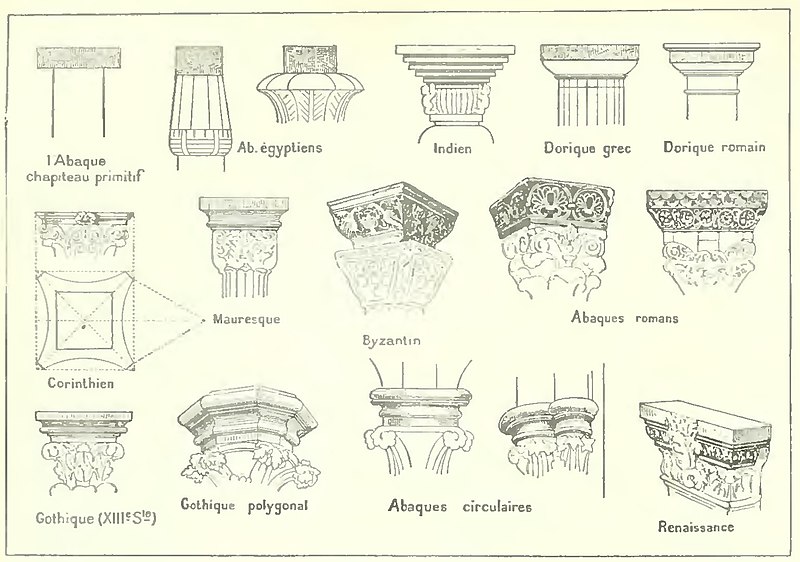
abacus
architectural term; flat slab forming the uppermost member or division of the capital of a column
%20(2)%20(cropped).jpg)
metope
thumb|Metope from the Elgin Marbles|Parthenon marbles depicting part of the battle between the Centaurs and the Lapiths; 442–438 BC; marble; height: 1.06 m; [[British Museum (London)]]

buttress
thumb|Buttresses of Miag-ao Church, [[Philippines]]

Telamon
thumb|280px|The marriage of Telamon and Hesione or Hesione's farewell to her brother [[Priam under the attention of Heracles and Telamon on the right, detail of fresco from the triclinium of the House of Octavius Quartio at Pompeii]]

triglyph
thumb|right|Triglyph centered over the last column in the Roman Doric order of the [[Theater of Marcellus]]
thumb|John Wood the Elder|John Wood's The Circus [[Bath, Somerset (1754), triglyphs and decorated metopes]]

volute
right|thumb|Examples of Ionic volutes. From Julien David LeRoy, Les ruines plus beaux des monuments de la Grèce, Paris, 1758 (Plate XX)
A volute is a spiral, scroll-like ornament that forms the basis of the Ionic order, found in the capital of the Ionic column. It was later incorporated into Corinthian order and Composite column capitals. Four are normally to be found on an Ionic capital, eight on Composite capitals and smaller versions (sometimes called helix) on the Corinthian capital.
%2001.JPG)
peristyle
thumb|Reconstruction of a Roman peristyle surrounding a courtyard in Pompeii, Italy
atlas
architectural support

entasis
thumb|upright|Diagram of a Corinthian order|Corinthian column showing a visible entasis bulge at "D"

dentil
thumb|right|300px|Closeup of dentils, above a Corinthian order capital, Town Hall, [[Westport, Connecticut, U.S.]]
thumb|right|250px|Long view of same

bucranium
thumb|280px|Garlanded bucrania on a frieze from the Samothrace temple complex

Djed
thumb|right|100px|The djed, an ancient Egyptian symbol meaning 'stability', is the symbolic vertebral column|backbone of the god [[Osiris.|class=skin-invert-image]]
The djed, also djt ( 𓊽, Coptic jōt "pillar", anglicized /dʒɛd/) is one of the more ancient and commonly found symbols in ancient Egyptian religion. It is a pillar-like symbol in Egyptian hieroglyphs representing stability. It is associated with the creator god Ptah and Osiris, the Egyptian god of the afterlife, the underworld, and the dead. It is commonly understood to represent his spine.

monopteros
thumb|upright|Schematic plan of a monopteros
A monopteros (Ancient Greek: , from: μόνος, 'only, single, alone', and , 'wing'), also called a monopteron or cyclostyle, is a circular colonnade supporting a roof but without any walls. Unlike a tholos (in its wider sense as a circular building), it does not have walls making a cella or room inside. In Greek and especially Roman antiquity, the term could also be used for a tholos. In ancient times, monopteroi (Ancient Greek: ) served among other things as a form of baldachin for a cult image. An example of this is the Monument of Lysicrates in Athe

cymatium
frame|Cyma molding profile (left) and shadow pattern (right)
dado
architectural element

gutta
thumb|400px|Labelled image of the Doric order entablature
A gutta (Latin pl. guttae, "drops") is a small water-repelling, cone-shaped projection used near the top of the architrave of the Doric order in classical architecture. At the top of the architrave blocks, a row of six guttae below the narrow projection of the taenia (fillet) formed an element called a regula. A regula was aligned under each triglyph of the Doric frieze. In addition, the underside of the projecting geison above the frieze had rectangular protrusions termed mutules that each had three rows of six guttae. These mutules we
Solomonic column
spiraling type of column
Boaz and Jachin
brass or bronze pillars on the porch of Solomon's temple
trumeau
central pillar or mullion supporting the tympanum of a large doorway
Achaemenid column
type of column developed in ancient Persia
prop
temporary structural element used during construction
fascia
in architecture, a plain horizontal frieze or band
engaged column
column embedded in a wall and partly projecting from the surface of the wall
.jpg)
Huabiao
thumb|right|A huabiao in front of the Tiananmen in [[Beijing.]]
thumb|right|The mythical creature atop a huabiao.
thumb|right|A modern huabiao at Chinese Culture University in [[Taipei.]]
thumb|A singular huabiao in Xinghai Square in [[Dalian.]]

Prostyle
thumb|Northeast view of the Temple of Athena Nike, a prostyle temple (but also an [[amphiprostyle temple, since there is a row of columns at the back as well)]]
thumb|The Roman temple of Bziza, a [[tetrastyle prostyle temple]]
taenia
raised band or fillet, often placed along the top of a Doric architrave
Estipite
thumb|right|220px|Estipite in the Basilica of la Vera Cruz in [[Caravaca de la Cruz, Region of Murcia, Spain.]]
thumb|220px|Estitipes on the facade of the Parroquia Antigua, Salamanca, Guanajuato|Parroquia Antigua in Salamanca, State of [[Guanajuato, Mexico]]
Rudi Geodetic Point
historical and technological monument of national importance in Moldova
Aethusa
In Greek mythology, Aethusa (Ancient Greek: Αἵθουσα) was a daughter of Poseidon and the Pleiad Alcyone, daughter of Atlas. She was loved by Apollo and bore to him Eleuther and Linus. Through either of the latter two, Aethusa became the grandmother of Pierus, father of Oeagrus, father of the musician Orpheus. Because of this genealogical fact, she was usually identified as a Thracian.
Pulvino
right|thumb|250px|Pulvino in the Basilica of San Vitale
A pulvino (or impost block) is an architectural structural element (dosseret) having the shape of an inverted pyramid cushion, which is placed between the column capital and the arch base.
term
in classical architecture, a pedestal which tapers towards the base and usually supports a bust or merges into a sculpted human or animal figure
perron
monument
spur
architectural ornament
monolithic column
Atlantean figures at Tula
collection of four statues in Mesoamerica
Knot columns
architectural element