Category
page 1Concepts in physics
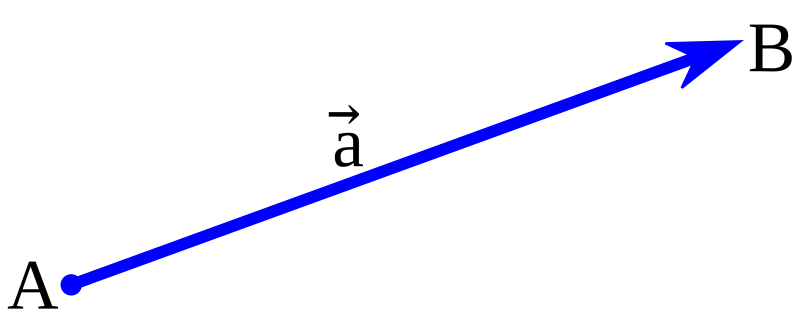
Euclidean vector
geometric object that has magnitude (or length) and direction

spacetime
In physics, spacetime, also called the space-time continuum, is a mathematical model that fuses the three dimensions of space and the one dimension of time into a single four-dimensional continuum. Spacetime diagrams are useful in visualizing and understanding relativistic effects, such as how different observers perceive where and when events occur.
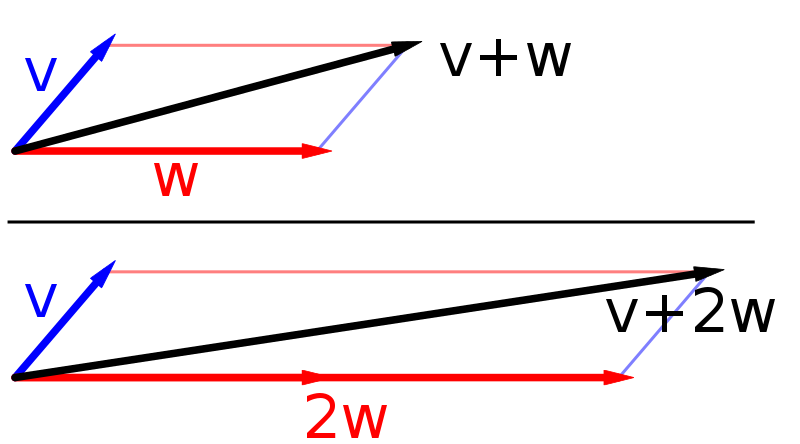
vector space
the basic algebraic structure of linear algebra; a module over a field, such that its elements can be added together or scaled by elements of the field

Standard Model
theory of particle physics based on Yang–Mills theory with gauge group SU(3)×SU(2)×U(1) and spontaneous symmetry breaking
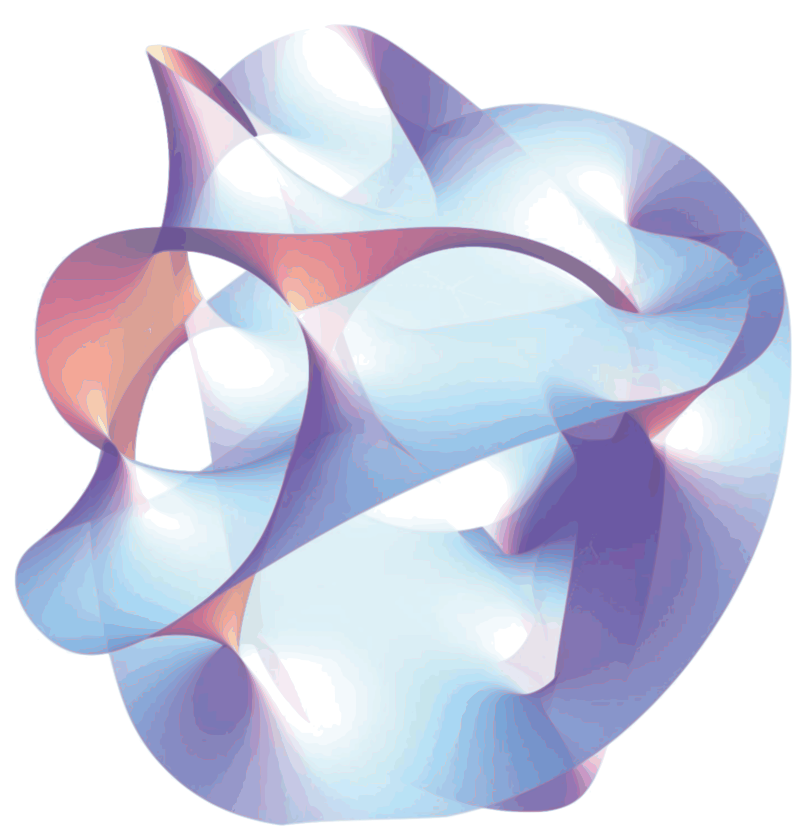
string theory
physical theory of quantized one-dimensional objects with conformal symmetry, which can describe gravitation, gauge theory and other phenomena
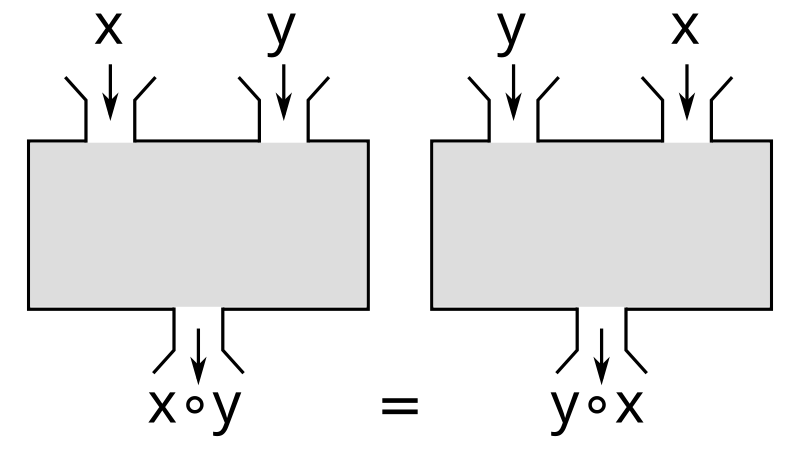
commutative property
property of binary operations, for which changing the order of the operands does not change the result
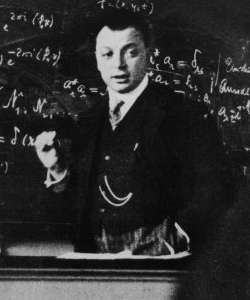
Pauli exclusion principle
quantum mechanical principle that two identical fermions cannot occupy the same quantum state simultaneously

spectrum
thumb|The spectrum in a rainbow

physical object
singular aggregation of tangible substance(s) such as matter or radiation, with overall properties

phase
region in a substance throughout which all physical properties are essentially uniform; region of material that is chemically uniform, physically distinct, (often) mechanically separable

tensor
right|thumb|300px|The second-order Cauchy stress tensor \mathbf{T} describes the stress experienced by a material at a given point. For any unit vector \mathbf{v}, the product \mathbf{T} \cdot \mathbf{v} is a vector, denoted \mathbf{T}(\mathbf{v}), that quantifies the force per area along the plane perpendicular to \mathbf{v}. This image shows, for cube faces perpendicular to \mathbf{e}_1, \mathbf{e}_2, \mathbf{e}_3, the corresponding stress vectors \mathbf{T}(\mathbf{e}_1), \mathbf{T}(\mathbf{e}_2), \mathbf{T}(\mathbf{e}_3) along those faces. Because the stress tensor takes one vector as inpu

turbulence
In fluid dynamics, turbulence or turbulent flow is fluid motion exhibiting chaotic changes in pressure and flow velocity. It is in contrast to laminar flow, which occurs when a fluid flows in parallel layers with no disruption between those layers.

Rayleigh scattering
elastic scattering of light, or other electromagnetic radiation, by particles of size much smaller than the wavelength of the radiation

supersymmetry
Supersymmetry is a theoretical framework in physics that suggests the existence of a symmetry between particles with integer spin (bosons) and particles with half-integer spin (fermions). It proposes that for every known particle, there exists a partner particle with different spin properties. There have been multiple experiments on supersymmetry that have failed to provide evidence that it exists in nature. If evidence is found, supersymmetry could help explain certain phenomena, such as the nature of dark matter and the hierarchy problem in particle physics.
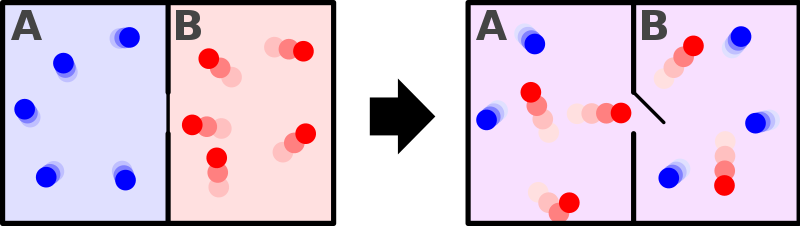
Bose-Einstein statistics
statistical description for the behaviour of bosons

Navier–Stokes equations
system of nonlinear partial differential equations describing the motion of viscous fluids

physical system
portion of the physical universe chosen for analysis; everything outside the system is known as the environment

coherence
ideal property of waves that enables stationary (i.e. temporally and spatially constant) interference
zero-point energy
lowest possible energy of a quantum system or field
Feynman diagram
pictorial representations of the behavior of subatomic particles

point particle
particle with no physical extent, either an idealization or a feature of elementary particles

nonlinear system
system in which the change of the output is not proportional to the change of the input

supercooling
thumb|Supercooled water, still in liquid state
thumb|Start of solidification as a result of leaving the state of rest
Supercooling, also known as undercooling, is the process of lowering the temperature of a liquid below its freezing point without it becoming a solid. Per the established international definition, supercooling means "cooling a substance below the normal freezing point without solidification". While it can be achieved by different physical means, the postponed solidification is most often due to the absence of seed crystals or nuclei around which a crystal structure can form. Th
Noether's theorem
physical law that differentiable symmetries correspond to conservation laws

four-vector
In special relativity, a four-vector (or 4-vector, sometimes Lorentz vector) is an element of a four-dimensional vector space object with four components, which transform under Lorentz transformations with respect to a change of basis. Its magnitude is determined by an indefinite quadratic form, the preservation of which defines the Lorentz transformations, which include spatial rotations and boosts (a change by a constant velocity to another reference frame).
%20self-organization2.jpg)
auto-organisation
thumb|upright=1.2|Self-organization in micron-sized Nb3O7(OH) cubes during a Hydrothermal synthesis|hydrothermal treatment at 200 °C. Initially [[amorphous cubes gradually transform into ordered 3D meshes of crystalline nanowires as summarized in the model below.]]
phase space
abstract space whose coordinates are the dynamic variables of the studied system
wave function collapse
process by which a quantum system takes on a definitive state
virtual particle
transient fluctuations of physical fields with existence limited and required by the uncertainty-principle
macroscopic scale
length scale on which objects or phenomena are large enough to be visible almost practically with the naked eye
metric tensor
symmetric rank (0, 2) tensor field on a smooth manifold
virial theorem
general equation that relates the time-averaged total kinetic energy of a stable system consisting of N particles, bound by potential forces, with that of the time-averaged total potential energy
path integral
formal sum or integral over all histories of a quantum system

clockwise direction
Two-dimensional rotation can occur in two possible directions, or senses of rotation. Clockwise motion (abbreviated CW) proceeds in the same direction as a clock's hands relative to the observer: from the top to the right, then down and then to the left, and back up to the top. The opposite sense of rotation or revolution is (in Commonwealth English) anticlockwise (ACW) or (in North American English) counterclockwise (CCW). Three-dimensional rotation can have similarly defined senses when considering the corresponding angular velocity vector.
perturbation theory
mathematical methods used to find an approximate solution to a problem which cannot be solved exactly
symmetry
feature of a system that is preserved under some transformation
vector potential
a vector field whose curl is a given vector field
action at a distance
spatially nonlocal causation: the concept that an object can be directly influenced by one that is not adjacent to it
Legendre transformation
involutive transformation on real-valued convex functions of one real variable
linear system
mathematical model of a system based on the use of a linear operator
Maxwell–Boltzmann statistics
statistical distribution used in many-particle mechanics
Poisson bracket
bilinear differential operation on scalar fields on a symplectic (or, more generally, Poisson) manifold
free particle
particle that, in some sense, is not bound by an external force, or equivalently not in a region where its potential energy varies
microscopic scale
scale of objects and events smaller than those that can easily be seen by the naked eye, requiring a lens or microscope to see them clearly
physical homogeneity
uniformity of a material or system at every point
first principle
concept
Eightfold Way
classification scheme for hadrons
Ansatz
In physics and mathematics, an ansatz (; , meaning: "initial placement of a tool at a work piece", plural ansatzes or, from German, ansätze ; ) is an educated guess or an additional assumption made to help solve a problem, and which may later be verified to be part of the solution by its results.
mass versus weight
(scientific contexts) mass refers loosely to the amount of "matter" in an object (though "matter" may be difficult to define), whereas weight refers to the force exerted on an object by gravity
spacetime curvature
mathematical model used in general relativity
quark model
Classification scheme of hadrons
node
point along a standing wave where the wave has minimum amplitude
.gif)
frame-dragging
Frame-dragging is an effect on spacetime, predicted by Albert Einstein's general theory of relativity, that is due to non-static stationary distributions of mass–energy. A stationary field is one that is in a steady state, but the masses causing that field may be non-static — rotating, for instance. More generally, the subject that deals with the effects caused by mass–energy currents is known as gravitoelectromagnetism, which is analogous to the magnetism of classical electromagnetism.
mean field theory
approximation method where the behavior of a single particle can be treated assuming all other influences are averaged
ergodic hypothesis
hypothesis that typical physical systems studied in statistical mechanics are ergodic, such that time averages equal phase space averages
center of curvature
point at a distance from the curve equal to the radius of curvature lying on the normal vector
causality
conceptual link between natural phenomena that temporally follow one another because one is the cause of the other
continuum
gradual quantitative transition without abrupt change
Lorenz gauge condition
incomplete, Lorentz-invariant gauge condition setting the four-divergence of the electromagnetic four-potential to zero
Lorentz scalar
quantity in the theory of relativity which is invariant under a Lorentz transformation