Pauli exclusion principle
Also known as exclusion principle (physics), principle of exclusion (quantum mechanics), exclusion principle (Fermi-Dirac statistics), Pauli principle
quantum mechanical principle that two identical fermions cannot occupy the same quantum state simultaneously
AI overview
The Pauli exclusion principle is a rule in quantum mechanics stating that two identical particles (called fermions) cannot exist in the exact same quantum state at the same time. This principle is fundamental to understanding why atoms have the structure they do and why materials have the properties we observe in everyday life.
AI-generated from the Wikipedia summary — may contain errors.
Article
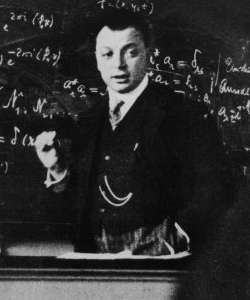
Wolfgang Pauli during a lecture in Copenhagen (1929). Wolfgang Pauli formulated the Pauli exclusion principle.
In quantum mechanics, the Pauli exclusion principle states that two or more identical particles with half-integer spins (i.e., fermions) cannot simultaneously occupy the same quantum state within a system that obeys the laws of quantum mechanics. This principle was formulated by Austrian physicist Wolfgang Pauli in 1925 for electrons, and later extended to all fermions with his spin–statistics theorem of 1940.