Category
page 1Critical thinking skills
.jpg)
rhetoric
thumb|right|upright=1.25|Painting depicting a lecture in a knight academy, painted by [[Pieter Isaacsz or Reinhold Timm for Rosenborg Castle as part of a series of seven paintings depicting the seven independent arts. This painting illustrates rhetoric.]]
thumb|upright|Jesus was a preacher in 1st-century Judea.

creativity
thumb|upright=0.7|alt=graphic of a lightbulb|A picture of an incandescent light bulb, a symbol associated with the formation of an [[idea, an example of creativity]]
.svg)
argument
An argument is one or more premises—sentences, statements, or propositions—directed towards arriving at a logical conclusion. The purpose of an argument is to give reasons for one's thinking and understanding via justification, explanation, or persuasion. As a series of logical steps, arguments are intended to determine or show the degree of truth or acceptability of a logical conclusion.
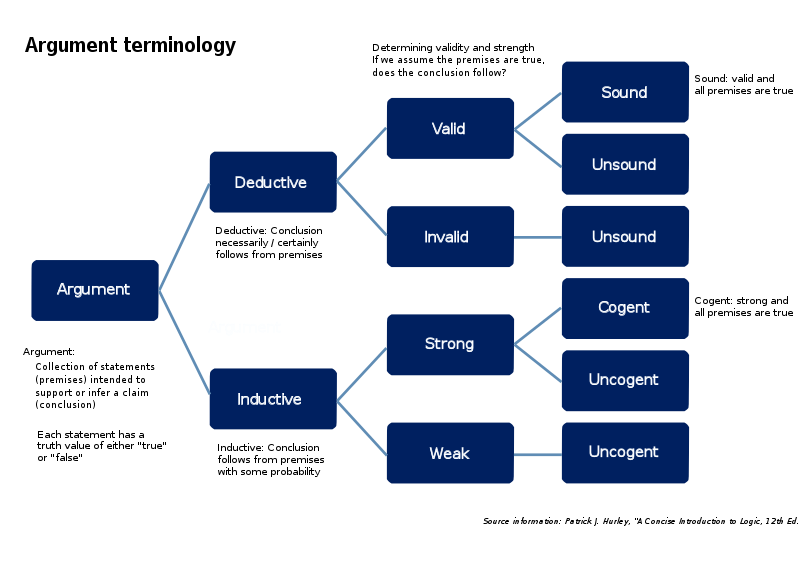
inductive reasoning
method of reasoning in which a body of observations is synthesized to hypothesize a general principle

analysis
thumb|Adriaen van Ostade, "Analysis" (1666)
introspection
Introspection is the examination of one's own conscious thoughts and feelings. In psychology, the process of introspection relies on the observation of one's mental state, while in a spiritual context it may refer to the examination of one's soul. Introspection is closely related to human self-reflection and self-discovery and is contrasted with external observation.

generalization
A generalization is a form of abstraction whereby common properties of specific instances are formulated as general concepts or claims. Generalizations posit the existence of a domain or set of elements, as well as one or more common characteristics shared by those elements (thus creating a conceptual model). As such, they are the essential basis of all valid deductive inferences (particularly in logic, mathematics and science), where the process of verification is necessary to determine whether a generalization holds true for any given situation.
inquiry
An inquiry (also spelled as enquiry in British English) is any process that has the aim of augmenting knowledge, resolving doubt, or solving a problem. A theory of inquiry is an account of the various types of inquiry and a treatment of the ways that each type of inquiry achieves its aim.

Socratic questioning
type of question to predict knowledge on a topic
critical reading
critical
higher-order thinking
education concept arguing that some types of learning require more cognitive processing but also have more generalized benefits
International Roman Law Moot Court