Category
page 1Decolonization
%2C%20by%20John%20Trumbull.jpg)
independence
thumb|upright=1.0|The Thirteen Colonies|Thirteen British Colonies on the east coast of North America issued a Declaration of Independence in 1776
thumb|upright=1.0| Chile, one of several Spanish Empire|Spanish territories in South America, issued a Declaration of independence in 1818 thumb|upright=1.0|Pedro I of Brazil|Prince Pedro surrounded by a crowd in [[São Paulo after breaking the news of Brazil's independence on 7 September 1822.]]
thumb|upright=1.0|The Senate of Finland|Finnish Senate of 1917, Prime Minister [[P. E. Svinhufvud in the head of table. The Senate declared Finland independe

Reconquista
thumb|250px|Detail of the Cantigas de Santa Maria|Cantiga #63 (13th century), which deals with a late 10th-century battle in San Esteban de Gormaz involving the troops of Count García and [[Almanzor]]
The Reconquista (Spanish and Portuguese for ) or the fall of al-Andalus was a series of military campaigns by northern Iberian Christian polities against Muslim-ruled al-Andalus, which had previously been part of the Visigothic Kingdom before the Muslim Conquest of 711. The Reconquista concluded in 1492 with the capture of Granada by the Catholic Monarchs of Spain, thereby ending the presence of

self-determination
Self-determination refers to a people's right to form its own political entity, and internal self-determination is the right to representative government with full suffrage.
.svg)
decolonization
Decolonization is the ending of colonialism, the latter being the process whereby imperial nations establish and dominate foreign territories, often overseas. The meanings and applications of the term are disputed. Some scholars of decolonization focus especially on independence movements in the colonies and the collapse of global colonial empires.

Indian independence movement
Indian national movement seeking to end British rule (1857–1947)

Carnation Revolution
1974 revolution in Portugal

Juliana of the Netherlands
Queen of the Netherlands from 1948 to 1980 (1909-2004)

Arab Revolt
uprising against the ruling Ottoman Turks during World War I

ubuntu
Southern African philosophy

land reform
changes to land ownership
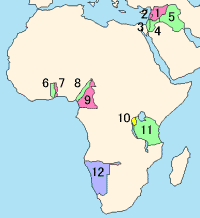
League of Nations mandate
political territorial entity
decolonisation of Africa
1950s–70s independence of African colonies from Western European powers

SWAPO Party
The '''South West Africa People's Organisation (SWAPO ; , SWAVO; , SWAVO), officially known as the SWAPO Party of Namibia''', is a political party and former independence movement in Namibia (formerly South West Africa). Founded in 1960, it has been the governing party in Namibia since the country achieved independence in 1990. The party continues to be dominated in number and influence by the Ovambo ethnic group.
Zanzibar Revolution
revolution in Zanzibar in 1964
United Nations trust territory
Territories under League of Nations Mandate, excluding Palestine and SW Africa, were transferred into UN trusteeships. Validity of existing rights of populations acquired by mandates, including the rights of Jews to settle in Palestine, is preserved
Malayan Emergency
1948–1960 conflict in British Malaya
From the river to the sea
political catchphrase referring to the region between the Jordan River and the Mediterranean Sea
New Caledonian independence referendum, 2018
referendum

Guevarism
thumb|Che Guevara, after whom Guevarism is named.
Bougainville independence referendum, 2019
Bougainville's referendum for independence from Papua New Guinea
United Nations list of non-self-governing territories
UN document listing places that are not self-governing and subject to decolonization
handover of Hong Kong
transfer of sovereignty of Hong Kong to the People's Republic of China
United Nations Mission for the Referendum in Western Sahara
organization
United Nations General Assembly Resolution 1514
United Nations General Assembly resolution adopted in 1960
transfer of sovereignty over Macau
transfer of sovereignty over Macau from Portugal to China
Khmer Issarak
political party in Cambodia
war of independence
conflict occurring over a territory that has declared independence
decolonization of the Americas
process by which the countries in the Americas gained their independence from European rule

Pan-Celticism
right|thumb|200px|A Pan-Celtic Flag of two interlaced Triskelion, designed by Breton Robert Berthelier in 1950.
Pan-Celticism (, Scottish Gaelic: Pan-Cheilteachas, Breton: Pan-Keltaidd, Welsh: Pan-Geltaidd, Cornish: Pan-Keltaidh, Manx: Pan-Cheltaghys), also known as Celticism or Celtic nationalism, is a political, social and cultural movement advocating solidarity and cooperation between Celtic nations (both the Brythonic and Gaelic branches) and the modern Celts in Northwestern Europe. Some pan-Celtic organisations advocate the Celtic nations seceding from the United Kingdom and France and fo
Special Committee on Decolonization
U.N. General Assembly special committee
Africanization
Africanization or Africanisation (lit., making something African) has been applied in various contexts, notably in geographic and personal naming and in the composition of the civil service via processes such as indigenization.
Anushilan Samiti
fitness club and anti-British underground revolutionary organization
Treaty of London
1864 multilateral treaty
decolonization of knowledge
process of undoing colonial legacies in knowledge
Vienna Convention on Succession of States in Respect of Treaties
1978 United Nations treaty
Republic of the North Solomons
unrecognized state
Unilateral Declaration of Egyptian Independence
britain's declaration of Egyptian independence
Revolutionary movement for Indian independence
violent factions of the Indian independence movement
Authenticité
official state ideology initiated in the former Republic of Zaire (current Democratic Republic of the Congo) by Mobutu Sese Seko starting in 1965
The Bush
Regions in Alaska not connected to major transportation networks
decoloniality
thumb|Installation by Romuald Hazoumè using gas cans. Hazoumè has stated: "I send back to the West that which belongs to them, that is to say, the [[refuse of consumer society that invades us every day."]]

Linda Tuhiwai Smith
New Zealand professor of indigenous education
Casablanca Group
organization
de-Sinicization
De-Sinicization or desinicization is a process of cultural or political movement aiming to eliminate or reduce Chinese cultural elements, identity or ethnic consciousness from a society or nation previously influenced by Chinese culture. In modern contexts, it is often contrasted with the assimilation process of Sinicization.
United Nations General Assembly Fourth Committee
United Nations committee
right to homeland
human right
New Caledonian independence referendum, 1987
Coloniality of knowledge
theoretical concept developed by Peruvian sociologist Anibal Quijano
decolonisation of Asia
mostly 20th-century independence of Asian countries from Western European powers
Creole nationalism
political ideology spread among the descendants of European colonists in Latin America, defending their rights, including independence
Eve Tuck
Indigenous studies scholar
data decolonization
process of divesting from colonial, hegemonic models and epistemological frameworks that guide the collection, usage, and dissemination of data related to Indigenous peoples and nations
Bougival Accord
political agreement about New Caledonia in 2025