Category
page 1Early scientific cosmologies
.png)
zodiac
The zodiac is a belt-shaped region of the sky that extends approximately 8° north and south celestial latitude of the ecliptic – the apparent path of the Sun across the celestial sphere over the course of the year. Within this zodiac belt appear the Moon and the brightest planets, along their orbital planes. The zodiac is divided along the ecliptic into 12 equal parts, called "signs", each occupying 30° of celestial longitude. These signs roughly correspond to the astronomical constellations with the following modern names: Aries, Taurus, Gemini, Cancer, Leo, Virgo, Libra, Scorpio, Sagittarius

heliocentrism
thumb|upright=1.2|Andreas Cellarius's illustration of the Copernican system, from the Harmonia Macrocosmica

geocentric model
thumb|upright=1.35|Figure of the heavenly bodies – An illustration of a Ptolemaic geocentric system by Portuguese cosmographer and cartographer Bartolomeu Velho, 1568 (Bibliothèque Nationale, Paris)
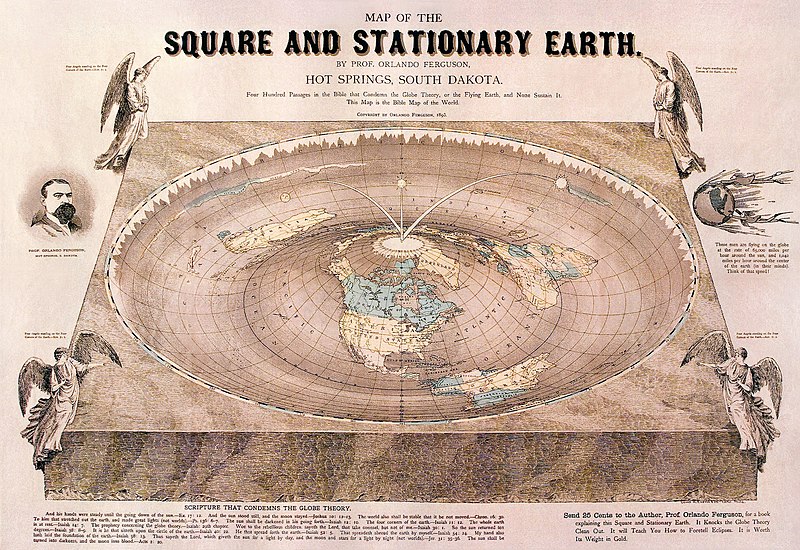
flat Earth
archaic conception of the Earth's shape
planet beyond Neptune
any Solar System planet that might orbit the Sun beyond Neptune
ancient Greek astronomy
Astronomy as practiced in the Hellenistic world of classical antiquity
spherical Earth
assertion that the Earth is (at least approximately) spherical
musica universalis
ancient philosophical concept that regards proportions in the movements of celestial bodies as a form of music

Counter-Earth
thumb|250px|right|Philolaus believed there was a "Counter-Earth" (Antichthon) orbiting the "Central Fire" (not labeled) that was not visible from Earth. The upper illustration depicts Earth at night while the lower one depicts Earth in the day.
The Counter-Earth is a hypothetical body of the Solar System that orbits on the other side of the Solar System from Earth, e.g. at the L3 Lagrange point of the Sun–Earth system. A Counter-Earth, or Antichthon (), was hypothesized by the pre-Socratic Greek philosopher Philolaus () to support his non-geocentric cosmology, in which all objects in the unive
astrological planet
in astrology, bodies that move across the zodiac and have astrological significance, corresponding to the astronomical planets except Earth as well as the Sun and the Moon

On the Heavens
work by Aristotle
Myth of Er
legend
.jpg)
Empyrean
thumb|right|upright=1.4|The Paradiso (Dante)#The Empyrean|Divine Comedys Empyrean, illustrated by [[Gustave Doré]]
celestial spheres
in ancient cosmological models, rotating spheres made of aether in which the stars or planets are embedded
Tychonic system
model of the Solar System proposed in 1588 by the Danish astronomer Tycho Brahe

Somnium Scipionis
work by Cicero
Ylem
Ylem ( or ) is a hypothetical original substance or condensed state of matter, which became subatomic particles and elements as are understood today. The term was used by George Gamow, his student Ralph Alpher, and their associates in the late 1940s, having resuscitated it from Middle English after Alpher found it in Webster's Second dictionary, where it was defined as "the first substance from which the elements were supposed to have been formed."
Pythagorean astronomical system
system
Fifth planet
any of various hypothetical planets thought to have existed
Primum Mobile
outermost moving sphere in the geocentric model of the universe
Galactocentrism
In astronomy, galactocentrism is the theory that the Milky Way Galaxy, home of Earths Solar System, is at or near the center of the Universe. The galactocentric model was the standard model of cosmology from the decline of heliocentrism onward, but was reliant on the assumption that the Milky Way is the only such galactic structure in the universe, surrounded by a starless void only occasionally populated by extragalactic nebulae.