File:Bartolomeu_Velho_1568.jpg · Wikimedia Commons · See Wikimedia Commons
geocentric model
Sign in to saveAlso known as geocentrism
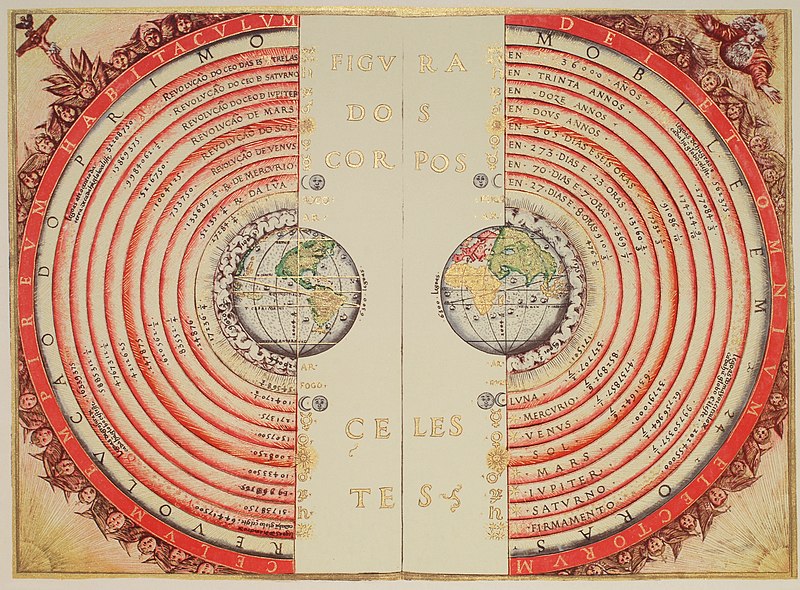
thumb|upright=1.35|Figure of the heavenly bodies – An illustration of a Ptolemaic geocentric system by Portuguese cosmographer and cartographer Bartolomeu Velho, 1568 (Bibliothèque Nationale, Paris)
The geocentric model was a scientific theory that placed Earth at the center of the universe, with all other heavenly bodies revolving around it—a view that was widely accepted until the development of the heliocentric model. It matters historically because it shaped astronomical understanding and cosmological thinking for centuries before being replaced by more accurate models based on observations and evidence.
AI-generated from the Wikipedia summary — may contain errors.
Wikidata facts
- Subclass of
- superseded scientific theory
- Image
- Ptolemaic system.svg
Show 4 more facts
- opposite of
- heliocentrism
- Commons category
- Geocentric model
- discoverer or inventor
- Aristotle
- on focus list of Wikimedia project
- Wikipedia:Vital articles/Level/4
Sources (3)
via Wikidata · CC0
~39 min read
Encyclopedic overview
19 sectionsContents
- Ancient Greece
- Ancient Indian
- Ptolemaic system
- Persian and Arab astronomy and geocentrism
- Ptolemaic and rival systems
- Copernican system
- Tychonic system
- Observation by Galileo and abandonment of the Ptolemaic model
- Historical positions of the Roman Catholic hierarchy
- Gravitation
- Relativity
- Religious and contemporary adherence to geocentrism
- Planetariums
- Ephemerides
- See also
- Notes
- References
- Bibliography
- External links
thumb|upright=1.35|Figure of the heavenly bodies – An illustration of a Ptolemaic geocentric system by Portuguese cosmographer and cartographer Bartolomeu Velho, 1568 (Bibliothèque Nationale, Paris)
Geocentrism is a superseded astronomical model description of the Universe with Earth at the center. It is also known as the geocentric model, often exemplified specifically by the Ptolemaic system. Under most geocentric models, the Sun, the Moon, stars, and planets all orbit Earth. The geocentric model was the predominant description of the cosmos in many European ancient civilizations, such as those of Aristotle in Classical Greece and Ptolemy in Roman Egypt, as well as during the Islamic Golden Age.
Excerpted from Wikipedia’s “geocentric model” article, available under the CC BY-SA 4.0 licence.
Gallery (23)
Available in 76 languages
- Español
- Français
- Deutsch
- 中文
- 日本語
- Русский
- Português
- Italiano
- العربية
- हिन्दी
- Afrikaans
- Albanian
- Armenian
- Asturian
- azb
- Azerbaijani
- Bahasa Indonesia
- Bangla
Show 57 more
- Bashkir
- Basque
- Belarusian
- Bulgarian
- Catalan
- Croatian
- Czech
- Danish
- Esperanto
- Estonian
- Filipino
- Finnish
- Galician
- Georgian
- Greek
- Hebrew
- Hungarian
- Icelandic
- Irish
- Kazakh
- Kyrgyz
- Latvian
- Lithuanian
- Luxembourgish
- Malay
- Malayalam
- Marathi
- Mingrelian
- nds_nl
- Nederlands
- Norwegian
- Norwegian Nynorsk
- Occitan
- Oromo
- Polski
- Romanian
- Serbian
- Serbian (Latin)
- simple
- Slovak
- Slovenian
- Svenska
- szy
- Tajik
- Telugu
- Tibetan
- Tiếng Việt
- Türkçe
- Ukrainian
- Urdu
- Uzbek
- Western Frisian
- Wu Chinese
- zh_yue
- فارسی
- ไทย
- 한국어
via Wikidata sitelinks · CC0