File:Orlando-Ferguson-flat-earth-map_edit.jpg · Wikimedia Commons · See Wikimedia Commons
flat Earth
Sign in to saveAlso known as flat-Earth model, flat-Earth theory
archaic conception of the Earth's shape
The flat Earth is an archaic belief that the Earth is flat rather than spherical, a conception that has been superseded by scientific evidence and modern understanding of planetary physics. While no longer credible scientifically, studying this historical misconception matters because it illustrates how human knowledge evolves and how societies move from intuitive but incorrect assumptions to evidence-based understanding of the world.
AI-generated from the Wikipedia summary — may contain errors.
Wikidata facts
- Instance of
- superseded scientific theory
- Main subject
- figure of the Earth
- Image
- Orlando-Ferguson-flat-earth-map edit.jpg
Show 5 more facts
- Commons category
- Flat Earth
- topic's main category
- Category:Flat Earth
- different from
- myth of the flat Earth
- opposite of
- spherical Earth
- facet of
- figure of the Earth
Sources (1)
via Wikidata · CC0
~37 min read
Encyclopedic overview
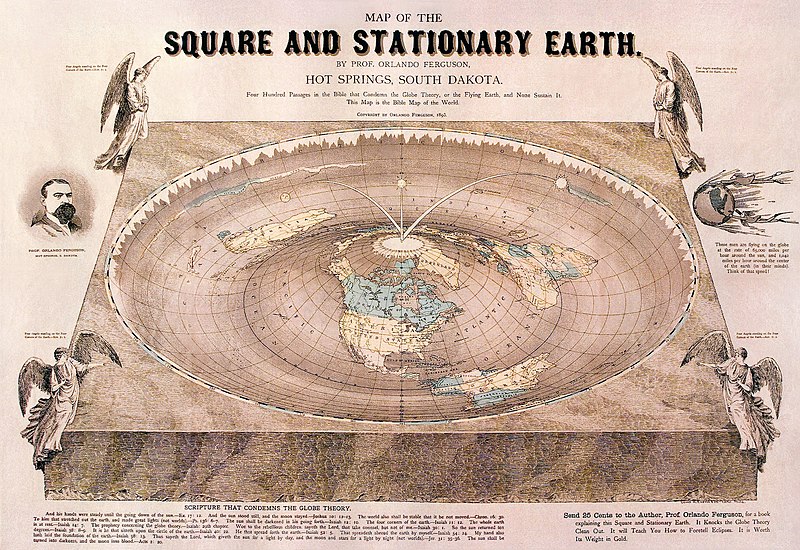
Flat Earth map drawn by Orlando Ferguson in 1893. The map contains several references to biblical passages as well as various supposed refutations of the "Globe Theory". Flat Earth is an archaic and scientifically disproven conception of the Earth's shape as a plane or disk. Many ancient societies subscribed to a flat-Earth cosmography. The model has undergone a recent resurgence as a conspiracy theory in the 21st century.
The idea of a spherical Earth appeared in ancient Greek philosophy with Pythagoras (6th century BC). However, the early Greek cosmological view of a flat Earth persisted among most pre-Socratics (6th–5th century BC). In the early 4th century BC, Plato wrote about a spherical Earth. By about 330 BC, his former student Aristotle had provided strong empirical evidence for a spherical Earth. Knowledge of the Earth's global shape gradually began to spread beyond the Hellenistic world. By the early period of the Christian Church, the spherical view was widely held, with some notable exceptions. In contrast, ancient Chinese scholars consistently describe the Earth as flat, and this perception remained unchanged until their encounters with Jesuit missionaries in the 17th century. Muslim scholars in early Islam maintained that the Earth is flat. However, since the 9th century, Muslim scholars have tended to believe in a spherical Earth.
Excerpted from Wikipedia’s “flat Earth” article, available under the CC BY-SA 4.0 licence.