Category
page 1EC 3.1

restriction enzyme
class of enzymes that cleaves DNA into fragments at or near specific recognition sites within the molecule known as restriction sites
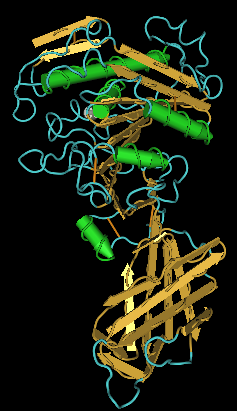
lipases
Lipase is a class of enzymes that catalyzes the hydrolysis of fats. Some lipases display broad substrate scope including esters of cholesterol, phospholipids, and of lipid-soluble vitamins and sphingomyelinases; however, these are usually treated separately from "conventional" lipases. Unlike esterases, which function in water, lipases "are activated only when adsorbed to an oil–water interface". Lipases perform essential roles in digestion, transport and processing of dietary lipids in most, if not all, organisms.

nuclease
thumb|Depiction of the restriction enzyme (endonuclease) [[HindIII cleaving a double-stranded DNA molecule at a valid restriction site ().]]

ribonuclease
Ribonuclease (commonly abbreviated RNase) is a type of nuclease that catalyzes the degradation of RNA into smaller components. Ribonucleases can be divided into endoribonucleases and exoribonucleases, and comprise several sub-classes within the EC 2.7 (for the phosphorolytic enzymes) and 3.1 (for the hydrolytic enzymes) classes of enzymes.

exonuclease
thumb|200px|3′ to 5′ Exonuclease associated with Pol I
esterase
In biochemistry, an esterase is a class of enzyme that splits esters into an acid and an alcohol in a chemical reaction with water called hydrolysis (and as such, it is a type of hydrolase).

endonuclease
In molecular biology, endonucleases are enzymes that cleave the phosphodiester bond within a polynucleotide chain (namely DNA or RNA). Some, such as deoxyribonuclease I, cut DNA relatively nonspecifically (with regard to sequence), while many, typically called restriction endonucleases or restriction enzymes, cleave only at very specific nucleotide sequences. Endonucleases differ from exonucleases, which cleave the ends of recognition sequences instead of the middle (endo) portion. Some enzymes known as "exo-endonucleases", however, are not limited to either nuclease function, displaying quali
exoribonuclease
thumb|Reaction diagrams for both hydrolytic (left) and phosphorolytic (right) 3'-5' exoribonuclease degradation of RNA.
endoribonuclease
In biochemistry, an endoribonuclease is a class of enzyme which is a type of ribonuclease (an RNA cleaver), itself a type of endonuclease (a nucleotide cleaver). It cleaves either single-stranded or double-stranded RNA, depending on the enzyme. Example includes both single proteins such as RNase III, RNase A, RNase T1, RNase T2 and RNase H and also complexes of proteins with RNA such as RNase P and the RNA-induced silencing complex. Further examples include endoribonuclease XendoU found in frogs (Xenopus).
Diacylglycerol lipase alpha
mammalian protein found in Homo sapiens
EcoRII
thumb|300px|Eco RII dimer based on [[Protein Data Bank|PDB ID 1NA6 ]]
EcoRII (pronounced 'eco R two') is an Restriction endonuclease enzyme (REase) of the restriction modification system (RM) naturally found in Escherichia coli, a Gram-negative bacteria. Its molecular mass is 45.2 kDa, being composed of 402 amino acids.
flap endonuclease
protein family
Serine hydrolase
class of enzymes
exodeoxyribonuclease
Exodeoxyribonucleases are both exonucleases and deoxyribonucleases. They catalyze digestion of the ends of linear DNA. They are a type of esterase. They are classified EC 3.1.11.