Category
page 1Ediacaran first appearances

Chordata
A chordate ( ) is a bilaterian animal belonging to the phylum Chordata ( ). All chordates possess, at some point during their larval or adult stages, five distinctive physical characteristics (synapomorphies) that distinguish them from other taxa: a notochord, a hollow dorsal nerve cord, an endostyle or thyroid, pharyngeal slits, and a post-anal tail.
.jpg)
Porifera
Sponges or sea sponges are primarily marine invertebrates of the animal phylum Porifera (; meaning 'pore bearer'). They are sessile filter feeders that are bound to the seabed, and are one of the most ancient members of macrobenthos, with many historical species being important reef-building organisms.

Cnidaria
thumb|Chrysaora fuscescens|Pacific sea nettles, Chrysaora fuscescens

Eumetazoa
Eumetazoa (), also known as Epitheliozoa or Histozoa, is a proposed basal animal subkingdom as a sister group of Porifera (sponges). The basal eumetazoan clades are the Ctenophora and the ParaHoxozoa. Placozoa is now also seen as a eumetazoan in the ParaHoxozoa. The competing hypothesis is the Myriazoa clade. The subkingdom Parazoa and Agnotozoa are the other taxa, and agnotozoa may be fake or even nonexistent at studies. Parazoa or Agnotozoa are a main sister group to eumetazoans, forming clade Blastozoa/Diploblastozoa. Alternatively,
Parazoa was considered as a sister group to Agnotozoa (now

Anthozoa
Anthozoa is one of the three subphyla of Cnidaria, along with Medusozoa and Endocnidozoa. It includes sessile marine invertebrates and invertebrates of brackish water, such as sea anemones, stony corals, soft corals and sea pens. Almost all adult anthozoans are attached to the seabed, while their larvae exist as zooplankton. The basic unit of the adult is the polyp, an individual animal consisting of a cylindrical column topped by a disc with a central mouth surrounded by tentacles. Sea anemones are mostly solitary, but the majority of corals are colonial, being formed by the budding of new po

deuterostome
Deuterostomes () are bilaterian animals of the superphylum Deuterostomia (), which are typically characterized by their blastopore becoming their anus during embryonic development. Deuterostomia comprises three phyla: Chordata, Echinodermata, Hemichordata, and the extinct clade Cambroernida.

protostome
Protostomia () is the clade of animals once thought to be characterized by the creature's blastopore becoming its mouth during embryonic development. This nature has since been discovered to be extremely variable among Protostomia's members, although the reverse is typically true of its sister clade, Deuterostomia. Well-known examples of protostomes are arthropods, molluscs, annelids, flatworms and nematodes. They are also called schizocoelomates since schizocoely typically occurs in them.

Bilateria
Bilateria () is a large clade of animals characterised by bilateral symmetry during embryonic development. This means their body plans are laid around a longitudinal axis with a front (or "head") and a rear (or "tail") end, as well as a left–right–symmetrical belly (ventral) and back (dorsal) surface. Nearly all bilaterians maintain a bilaterally symmetrical body as adults; the most notable exception is the echinoderms, which have pentaradial symmetry as adults, but bilateral symmetry as embryos. With few exceptions, bilaterian embryos are triploblastic, having three germ layers: endoderm, mes

Placozoa
Placozoa ( ; ) is a phylum of free-living (non-parasitic) marine invertebrates. They are blob-like animals composed of aggregations of cells. Moving in water by ciliary motion, eating food by engulfment, and reproducing by fission or budding, placozoans are described as "the simplest animals on Earth". Structural and molecular analyses have supported them as among the most basal animals, thus constituting a primitive metazoan phylum.

Scyphozoa
thumb|Fossilized stranded scyphozoans on a Cambrian tidal flat at Blackberry Hill, Wisconsin.
The Scyphozoa are an exclusively marine class of the phylum Cnidaria, referred to as the true jellyfish (or "true jellies").
.png)
Nephrozoa
Nephrozoa is a proposed major clade which would contain nearly all living bilaterian animals. Under this hypothesis, Xenacoelomorpha forms the earliest diverging branch of Bilateria, with all other bilaterians placed in Nephrozoa. It contrasts with the Xenambulacraria hypothesis, which instead posits that Xenacoelomorpha is most closely related to Ambulacraria (usually placed as deuterostomes). Which hypothesis is correct has been debated, and as of 2024 the issue is unresolved. The clade is named after a key synapomorphy of the group: the presence of specialized excretory organs known as neph
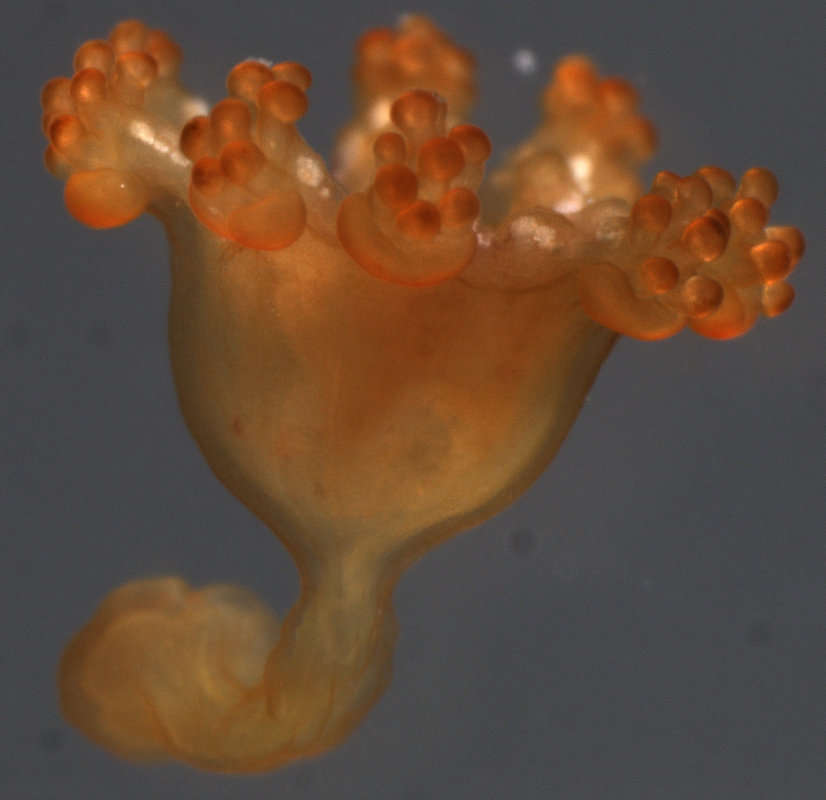
Stauromedusae
Stauromedusae are the stalked jellyfishes. They are the sole living members of the class Staurozoa and belong to the Medusozoa subphylum of Cnidaria. They are unique among medusa jellyfish in that they do not have an alternation of polyp and medusa life cycle phases, but are instead interpreted as an attached medusa stage, with a lifestyle more resembling that of polypoid forms. They have a generally trumpet-shaped body, oriented upside-down in comparison with other jellyfish, with the tentacles projecting upwards, and the stalk located in the centre of the umbrella. Stauromedusae usually has

Ambulacraria
Ambulacraria , or Coelomopora , is a clade of invertebrate phyla that includes echinoderms and hemichordates;

Trilobozoa
Trilobozoa, from Ancient Greek τρεῖς (treîs), meaning "three", λοβός (lobós), meaning "lobe", and ζῷον (zôion), meaning "animal", is a phylum of extinct, sessile animals that were originally classified into the Cnidaria. The basic body plan of trilobozoans is often a triradial or radial sphere-shaped form with lobes radiating from its centre.
Fossils of trilobozoans are restricted to marine strata of the Late Ediacaran period.
Small shelly fossils
mineralized fossils, many only a few millimetres long, with a nearly continuous record from the latest stages of the Ediacaran to the end of the Early Cambrian Period.
Ikaria wariootia
fossil bilaterian

Conulariidae
Conulariida are an extinct group of medusozoan cnidarians known from fossils spanning from the latest Ediacaran up until the Late Triassic. They are almost exclusively known from their hard external structures (alternatively referred to as a theca, periderm or test), which were pyramidal in shape and made up of numerous lamellae (thin layers). They are thought to have been sessile animals that grew with the narrower tip anchored to the seafloor, with the wider end bearing an array of tentacles used to ensnare prey.
Dickinsoniidae
Dickinsoniidae is a taxon of Ediacaran fossils with an airbed-like quilted morphology, sometimes found in association with bizarre trace fossils. It is placed within the extinct phylum Proarticulata, and contains the defined genera Dickinsonia and probably Windermeria. Phyllozoon is associated with this family, and is thought to represent ichnofossils of Dickinsonia.