Category
page 1Edible seaweeds

seaweed
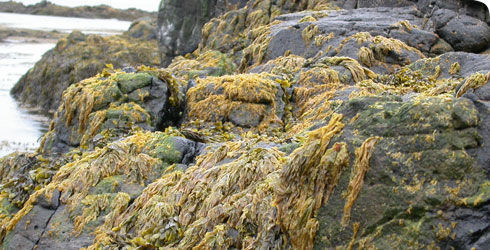
thumb|upright|Ascophyllum nodosum exposed to the sun in [[Nova Scotia, Canada|alt=Photo of seaweed with small swollen areas at the end of each frond]]
thumb|Dead man's fingers (Codium fragile) off the [[Massachusetts coast in the United States|alt=Photo of detached seaweed frond lying on sand]]
right|thumb|The top of a kelp forest in [[Otago, New Zealand|alt=Photo of seaweed with the tip floating at the surface]]
Seaweed, or macroalgae, refers to thousands of species of macroscopic, multicellular, marine algae. The term includes some types of Rhodophyta (red), Phaeophyta (brown) and Chlorophyt

kelp
Kelps are large brown algae or seaweeds that make up the order Laminariales. There are about 30 genera. Despite its appearance and use of photosynthesis in chloroplasts, kelp is not a plant but a stramenopile.
.jpg)
nori
Nori is a dried edible seaweed used in Japanese cuisine, usually made from species of the red algae genus Pyropia, including P. yezoensis and P. tenera. It has a strong and distinctive flavor, and is generally made into flat sheets and used to wrap rolls of sushi or onigiri (rice balls).

wakame
Wakame (Undaria pinnatifida) is a species of kelp native to cold, temperate coasts of the northwest Pacific Ocean. As an edible seaweed, it has a subtly sweet, but distinctive and strong flavour and satiny texture. It is most often served in soups and salads.

Fucus vesiculosus
species of Phaeophyceae

Ulva
genus of algae

kombu
thumb|Dried kombu
thumb|Dried kombu sold in a Japanese supermarket

Ulva lactuca
species of alga

Palmaria palmata
species of edible alga

Caulerpa
Caulerpa is a genus of seaweeds in the family Caulerpaceae (among the green algae). They are unusual because they consist of only one cell with many nuclei, also known as coenocytic or siphonous algae, making them among the biggest single cells in the world.

hijiki
(Sargassum fusiforme, syn. Hizikia fusiformis), sometimes called hiziki or tot (), is a brown seaweed that grows wild on the rocky coastlines of East Asia.

Laminaria digitata
species of alga

Ascophyllum nodosum
Ascophyllum nodosum is a large, common cold water seaweed or brown alga (Phaeophyceae) in the family Fucaceae. Its common names include knotted wrack, egg wrack, feamainn bhuí, rockweed, knotted kelp and Norwegian kelp. It grows only in the northern Atlantic Ocean, along the north-western coast of Europe (from the White Sea to Portugal) including east Greenland and the north-eastern coast of North America. Its range further south of these latitudes is limited by warmer ocean waters. It dominates the intertidal zone. Ascophyllum nodosum has been used numerous times in scientific research and ha

Caulerpa lentillifera
species of alga

Saccharina japonica
species of Phaeophyceae

Porphyra
Porphyra is a genus of coldwater seaweeds that grow in cold, shallow seawater. More specifically, it belongs to red algae phylum of laver species (from which comes laverbread), comprising approximately 70 species. It grows in the intertidal zone, typically between the upper intertidal zone and the splash zone in cold waters of temperate oceans. In East Asia, it is used to produce the sea vegetable products nori (in Japan) and gim (in Korea). There are considered to be 60–70 species of Porphyra worldwide and seven around Britain and Ireland, where it has been traditionally used to produce edibl
edible seaweed
algae that can be eaten and used in the preparation of food
green laver
type of edible green seaweed

Gracilaria
Gracilaria, also known as Irish moss or ogonori, is a genus of red algae in the family Gracilariaceae. It is notable for its economic importance as an agarophyte meaning that it is used to make agar, as well as its use as a food for humans and various species of shellfish. Various species in the genus are cultivated among Asia, South America, Africa and Oceania. They produce over 90% of the world's agar.
Porphyra umbilicalis
coldwater seaweed

Alaria esculenta
edible seaweed
.jpg)
Pyropia
Pyropia is a genus of red algae in the family Bangiaceae. It is found around the world in intertidal zones and shallow water. The genus has folding frond-like blades which are either red, brown or green. Some Pyropia species are used to create nori, and are thus important subjects for aquaculture.
Gim
Korean edible seaweed

Eisenia bicyclis
, sea oak is a species of kelp, of the brown algae, best known for its use in Japanese cuisine.

Durvillaea antarctica
species of seaweed

Ulva intestinalis
species of alga

Codium fragile
species of alga

Cladosiphon okamuranus
species of alga
kaipen
Kaipen (, ) is a Laotian snack made of fresh water green algae, garlic, vegetables, and sesame seeds.

Postelsia palmaeformis
Postelsia palmaeformis, also known as the sea palm (not to be confused with the southern sea palm) or palm seaweed, is a species of kelp and classified within brown algae in the SAR supergroup of eukaryotes. It is the only known species in the genus Postelsia. The sea palm is found along the western coast of North America, on rocky shores with constant waves.

Asparagopsis taxiformis
species of alga

Alaria
genus of algae

Ulva linza
species of alga

Ecklonia cava
species of alga

Pyropia tenera
species of alga

Analipus japonicus
species of Phaeophyceae