Category
page 1Egyptian goddesses

Isis
thumb|Isis wall painting in the tomb of Seti I (KV17)

Hathor
thumb|right|Hathor as a cow
Hathor (, , , Meroitic: '''') was a major goddess in ancient Egyptian religion who played a wide variety of roles. As a sky deity, she was the mother or consort of the sky god Horus and the sun god Ra, both of whom were connected with kingship, and thus she was the symbolic mother of their earthly representatives, the pharaohs. She was one of several goddesses who acted as the Eye of Ra, Ra's feminine counterpart, and in this form, she had a vengeful aspect that protected him from his enemies. Her beneficent side represented beauty, music, dance, joy, love, sexualit

Bastet
thumb|Bastet in her earlier form of a lioness-headed woman depicted the same or very similar to Sekhmet
Bastet or Bast (), also known as Ubasti or Bubastis, is a goddess of ancient Egyptian religion, possibly of Nubian origin, worshipped as early as the Second Dynasty (2890 BCE). In ancient Greek religion, she was known as Ailuros ().

Maat
'''Ma'at or Maat' (Egyptian: ma’at /ˈmuʀʕat/, Coptic: ⲙⲉⲓ) comprised the ancient Egyptian concepts of truth, balance, law, morality, and justice. Maat was also the goddess who personified these concepts, and regulated the stars, seasons, and the actions of mortals and the deities who had brought order from chaos at the moment of creation. Her ideological opposite was Isfet (Egyptian jzft''), meaning injustice, chaos, violence or to do evil.

Nut
goddess of the sky in the Ennead of Egyptian mythology

Mut
thumb|Mut nursing the pharaoh, Seti I, in relief from the second hypostyle hall of Seti's mortuary temple in Abydos.

Sekhmet
In Egyptian mythology, Sekhmet ( or Sachmis , from ; ) is a warrior goddess as well as goddess of medicine.

Neith
thumb|Neith wearing the Deshret|Red Crown of Lower Egypt.

Anuket
Anuket was the ancient Egyptian goddess of the cataracts of the Nile and Lower Nubia in general, worshipped especially at Elephantine near the First Cataract.

Tefnut
Tefnut ( ; ) is a deity in Ancient Egyptian religion, the feminine counterpart of the air god Shu. Her mythological function is less clear than that of Shu, but Egyptologists have suggested she is connected with moisture, based on a passage in the Pyramid Texts in which she produces water, and on parallelism with Shu's connection with dry air. She was also one of the goddesses who could function as the fiery Eye of Ra.

Amunet
Amunet () or Imnt (The Hidden One in hieroglyphics; also spelled Amonet or Amaunet; ) is a primordial goddess in ancient Egyptian religion. Thebes was the center of her worship through the last dynasty, the Ptolemaic Kingdom, in 30 BCE. She is attested in the earliest known of Egyptian religious texts and, as was the custom, was paired with a counterpart who is entitled with the same name, but in the masculine, Amun. They were thought to have existed prior to the beginning of creation along with three other couples representing primeval concepts.

Taweret
thumb|Images of protective deities like Taweret and Bes were placed on the outer walls of Ptolemaic temples in order to keep evil forces at bay. [[Edfu, Egypt.]]In Ancient Egyptian religion, Taweret (, also spelled Taurt, Tuat, Tuart, Ta-weret, Tawaret, Twert and Taueret, and in , Thoeris, Taouris and Toeris) is the protective goddess of childbirth and fertility. The name "Taweret" means "she who is great" or simply "great one", a common pacificatory address to dangerous deities. The deity is typically depicted as a bipedal female hippopotamus with feline attributes, pendulous female human bre
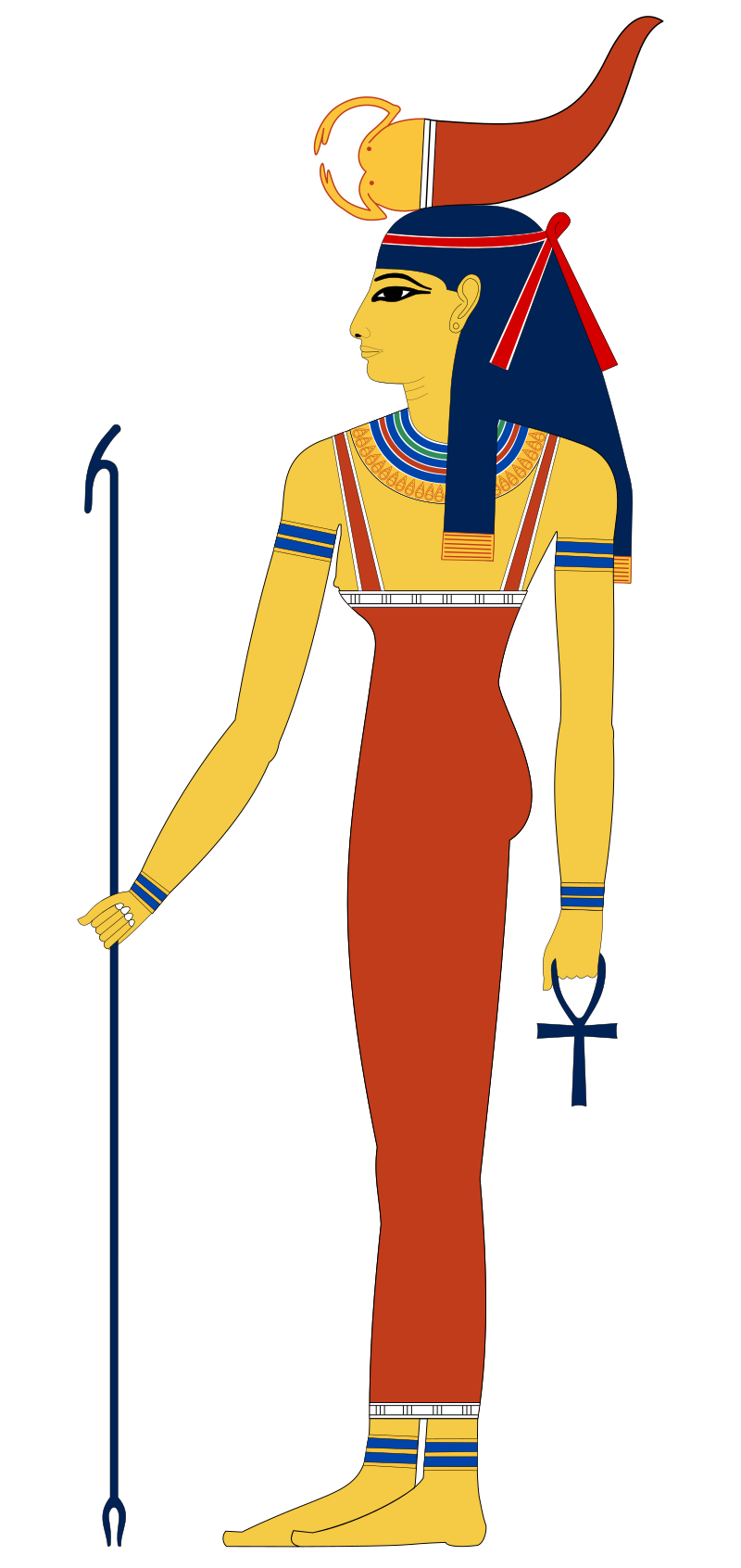
Serket
Serket /ˈsɜːrˌkɛt/ (Ancient Egyptian: srqt) is the goddess of protection against the venomous stings and bites of scorpions in Egyptian mythology. She was primarily worshiped in Lower Egypt during the Predynastic Period (c. 6000 – c. 3150 BCE). Serket is often depicted as a woman whose head is surmounted by a scorpion with its tail is ready to sting, an ankh in one hand, and a was-sceptre in her other. Her name, also rendered as Serqet, Selkis, or Selket, is a shortened version of 'Serket hetyt' which means "she who causes the throat to breathe."

Wadjet
thumb|Map of the Nile Delta locating Buto.
Wadjet (; "Green One"), known to the Greek world as Uto (; ) or Buto (; ) among other renderings including Wedjat, Uadjet, and Udjo, was originally the ancient Egyptian local goddess of the city of Dep or Buto in Lower Egypt, which was an important site in prehistoric Egypt. Wadjet's worship originally started in the Predynastic period, but evolved over time from a local goddess to a patron goddess.

Astarte
Astarte (; ) is the Hellenized form of the Ancient Near Eastern goddess ʿAṯtart. ʿAṯtart was the Northwest Semitic equivalent of the East Semitic goddess Ishtar.

Nekhbet
Nekhbet (; also spelt Nekhebet) is an early predynastic local goddess in Egyptian mythology, who was the patron of the city of Nekheb (her name meaning of Nekheb). Ultimately, she became the patron of Upper Egypt and one of the two patron deities (alongside Wadjet) for all of Ancient Egypt when it was unified.

Arsinoe II
Ptolemaic Greek Princess of Ancient Egypt and Queen of Thrace, Asia Minor and Macedonia

Heqet
Heqet (Egyptian ', also ' "Heqtit"), sometimes spelled Heket, is an Egyptian goddess of fertility, identified with Hathor, represented in the form of a frog.

Seshat
Seshat (, under various spellings) was the ancient Egyptian goddess of writing, wisdom, and knowledge. She was seen as a scribe and record keeper. She was also credited with inventing writing. She became identified as the goddess of measurement, accounting, architecture, science, astronomy, mathematics, geometry, history and surveying. She was variously depicted as the wife, daughter, or feminine counterpart of Thoth, who was also associated with knowledge, astronomy, measurement, and writing.''''''

Meretseger
Meretseger (also known as Mersegrit' or Mertseger) was a Theban cobra-goddess in ancient Egyptian religion, in charge with guarding and protecting the vast Theban Necropolis — on the west bank of the Nile, in front of Thebes — and especially the heavily guarded Valley of the Kings. Her cult was typical of the New Kingdom of Egypt (1550–1070 BC).

Anat
Anat (, ), Anatu, classically Anath (; ʿnt; ʿĂnāṯ; ; ; Egyptian: ꜥntjt) was a goddess associated with warfare and hunting, best known from the Ugaritic texts. Most researchers assume that she originated in the Amorite culture of Bronze Age upper Mesopotamia, and that the goddess Ḫanat, attested in the texts from Mari and worshiped in a city sharing her name located in Suhum, should be considered her forerunner.
Satis
ancient Egyptian goddess
Bat
cow goddess in Egyptian mythology depicted as a human face with cow ears and horns
Meskhenet
In ancient Egyptian mythology, Meskhenet, (also spelt Mesenet, Meskhent, and Meshkent) was the goddess of childbirth, and the creator of each child's Ka, a part of their soul, which she breathed into them at the moment of birth. She was worshipped from the earliest of times by Egyptians.
Menhit
Menhit (also known as Menhyt, and Menchit) was originally a Nubian lion goddess of war in the Kingdom of Kush, who was regarded as a tutelary and sun goddess. Her name means either "she who sacrifices" or "she who massacres."

Renenutet
Renenūtet (also transliterated Ernūtet, Renen-wetet, Renenet) was a goddess of grain, grapes, nourishment and the harvest in the ancient Egyptian religion. The importance of the harvest caused people to make many offerings to Renenutet during harvest time.
Initially, her cult was centered in Terenuthis. Renenutet was depicted as a cobra or as a woman with the head of a cobra.

Sopdet
Sopdet is the ancient Egyptian name of the star Sirius and its personification as an Egyptian goddess. Known to the Greeks as Sothis, she was conflated with Isis as a goddess and Anubis as a god.
Wosret
Wosret, Waset, or Wosyet meaning "the powerful female one" was an Egyptian goddess whose cult was centered on Thebes in Upper Egypt and her name was the same as the Egyptian name of the city, Waset. She was a minor goddess, but three pharaohs during the Twelfth Dynasty plus an additional one during the second intermediate peroiod incorporated her name into theirs: Senwosret, or Senusret, means "man of Wosret".
Mafdet
Mafdet (also Mefdet, Maftet) was a goddess in the ancient Egyptian religion. She was often depicted wearing a skin of a cheetah, and protected against the bite of snakes and scorpions. She was part of the pantheon of ancient Egyptian deities that was prominent during the First Dynasty of Egypt. She was prominent during the reign of pharaoh Den whose image appears on stone vessel fragments from his tomb and is mentioned in a dedicatory entry in the Palermo Stone. Mafdet was the deification of legal justice, or possibly of capital punishment. She was associated with the protection of the king's

Pakhet
In Egyptian mythology, Pakhet, Egyptian Pḫ.t, meaning she who scratches (also spelt Pachet, Pehkhet, Phastet, and Pasht) is a lioness goddess of war.
.jpg)
Qetesh
Qetesh (also Qodesh, Qadesh, Qedesh, Qetesh, Kadesh, Kedesh, Kadeš or Qades ) was a goddess who was incorporated into the ancient Egyptian religion in the late Bronze Age. The Egyptians likely developed her name based on the Semitic root Q-D-Š, meaning 'holy' or 'blessed,' attested as a title of El and possibly Athirat and a further independent deity in texts from Ugarit.
Hatmehit
Hatmehit or Hatmehyt () was an Ancient Egyptian goddess associated with the city in the Nile Delta known as Djedet () or Mendes ().
%20(Vall%C3%A9e%20des%20Rois%20Th%C3%A8bes%20ouest)%20-2.jpg)
Imentet
Imentet (Ament, Amentet or Imentit, meaning "She of the West") was a goddess in ancient Egyptian religion representing the necropolises west of the Nile.
Werethekau
Werethekau (Egyptian: wrt-ḥk3w "great one of magic, great enchantress"; alternately Urthekau, Weret Hekau, Wusa) was an ancient Egyptian and ancient Nubian deity. She served as the personification of supernatural powers.
Hesat
Hesat is an ancient Egyptian goddess in the form of a cow. She was said to provide humanity with milk (called "the beer of Hesat") and in particular to suckle the pharaoh and several ancient Egyptian bull gods. In the Pyramid Texts she is said to be the mother of Anubis and of the deceased king. She was especially connected with Mnevis, the living bull god worshipped at Heliopolis, and the mothers of Mnevis bulls were buried in a cemetery dedicated to Hesat. In Ptolemaic times (304–30 BC) she was closely linked with the goddess Isis.
Eye of Ra
ancient Egyptian symbol of protection, royal power and good health
Mehet-Weret
Mehet-Weret or Mehturt () is an ancient Egyptian deity of the sky in ancient Egyptian religion. Her name means "Great Flood".
Two Ladies
Egyptian hieroglyph
Raet-Tawy
Raet-Tawy or Raet is an ancient Egyptian solar deity, the female aspect of Ra. Her name is simply the female form of Ra's name; the longer name Raet-Tawy means "Raet of the Two Lands" (Upper Egypt and Lower Egypt).
Mehit
Mehit (also Mehyt, Mekhit) was an ancient Egyptian and Nubian lion goddess of Nubian origin.
Iusaaset
Iusaaset, Iusaas, or, in Greek, Saosis, is a primordial goddess in Ancient Egyptian religion, a feminine counterpart to the male creator deity Atum. Iusaaset was depicted as a woman with a scarab beetle on her head. She was worshipped in the city of I͗wnw or Iunu, Greek Heliopolis, as was Atum. Iusaaset was associated with the acacia tree and acacias stood at the sanctuary dedicated to Iusaaset at Heliopolis.

Unut
Unut, also known as Wenut or Wenet, was a prehistoric Ancient Egyptian hare and snake goddess of fertility and new birth.
Ba‘alat Gebal
Phoenician deity
Renpet
Renpet was, in the Egyptian language, the word for "year". Its hieroglyph was figuratively depicted in art as a woman wearing a palm shoot (symbolizing time) over her head. She was often referred to as the Mistress of Eternity and also personified fertility, youth and spring. The glyph regularly appears on monuments and documents throughout Egyptian history as the beginning of the phrase recording the regnal year of the pharaoh.
Iabet
Iabet (Iabtet, Iab, Abet, Abtet, Ab) is a goddess in Egyptian mythology, counterpart of Imentet.
Tjenenyet
Tjenenyet, alternatively Tenenet, Tjenenet, Zenenet, Tanenet, Tenenit, Manuel de Codage transliteration Tnn.t, was an ancient Egyptian goddess of childbirth and protection. She is mentioned in texts dating from the Ptolemaic period as well as in the Book of the Dead.
Meret
In Egyptian mythology, Meret (also spelled Mert) was a goddess who was strongly associated with rejoicing, such as singing and dancing.
Hedetet
Hededet or Hedjedjet (ḥdd.t) is a scorpion goddess of the ancient Egyptian religion. She resembles Serket in many ways, but was in later periods merged into Isis. She was depicted with the head of a scorpion, nursing a baby. She is mentioned in the Book of the Dead.
Nebethetepet
Nebethetepet (nb.t-ḥtp.t) is an ancient Egyptian goddess. Her name means "Lady of the Offerings" or "Satisfied Lady". She was worshipped in Heliopolis as a female counterpart of Atum. She personified Atum's hand, the female principle of creation, and could also be a title for Hathor, but aside from that had little significance.
Iunit
Iunit was a minor goddess in ancient Egyptian religion, whose name means "She of Armant". She is the consort of Montu.
Shesmetet
Shesmetet (šsm.t.t) is an ancient Egyptian goddess. She was mentioned in the Pyramid Texts and was usually referred to as the deceased's mother. She was depicted as a lion or a woman with a lion's head, and thus was sometimes considered a form of Sekhmet or Bastet, but one of her epithets – "Lady of Punt" – differentiates her from them and may refer to a possible African origin. Her name comes from shesmet, a sash decorated with beads, which appears on the depictions of Old Kingdom rulers and the god Sopdu.
Hemsut
In Egyptian mythology, The ḥmswt (anglicized as Hemsut, Hemuset or Hemusut) were the goddesses of fate and protection. They are representative of the Ka (male protective spirit).
Nehmetawy
Nehmetawy (nḥm.t-ˁw3ỉ; "she who embraces those in need") is a goddess in the ancient Egyptian religion. She is not very widely known. Nehmetawy was the wife of snake god Nehebkau, or in other places of worship, like in Hermopolis, the wife of Thoth. A local form of the god Horus called Horus-nefer ("Horus, the good one)" might have been viewed as the son of Thoth and Nehmetawy. Her depictions are anthropomorph, with a sistrum-shaped headdress, often with a child in her lap.

Amesemi
Amesemi is a Kushite protective goddess and wife of Apedemak, the lion-god. She was represented with a crown shaped as a falcon, or with a crescent moon on her head on top of which a falcon was standing. The clothing that Amesemi is seen wearing is a robe that is made from cloth and is worn over her undergarments. She is often seen wearing a short necklace with large beads. She is also depicted holding a second set of hands with her.
Ta-Bitjet
Ta-Bitjet is an ancient goddess of Egyptian mythology. She is identified as the consort of Horus. Ta-Bitjet is a scorpion goddess and the blood that flowed from when Horus ruptured her hymen can serve as a panacea for poisons. She could be associated with another bride of one of Horus, Serket.
Khensit
In Egyptian mythology, Khensit (also spelled Chensit, Khenset), which means "placenta", was the patron goddess of the twentieth nome of Lower Egypt. Khensit was the wife of Sopdu and the daughter of Ra, and was depicted as an uraeus. Khensit and Sopdu were sometimes known as the divine pair of Saft el-Hinna.
Wepset
Wepset (wps.t) is an ancient Egyptian goddess. She is one of the personifications of the uraeus cobra that protected the kings; she is also an Eye of Ra and is mentioned as "the Eye" in the Coffin Texts. Her name means "she who burns". In New Kingdom texts she destroys the enemies of Osiris. She was mentioned as having a temple on the island of Biga; no such structure has been found there, but she appears in the temples of other deities here and in Lower Nubia.
Repyt
Repyt, or Repit, was an ancient Egyptian goddess. Typically, she was portrayed as one of the lioness goddesses of Egypt. Her husband was Min.
Iat
Iat () is an ancient Egyptian minor goddess of milk and, by association, of nurturing and childbirth.