Category
page 1Egyptian inventions

tax
A tax is a mandatory financial charge or levy imposed on an individual or legal entity by a governmental organization to support government spending and public expenditures collectively or to regulate economic activity through measures designed to mitigate negative externalities. Tax compliance refers to policy actions and individual behavior aimed at ensuring that taxpayers are paying the right amount of tax at the right time and securing the correct tax allowances and tax relief. The first known taxation occurred in Ancient Egypt around 3000–2800 BC. Taxes consist of direct or indirect taxes

lighthouse
thumb|300px|Barnegat Lighthouse at the coast of [[Ocean County, New Jersey, U.S., facing the Atlantic Ocean at sunrise]]
thumbnail|Aerial drone footage of the Roman Rock Lighthouse off the southern coast of South Africa.

lever
A lever is a simple machine consisting of a beam or rigid rod pivoted at a fixed hinge, or fulcrum. A lever is a rigid body capable of rotating on a point on itself. On the basis of the locations of fulcrum, load, and effort, the lever is divided into three types. It is one of the six simple machines identified by Renaissance scientists. A lever amplifies an input force to provide a greater output force, which is said to provide leverage, which is mechanical advantage gained in the system, equal to the ratio of the output force to the input force. As such, the lever is a mechanical advantage d

pulley
A pulley is a wheel on an axle or shaft enabling a taut cable or belt passing over the wheel to move and change direction, or transfer power between itself and a shaft.

papyrus
thumb|220px|Papyrus (P. British Museum|BM EA 10591 [[recto column IX, beginning of lines 13–17)]]

sundial
thumb|right|SSW facing, vertical declining sundial on the Moot Hall in Aldeburgh, Suffolk, England. The gnomon is a rod that is very narrow, so it functions as the style. The Latin motto loosely translates as "I only count the sunny hours."
[[File:Melbourne sundial at Flagstaff Gardens.JPG|thumb|right|A horizontal dial commissioned in 1862, the gnomon is the triangular blade. The style is its inclined edge.
.jpg)
loom
right|250px|thumb|Wooden loom in Lesbos, Greece.
thumb|A treadle-driven Hattersley & Sons Domestic
Loom, built under licence in 1893, in [[Keighley, Yorkshire. This loom has a flying shuttle and automatically rolls up the woven cloth; it is not just controlled but powered by the pedals.]]

board game
game that involves counters or pieces moved or placed on a pre-marked surface or "board", according to a set of rules
.jpg)
obelisk
thumb|One of the two Luxor Obelisks, on the [[Place de la Concorde in Paris; a red granite monolithic column, high, including the base, which weighs over .]]
thumb|Lateran Obelisk in Piazza San Giovanni in Laterano, [[Rome. With its height of (with the base and the cross it reaches 45.70 m) it is the largest standing ancient monolithic obelisk in the world.]]
lute
thumb|start=7|thumbtime=12|Playing a lute made
A lute ( or ) is any plucked string instrument with a neck and a deep round back enclosing a hollow cavity, usually with a sound hole or opening in the body. It may be either fretted or unfretted.

steam turbine
type of turbine device which uses steam from a boiler to rotate the turbine blades

wig
thumb|upright|A conventional hime cut wig

fountain pen
writing implement

oud
The oud ( ; , ) is a Middle Eastern short-neck lute-type, pear-shaped, fretless stringed instrument (a chordophone in the Hornbostel–Sachs classification of instruments), usually with 11 strings grouped in six courses, but some models have five or seven courses, with 10 or 13 strings respectively.

lathe
thumb|upright=1.35|Modern metal lathe
thumb|upright=1.35|A watchmaker using a lathe to prepare a component cut from copper for a watch
A lathe () is a machine tool that rotates a workpiece about an axis of rotation to perform various operations such as cutting, sanding, knurling, drilling, deformation, facing, threading and turning, with tools that are applied to the workpiece to create an object with symmetry about that axis.

prosthesis
thumb|A person with a running prosthesis
In medicine, a prosthesis (: prostheses; from ), or a prosthetic implant, is an artificial device that replaces a missing body part, which may be lost through physical trauma, disease, or a condition present at birth (congenital disorder). Prostheses may restore the normal functions of the missing body part, or may perform a cosmetic function.

chest
box-shaped type of furniture

rudder
thumb|Modern ship rudder (the tall red rectangle behind the propeller (marine)|propeller)
thumbnail|right|'s rudder turned

mastaba
right|thumb|Example of a mastaba, the Mastabat al-Fir'aun of [[Shepseskaf]]
A mastaba ( , or ), also mastabah or mastabat) is a type of ancient Egyptian tomb in the form of a flat-roofed, rectangular structure with inward sloping sides, constructed out of mudbricks or limestone. These edifices marked the burial sites of many eminent Egyptians during Egypt's Early Dynastic Period and Old Kingdom. Non-royal use of mastabas continued for over a thousand years.

water wheel
machine for harnessing energy from the flow of water

flip-flop
thumb|Flip flops on feet being worn
Flip-flops (or thongs in Australian English) are a type of light sandal-like shoe, typically worn as a form of casual footwear. They consist of a flat sole held loosely on the foot by a Y-shaped strap known as a toe thong that passes between the first and second toes and around both sides of the foot. This style of footwear has been worn by people of many cultures throughout the world, originating as early as the ancient Egyptians in 1500 BC. In the United States the modern flip-flop may have had its design taken from the traditional Japanese zōri after Worl

water clock
timepiece in which time is measured by the flow of liquid into a vessel

bookbinding
thumb|A traditional bookbinder at work
thumb|Bookbinder's type holder

vending machine
machine which automatically dispenses beverages, food or non-food products to customers after a payment

Egyptian hieratic
Hieratic (; ) is the name given to a cursive writing system used for Ancient Egyptian and the principal script used to write that language from its development in the third millennium BCE until the rise of Demotic in the mid-first millennium BCE. It was primarily written in ink with a reed brush on papyrus.

field-effect transistor
transistor that uses an electric field to control its electrical behaviour

siphon
thumb|right|Siphon principle
thumb|In the flying-droplet siphon, surface tension pulls the stream of liquid into separate droplets inside of a sealed air-filled chamber, preventing the liquid going down from having contact with the liquid going up, and thereby preventing liquid tensile strength from pulling the liquid up. It also demonstrates that the effect of atmospheric pressure at the entrance is not canceled by the equal atmospheric pressure at the exit.
ancient Egyptian architecture
aspect of architecture

bowling
Bowling is a target sport and recreational activity in which a player rolls a ball toward pins (in pin bowling) or another target (in target bowling). Most references to bowling are to pin bowling, specifically tenpin bowling, played in the United Kingdom and Commonwealth countries. Bowling can also refer to target bowling, such as lawn bowls. Bowling is played by 120 million people in more than 90 countries, including 70 million people in the United States alone.
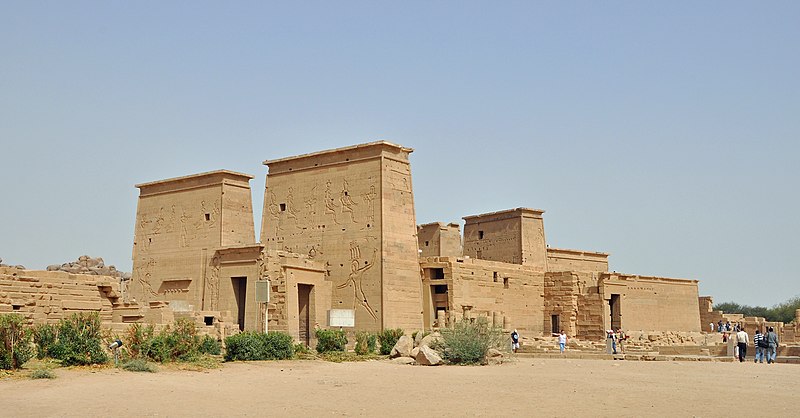
Egyptian temple
structures for official worship of the gods and commemoration of pharaohs in Ancient Egypt

ostracon
[[Image:AGMA Ostrakon Cimon.jpg|right|thumb|Ostrakon inscribed with "Kimon [son] of Miltiades", for Cimon, an Athenian statesman.]]
thumb|Ostrakon of Megacles, son of Hippocrates (inscription: ΜΕΓΑΚΛΕΣ ΗΙΠΠΟΚΡΑΤΟΣ), 487 BC. On display in the Ancient Agora Museum in Athens, housed in the [[Stoa of Attalus]]
right|thumb|Ancient Greek ostraca voting for the ostracism|ostracization of [[Themistocles in 472/471 BC.]]

Senet
Senet or senat (; cf. Coptic , 'passing, afternoon') is a board game from ancient Egypt that consists of ten or more pawns on a 30-square playing board. The earliest representation of senet is dated to 2620 BCE from the Mastaba of Hesy-Re, while similar boards and hieroglyphic signs are found even earlier, including in the Levant in the Early Bronze Age II period. Even though the game has a 2,000-year history in Egypt, there appears to be very little variation in terms of key components. This can be determined by studying the various senet boards that have been found by archaeologists, as well

noria
thumb|The norias of Hama on the [[Orontes River in Syria (video).]]
Ancient Egyptian medicine
remedies from ancient Egypt
shale oil
oil produced from oil shale rock fragments

Sakia
thumb|The Saqiyah, c. 1905
thumb|alt=taken at Sikandra, India c1917 and titled near the time as 'A Punjabi Wheel'; from photo album of Robert Victor Soper, Private, Hampshire Regiment, in India 1916-19|'Punjab Wheel', India c.1917
A sāqiyah or saqiya (), also spelled sakia or saqia) is a mechanical water lifting device. It is also called a Persian wheel, tablia, rehat, and in Latin tympanum. It is similar in function to a scoop wheel, which uses buckets, jars, or scoops fastened either directly to a vertical wheel, or to an endless belt activated by such a wheel. The vertical wheel is itself a
NMOS logic
implements logic gates and other digital circuits
.jpg)
lusterware
thumb|Staffordshire pottery jug, c. 1815
Lustreware or lusterware (the respective spellings for British English and American English) is a type of pottery or porcelain with a metallic glaze that gives the effect of iridescence. It is produced by metallic oxides in an overglaze finish, which is given a second firing at a lower temperature in a "muffle kiln", or a reduction kiln, excluding oxygen.
PMOS logic
p-type MOSFETs to implement logic gates
Egyptian faience
type of Ancient Egyptian sintered-quartz ceramic
Mehen
ancient Egyptian board game
screw
mechanism that converts rotational motion to linear motion, and a torque (rotational force) to a linear force; one of the six classical simple machines
Cursive hieroglyphs
handwritten Egyptian hieroglyphs
core drill
drill specifically designed to remove a cylinder of material
Egyptian medical papyri
Ancient Egyptian text
secure cryptoprocessor
device used for encryption
Egyptian pyramid construction techniques
overview about the Egyptian pyramid construction techniques
Egyptian technology
devices and technologies invented or used in Egypt

watercolor paper
special paper for watercolors
screw pump
type of pump construction
mural instrument
angle-measuring device used for astronomical purposes
Gate dielectric
field-effect transistor

gate oxide
dielectric layer of a MOSFET separating the source and drain from the gate terminal
charge trap flash
type of flash storage
Chariotry in ancient Egypt
FET amplifier
Device using a field effect transistor
Rope stretcher
history of timekeeping devices in Egypt
aspect of history