Category
page 1Food preparation utensils

funnel
thumb|A typical kitchen funnel
thumb|A ceramic Ancient Rome|Roman kitchen funnel (1st–3rd century AD)

grater
thumb|Box grater with a vegetable slicing surface (top) and grating surface (front) displayed
A grater, also referred to as a shredder, is a kitchen utensil used to grate or shred foods into fine pieces. They come in several shapes and sizes, with box graters being the most common. Other styles include paddles, microplane/rasp graters, and rotary drum graters.

cutlery
Cutlery are utensils used for serving and eating food at the dining table — originally referring to just knives, whereas forks and spoons were silverware — all part of flatware (American English) or tableware, these both encompassing crockery as well. These three implements first appeared together on tables as a set in Britain in the Georgian era. A collected set of silverware is called a canteen of cutlery, typically referring to the polished wooden compartmental case in which they are stored.

corkscrew
thumb|Three types of corkscrew: two modern (left and bottom) and one old (right)
thumb|upright|A basic corkscrew
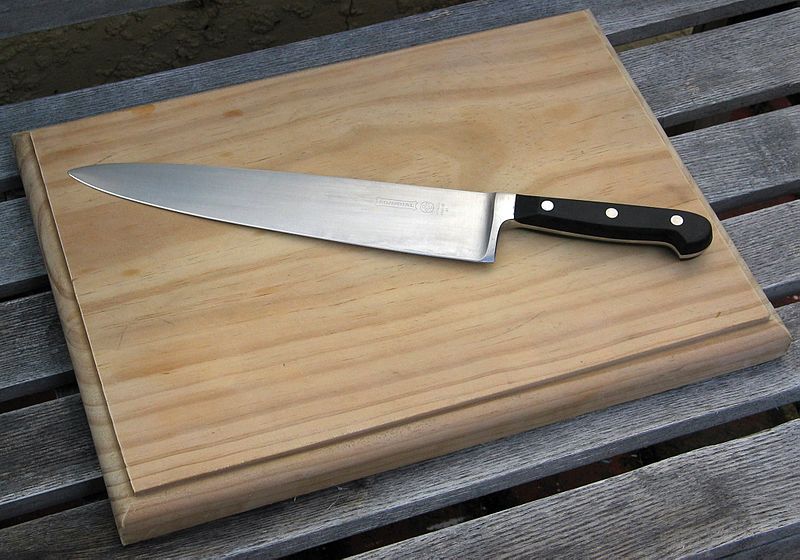
cutting board
durable board on which to place material for cutting

colander
thumb|300x300px|Vitreous enamel|Enamelled colander (collection Museum of Industry Ghent)
A colander or cullender is a kitchen utensil perforated with holes used to strain foods such as pasta or to rinse vegetables. The perforations of the colander allow liquid to drain through while retaining the solids inside. It is sometimes called a pasta strainer. A sieve, with much finer mesh, is also used for straining.

whisk
thumb|right|upright=1.35|French (top) and balloon whisks. Balloon whisks are bulbous; French whisks are longer and narrower.
mixer
kitchen appliance intended for mixing, folding, beating, and whipping food ingredients
butter churn
device used to turn cream into butter through stirring and agitation

nutcracker
thumb|Using a nutcracker
A nutcracker is a tool designed to open nuts by cracking their shells. There are many designs, including levers, screws, and ratchets. The lever version is also used for cracking lobster and crab shells.
aluminium foil
thin, flexible sheets of aluminium, used for wrapping food, and other purposes

skewer
thumb|upright=1.35|Wooden skewers

spatula
thumb|120px|Ancient Roman spatulas at the British Museum
A spatula is a broad, flat, flexible blade used to mix, spread and lift material including foods, drugs, plaster and paints.

mallet
thumb|Rubber mallets
thumb|A wooden mallet
thumb|Rawhide mallet
thumb|Stonemason's mallets of plastic, wood and steel
thumb|An iron mallet with copper faces. Solid head copper mallets are produced with a round or square head
thumb|An aluminium [[meat mallet, for tenderizing meat]]
thumb|Meat mallet.
thumb|Cooking mallet for crushing crops.
thumb|Indian cobbler tool kit, with an iron mallet
A mallet is a tool used for imparting force on another object, often made of rubber or sometimes wood, that is smaller than a maul or beetle, and usually has a relatively large head.
parchment paper
paper treated with sulfuric acid to reduce its porosity and increase its impermeability
bottle opener
device that enables the removal of metal bottle caps from bottles
garlic press
kitchen utensil used to crush garlic cloves

peeler
thumb|A fixed blade (aka sugarcane peeler knife), Australian and Y peeler

juicer
thumb|Electric centrifugal juicer

tongs
thumb|Silicone-tipped locking tongs designed to withstand temperatures up to
thumb|Long handled locking tongs designed for outdoor grilling
thumb|Sugar tong
thumb|Blacksmith tongs used for forging
egg slicer
kitchen utensil
skimmer
kitchen utensil used for skimming
plastic wrap
thin plastic film typically used for sealing food
potato masher
utensil used for preparing food
pastry bag
kitchen utensil

mandoline
right|thumb|A mandoline used for slicing a carrot
meat tenderizer
hand tool used to tenderize slabs of meat
lemon squeezer
kitchen tool to extract lemon juice
coffee filter
coffee-brewing utensil, usually made of disposable paper
measuring cup
kitchen utensil to measure volume of cooking ingredients
peel
tool
wax paper
paper that is made moisture-proof through the application of wax

trivet
thumb|Reconstruction of Iron-age European cookery, using pots suspended in trivets over an open fire
apple corer
device for removing core and pips from an apple or other fruit
scraper
kitchen implement used to remove material from containers
kitchen utensil
small hand-held tool used for food preparation
salt and pepper shaker
kitchen utensil

chawan
A chawan (; literally "tea bowl") is a bowl used for preparing and drinking tea. Many types of chawan are used in East Asian tea ceremonies.
food mill
kitchen utensil
milk watcher
cooking utensil
cookie cutter
tool to cut dough in a particular shape
honey dipper
tool to serve honey
fish slice
Cooking or serving utensil
.jpg)
makiyakinabe
thumb|255x255px|Makiyakinabe are used to make tamagoyaki, occasionally with the aid of a shaping board.|alt=Man in chef's whites at a stove, cooking in four rectangular pans
are square or rectangular cooking pans used to make Japanese-style rolled omelettes (). The pans are commonly made from metals such as copper and tin, and can also be coated with a non-stick surface. Dimensions and proportions of the pan vary among regions of Japan, but it is always rectangular. Rolled omelettes made with are commonly used as a side dish in sushi and bentō.
Cherry pitter
device for removing the pit from fruit
Sujeo
'''''' () is the Korean term for the set of eating utensils commonly used to eat Korean cuisine. The word is a portmanteau of the words (, 'spoon') and (, 'chopsticks'). The set includes a pair of metal (often stainless steel) chopsticks with an oval or rounded-rectangular cross-section, and a long handled shallow spoon of the same material. One may use both at the same time, but this is a recent way to eat quicker. It is not considered good etiquette to hold the spoon and the chopstick together in one hand especially while eating with elders. More often food is eaten with chopsticks alone. So

zester
thumb|200px|A zester zests an orange.
thumb|200px|A Microplane grater / zester in use
A zester (also citrus zester or lemon zester) is a kitchen utensil for obtaining zest from lemons and other citrus fruit. A kitchen zester is approximately long, with a handle and a curved metal end, the top of which is perforated with a row of round holes with sharpened rims. To operate, the zester is pressed with moderate force against the fruit and drawn across its peel. The rims cut the zest from the pith underneath. The zest is cut into ribbons, one drawn through each hole.
baking stone
portable cooking surface used in baking

chinois
thumb|A French-made chinois from a commercial kitchen
potato ricer
kitchen tool used to process potatoes or other food
.jpg)
cheesecloth
thumb|300px|right|Cheesecloth on sauerkraut (fermented cabbage)
thumb|Cheesecloth under a microscope
Cheesecloth is a loose-woven gauze-like carded cotton cloth used primarily in cheesemaking and cooking. The fabric has holes large enough to quickly allow liquids (like whey) to percolate through the fabric, but small enough to retain solids like cheese curds.
measuring spoon
spoon of known volume used to measure food ingredients
bread trough
rectangular receptacle with a shallow basin used for making dough
tomato knife
kitchen utensil
list of food preparation utensils
Wikimedia list article
soup spoon
a spoon for soup; it may be a Western or Chinese style spoon
Juicy Salif
citrus reamer
egg piercer
device used in the cooking of eggs
springform pan
type of bakeware with detachable sides
melon baller
utensil to scoop out balls of melon