Category
page 1Greenhouse gases

carbon dioxide
chemical compound

methane
Methane ( , ) is a chemical compound that has the chemical formula (one carbon atom bonded to four hydrogen atoms). It is a group-14 hydride, the simplest alkane, and the main constituent of natural gas. The abundance of methane on Earth makes it an economically attractive fuel, although capturing and storing it is difficult because it is a gas at standard temperature and pressure. In the Earth's atmosphere methane is transparent to visible light but absorbs infrared radiation, acting as a greenhouse gas. Methane is an organic hydrocarbon, and among the simplest of organic compounds.

ozone
Ozone (), also called trioxygen, is an inorganic molecule with the chemical formula ''''''. It is a pale-blue gas with a distinctively pungent odour. It is an allotrope of oxygen that is much less stable than the diatomic allotrope , breaking down in the lower atmosphere to (dioxygen). Ozone is formed from dioxygen by the action of ultraviolet (UV) light and electrical discharges within the Earth's atmosphere. It is present in very low concentrations throughout the atmosphere, with its highest concentration high in the ozone layer of the stratosphere, which absorbs most of the Sun's ultraviole
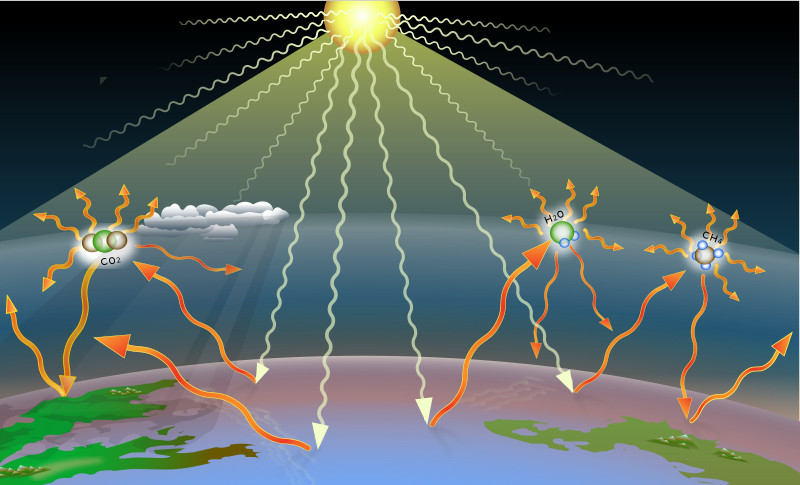
greenhouse gas
heat-trapping gas in a planet's atmosphere

water vapor
gaseous phase of water; unlike other forms of water, water vapor is invisible

ethane
Ethane ( , ) is a naturally occurring organic chemical compound with chemical formula . At standard temperature and pressure, ethane is a colorless, odorless gas. Like many hydrocarbons, ethane is isolated on an industrial scale from natural gas and as a petrochemical by-product of petroleum refining. Its chief use is as feedstock for ethylene production. The ethyl group is formally, although rarely practically, derived from ethane.

ethylene
Ethylene (IUPAC name: ethene) is a hydrocarbon which has the formula or . It is a colourless, flammable gas with a faint "sweet and musky" odour when pure. It is the simplest alkene (a hydrocarbon with carbon–carbon double bonds).
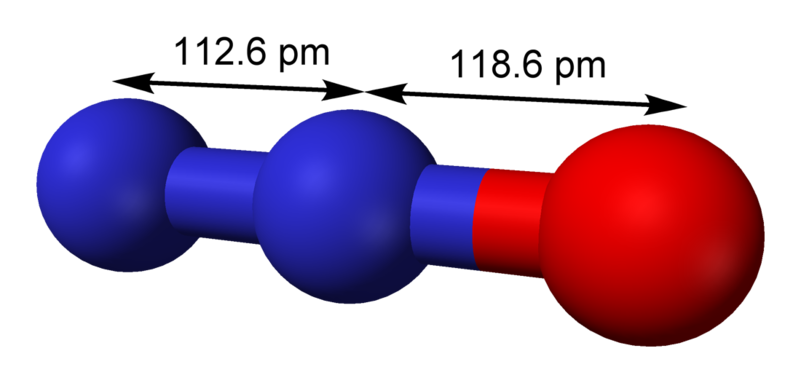
nitrous oxide
chemical compound

chlorofluorocarbon
Chlorofluorocarbons (CFCs) and hydrochlorofluorocarbons (HCFCs) are fully or partly halogenated hydrocarbons that contain carbon (C), hydrogen (H), chlorine (Cl), and fluorine (F). They are produced as volatile derivatives of methane, ethane, and propane.

carbon tetrachloride
chemical compound

methyl chloride
Chloromethane, also called methyl chloride, Refrigerant-40, R-40 or HCC 40, is an organic compound with the chemical formula . One of the haloalkanes, it is a colorless, sweet-smelling, flammable gas. Methyl chloride is a crucial reagent in industrial chemistry, although it is rarely present in consumer products, and was formerly utilized as a refrigerant. Most chloromethane is biogenic.
sulfur hexafluoride
chemical compound, non-toxic, climate-damaging gas
properties of water
overview about physical and chemical properties of pure water
tetrafluoromethane
chemical compound

norflurane
1,1,1,2-Tetrafluoroethane (also known as norflurane (INN), R-134a, Klea 134a, Freon 134a, Forane 134a, Genetron 134a, Green Gas, Florasol 134a, Suva 134a, HFA-134a, or HFC-134a) is a hydrofluorocarbon (HFC) and haloalkane refrigerant with thermodynamic properties similar to R-12 (dichlorodifluoromethane) but with insignificant ozone depletion potential and a lower 100-year global warming potential (1,430, compared to R-12's GWP of 10,900). It has the formula CFCHF and a boiling point of −26.3 °C (−15.34 °F) at atmospheric pressure. R-134a cylinders are colored light blue. A phaseout
---No%2C2%20%E3%80%90%20Pictures%20taken%20in%20Japan%20%E3%80%91.jpg)
chlorodifluoromethane
Chlorodifluoromethane or difluoromonochloromethane is a hydrochlorofluorocarbon (HCFC). This colorless gas is better known as HCFC-22, or R-22, or . It was commonly used as a propellant and refrigerant. These applications were phased out under the Montreal Protocol in developed countries in 2020 due to the compound's ozone depletion potential (ODP) and high global warming potential (GWP), and in developing countries this process will be completed by 2030. R-22 is a versatile intermediate in industrial organofluorine chemistry, e.g. as a precursor to tetrafluoroethylene.
== Production and curr
sevoflurane
Sevoflurane, sold under the brand name Sevorane, among others, and informally known as sevo, is a sweet-smelling, nonflammable, highly fluorinated methyl isopropyl ether used as an inhalational anaesthetic for induction and maintenance of general anesthesia. After desflurane, it is the volatile anesthetic with the fastest onset. While its offset may be faster than agents other than desflurane in a few circumstances, its offset is more often similar to that of the much older agent isoflurane. While sevoflurane is only half as soluble as isoflurane in blood, the tissue blood partition coefficien
dichlorodifluoromethane
Dichlorodifluoromethane (R-12) is a colorless gas popularly known by the genericized brand name Freon (as Freon-12). It is a chlorofluorocarbon halomethane (CFC) used as a refrigerant and aerosol spray propellant. In compliance with the Montreal Protocol, its manufacture was banned in developed countries (non-article 5 countries) in 1996, and in developing countries (Article 5 countries) in 2010 out of concerns about its damaging effect on the ozone layer. Its only allowed usage is as a fire retardant in submarines and aircraft. It is soluble in many organic solvents. R-12 cylinders are colore
trichloromonofluoromethane
Trichlorofluoromethane, also called freon-11, CFC-11, or R-11, is a chlorofluorocarbon (CFC). It is a colorless, faintly ethereal, and sweetish-smelling liquid that boils around room temperature. CFC-11 is a Class 1 ozone-depleting substance which damages Earth's protective stratospheric ozone layer. R-11 is not flammable at ambient temperature and pressure but it can become very combustible if heated and ignited by a strong ignition source.

trichloroethane
1,1,1-Trichloroethane, also known as methyl chloroform and chlorothene, is a chloroalkane with the chemical formula . It is an isomer of 1,1,2-trichloroethane. A colourless and sweet-smelling liquid, it was once produced industrially in large quantities for use as a solvent. It is regulated by the Montreal Protocol as an ozone-depleting substance, and as such, use has declined since 1996. Trichloroethane should not be confused with the similar-sounding trichloroethene which is also commonly used as a solvent.

fluoroform
Fluoroform, or trifluoromethane, is the chemical compound with the formula . It is a hydrofluorocarbon as well as being a part of the haloforms, a class of compounds with the formula (X = halogen) with C3v symmetry. Fluoroform is used in diverse applications in organic synthesis. It is not an ozone depleter but is a greenhouse gas.
volcanic gas
gases given off by active volcanoes

perfluorocarbon
thumb|alt=Beaker with two layers of liquid, goldfish and crab in top, coin sunk in the bottom|miscibility|Immiscible layers of colored water (top) and much denser [[perfluoroheptane (bottom) in a beaker; a goldfish and crab cannot penetrate the boundary; coins rest at the bottom.]]
nitrogen trifluoride
chemical compound
carbon dioxide in the atmosphere of Earth
atmospheric constituent; greenhouse gas
chlorotrifluoromethane
Chlorotrifluoromethane, R-13, CFC-13, or Freon 13, is a non-flammable, non-corrosive, nontoxic chlorofluorocarbon (CFC) and also a mixed halomethane. It is a man-made substance used primarily as a refrigerant. When released into the environment, CFC-13 has a high ozone depletion potential, and long atmospheric lifetime. Only a few other greenhouse gases surpass CFC-13 in global warming potential (GWP). The IPCC AR5 reported that CFC-13's atmospheric lifetime was 640 years.
sulfuryl fluoride
chemical compound

bromotrifluoromethane
Bromotrifluoromethane, commonly referred to by the code numbers Halon 1301, R13B1, Halon 13B1 or BTM, is an organic halide with the chemical formula CBrF3. It is used for gaseous fire suppression as a far less toxic alternative to bromochloromethane.
bromochlorodifluoromethane
Bromochlorodifluoromethane (BCF), also referred to by the code numbers Halon 1211 and Freon 12B1, is a haloalkane with the chemical formula CF2ClBr. It is used for fire suppression, especially for expensive equipment or items that could be damaged by the residue from other types of extinguishers. It is stored as a liquid under pressure and vaporizes when discharged to suppress fires.
The use of halons, including Halon 1211, has decreased over time due to their adverse impact on the ozone layer. Alternatives have been developed to mitigate environmental concerns while still providing effective
Greenhouse Gases Observing Satellite
Japanese Earth observation satellite

dichlorotetrafluoroethane
1,2-Dichlorotetrafluoroethane, or R-114, also known as cryofluorane (INN), is a chlorofluorocarbon (CFC) with the molecular formula ClFCCFCl. Its primary use has been as a refrigerant. It is a non-flammable gas with a sweetish, chloroform-like odor with the critical point occurring at 145.6 °C and 3.26 MPa. When pressurized or cooled, it is a colorless liquid. It is listed on the Intergovernmental Panel on Climate Change's list of ozone depleting chemicals, and is classified as a Montreal Protocol Class I, group 1 ozone depleting substance.
==Uses==
When used as a refrigerant, R-114

R-410A
R-410A is a refrigerant fluid used in air conditioning and heat pump applications. It is a zeotropic but near-azeotropic mixture of difluoromethane (CH2F2, called R-32) and pentafluoroethane (CHF2CF3, called R-125). R-410A is sold under the trademarked names AZ-20, EcoFluor R410, Forane 410A, Genetron R410A, Puron, and Suva 410A. Due to its high global warming potential, R410A is being phased out in several countries.
perfluoro(2-methyl-3-pentanone)
Perfluoro(2-methyl-3-pentanone) is a fluorinated ketone with the structural formula CF3CF2C(=O)CF(CF3)2, a fully-fluorinated analog of ethyl isopropyl ketone. It is used as an electronics coolant liquid and fire protection fluid sold commercially by 3M under brand names such as Novec 1230, Novec 649, and FK-5-1-12. It is also known as "waterless water" or "dry water".

1,1,2-trichlorotrifluoroethane
1,1,2-Trichloro-1,2,2-trifluoroethane, also called simply trichlorotrifluoroethane (often abbreviated as TCTFE) or CFC-113, is a chlorofluorocarbon. It has the formula . This colorless, volatile liquid was a versatile solvent used in various precision cleaning operations until it was phased out due its impact on the ozone layer.
Orbiting Carbon Observatory
NASA climate satellite destroyed during a 2009 launch failure
list of countries by carbon dioxide emissions per capita
Wikimedia list article

1,1-difluoroethane
1,1-Difluoroethane, or DFE, is an organofluorine compound with the chemical formula CHF. This colorless gas is used as a refrigerant, where it is often listed as R-152a (refrigerant-152a) or HFC-152a (hydrofluorocarbon-152a). It is also used as a propellant for aerosol sprays and in gas duster products. As an alternative to chlorofluorocarbons, it has a global warming potential of 120-140, lower than other hydrofluorocarbons, and a shorter atmospheric lifetime (1.4 years).

1-chloro-1,1-difluoroethane
1-Chloro-1,1-difluoroethane (HCFC-142b) is a haloalkane with the chemical formula CH3CClF2. It belongs to the hydrochlorofluorocarbon (HCFC) family of man-made compounds that contribute significantly to both ozone depletion and global warming when released into the environment. It is primarily used as a refrigerant where it is also known as R-142b and by trade names including Freon-142b.

1,1-dichloro-1-fluoroethane
1,1-Dichloro-1-fluoroethane is a haloalkane with the formula . It is one of the three isomers of dichlorofluoroethane. It belongs to the hydrochlorofluorocarbon (HCFC) family of man-made compounds that contribute significantly to both ozone depletion and global warming when released into the environment.
chloropentafluoroethane
Chloropentafluoroethane is a chlorofluorocarbon (CFC) once used as a refrigerant and also known as R-115 and CFC-115. Its production and consumption has been banned since 1 January 1996 under the Montreal Protocol because of its high ozone depletion potential and very long lifetime when released into the environment. CFC-115 is also a potent greenhouse gas.
atmospheric methane
Methane in Earth's atmosphere
perfluorohexane
Perfluorohexane (), or tetradecafluorohexane, is a fluorocarbon. It is a derivative of hexane in which all the hydrogen atoms are replaced by fluorine atoms. It is used in one formulation of the electronic cooling liquid/insulator Fluorinert for low-temperature applications due to its low boiling point of 56 °C and freezing point of −90 °C. It is odorless and colorless. Unlike typical hydrocarbons, the structure features a helical carbon backbone. In medical imaging it is used as a contrast agent.

hexafluoroethane
Hexafluoroethane is an organofluorine compound with the chemical formula . It is a non-flammable colorless odorless gas negligibly soluble in water and slightly soluble in methanol. Its structure is . It is an extremely potent and long-lived greenhouse gas. It is the perfluorocarbon counterpart to the hydrocarbon ethane.
Azolla event
hypothetical geoclimactic event
carbon-neutral
type of fuel which have no net greenhouse gas emissions
list of countries by greenhouse gas emissions
Wikimedia list article

halomethane
alt=Molecule of methane. |thumb|A methane [[molecule in 3D space filling model.]]
Halomethane compounds are derivatives of methane () with one or more of the hydrogen atoms replaced with halogen atoms (F, Cl, Br, or I). Halomethanes are both naturally occurring, especially in marine environments, and human-made, most notably as refrigerants, solvents, propellants, and fumigants. Many, including the chlorofluorocarbons, have attracted wide attention because they become active when exposed to ultraviolet light found at high altitudes and destroy the Earth's protective ozone layer.
octafluoropropane
Octafluoropropane (C3F8) is the perfluorocarbon counterpart to the hydrocarbon propane. This non-flammable and non-toxic synthetic substance has applications in semiconductor production and medicine. It is also an extremely potent greenhouse gas.
list of countries by greenhouse gas emissions per capita
Wikimedia list article

Orbiting Carbon Observatory 2
NASA climate satellite
perfluorotributylamine
Perfluorotributylamine (PFTBA), also referred to as FC43, is an organic compound with the chemical formula . It is a colorless liquid. A molecule of this chemical compound consists of three butyl groups connected to one nitrogen atom, in which all of the hydrogen atoms are replaced with fluorine atoms. The compound is produced for the electronics industry, along with other perfluoroalkylamines. The high degree of fluorination significantly reduces the basicity of the central amine due to electron-withdrawing effects.
R-407C
thumb | 220x124px | right | R-407C container
R-407C is a mixture of hydrofluorocarbons used as a refrigerant. It is a zeotropic blend of difluoromethane (R-32), pentafluoroethane (R-125), and 1,1,1,2-tetrafluoroethane (R-134a). Difluoromethane provides heat capacity, pentafluoroethane decreases flammability, and tetrafluoroethane reduces pressure. R-407C has a glide of approximately 5°C compared with R-410a which has less than 0.17K. R-407C cylinders are colored burnt orange.
1,1,1-trichloro-2,2,2-trifluoroethane
1,1,1-Trichloro-2,2,2-trifluoroethane, also called Asymmetrical trichlorotrifluoroethane or CFC-113a, is a chlorofluorocarbon (CFC) with the formula .
1,1,2,2-tetrafluoroethane
1,1,2,2-Tetrafluoroethane (also called R-134 or HFC-134) is a hydrofluorocarbon, a fluorinated alkane. It is an isomer of the more-used 1,1,1,2-tetrafluoroethane (R-134a). It is used as a foam expansion agent and heat transfer fluid.

Science Based Targets initiative
international collaboration
Advisory Group on Greenhouse Gases
organization
GOSAT 2
earth observation satellite