Category
page 1Handheld game consoles

Nintendo Switch
hybrid video game console

PlayStation Portable
handheld game console by Sony

Nintendo DS
Nintendo handheld game console
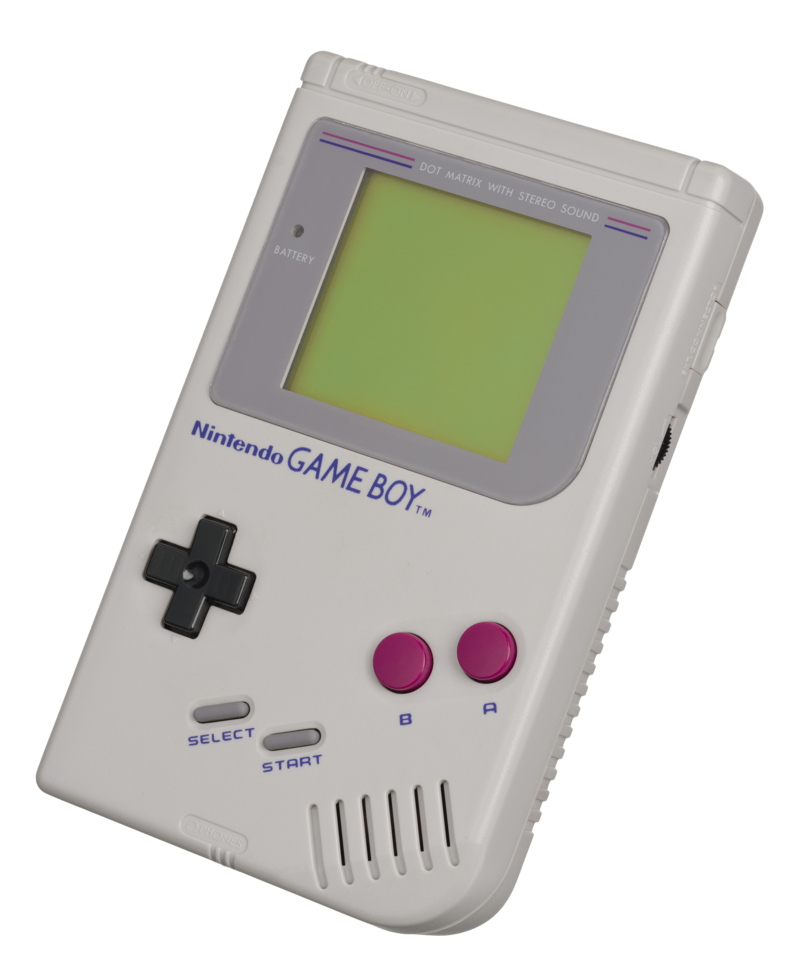
Game Boy
1989 portable video game console

PlayStation Vita
portable game console developed by Sony Computer Entertainment

Game Boy Advance
handheld game console by Nintendo

Nintendo 3DS
portable 3D dual-screen handheld by Nintendo

Game Boy Color
handheld Nintendo video game console introduced in 1998
Nintendo Switch 2
video game console developed by Nintendo
handheld game console
lightweight, portable electronic device used for gaming
Game Boy Advance SP
handheld video game console

N-Gage
The N-Gage is a mobile device combining features of a cellular phone and a handheld game system developed by Nokia, released on 7 October 2003. Officially nicknamed the game deck, the N-Gage's phone works on the GSM cellular network, and software-wise runs on the Series 60 platform on top of Symbian OS v6.1.
Atari Lynx
handheld game console developed by Atari Corporation and Epyx
Nintendo 2DS
handheld game console by Nintendo
Sega Nomad
handheld game console by Sega

WonderSwan
The is a handheld game console released in Japan by Bandai. Developed in collaboration with Gunpei Yokoi's company Koto Laboratory, it was the final piece of hardware Yokoi worked on before his death in 1997. Launched in Japan in March 1999 during the sixth generation of video game consoles, the WonderSwan was followed by two upgraded models, the WonderSwan Color and SwanCrystal, before Bandai discontinued the line in 2003. Throughout its lifespan, no version of the WonderSwan was officially released outside Japan.
Pokémon Mini
handheld game console
.png)
Gizmondo
The Gizmondo is a handheld gaming console developed by Gizmondo Europe. Its development was led by Swedish entrepreneur Carl Freer, who served as chairman of its parent company, Tiger Telematics. The device was originally launched on 19 March 2005 in Britain; although releases in other European territories were planned for 19 May, this never occurred, and it instead only received a limited release in Sweden. It also had a limited release in the United States in October 2005. The Gizmondo was produced and marketed until 2006 when Gizmondo Europe was liquidated.
%20-%20Gameplay%20screenshot.svg)
Microvision
The Microvision (aka Milton Bradley Microvision or MB Microvision) is the first handheld game console that used interchangeable cartridges and in that sense is reprogrammable. It was released by the Milton Bradley Company in November 1979 for a retail price of $49.99, equivalent to $221.00 in 2025.
New Nintendo 3DS
handheld game console developed by Nintendo
Neo Geo Pocket Color
handheld console
Entex Adventure Vision
tabletop game console

GP32
The GP32 (GamePark 32) is a ARM-based handheld game console developed by the South Korean company Game Park. It was released on November 23, 2001, in South Korea and distributed in some parts of Europe.
Watara Supervision
handheld game console

Game.com
The Game.com is a fifth-generation handheld game console developed and released by Tiger Electronics on September 12, 1997. Designed as a multimedia device for older audiences, it aimed to combine gaming with early digital functions such as touchscreen input and limited Internet connectivity. The original model features a monochrome touchscreen, dual cartridge slots, and could be connected to a 14.4 kbit/s modem for access to e-mail and basic web functions via a proprietary interface. Its name is a reference to the .com top-level domain, reflecting its Internet-related features. It was th
Tapwave Zodiac
mobile entertainment console released in 2003

Dingoo A320
The Dingoo () is a handheld gaming console that supports music and video playback and open game development. The system features an on-board radio and recording program. It was sold to consumers in three colors: white, black, and pink. It was released in February 2009 and had sold over 1 million units.

VMU
The Visual Memory Unit (VMU), also referred to as the (VMS) in Japan, is the primary memory card produced by Sega for the Dreamcast home video game console. The device features a monochrome liquid crystal display (LCD), multiplayer gaming capability (via connectors at the top), second screen functionality, a real-time clock, file manager, built-in flash memory, and sound capability. Prior to the launch of the Dreamcast, a special Godzilla edition VMU, preloaded with a virtual pet game, was released on July 30, 1998, in Japan.
New Nintendo 2DS XL
handheld video game console

TurboExpress
The TurboExpress is an 8-bit handheld game console by NEC Home Electronics, released in late 1990 in Japan and the United States, branded as the PC Engine GT in Japan and TurboExpress Handheld Entertainment System in the U.S. It is essentially a portable version of the TurboGrafx-16 home console that came out one to three years earlier. Its launch price in Japan was ¥44,800 and in the U.S.
list of best-selling game consoles
Wikimedia list article
Playdate
handheld game console developed by Panic
Barcode Battler
handheld game console released by Epoch Co. in 1991

ODROID
The ODROID is a series of single-board computers and tablet computers created by Hardkernel Co., Ltd., located in South Korea. Even though the name ODROID is a portmanteau of open + Android, many ODROID systems are capable of running not only Android, but also regular Linux distributions, with the H Series featuring Intel Core Series Processors being able to run Windows.
WowCube
handheld electronic game console developed by Cubios Inc.
Epoch Game Pocket Computer
handheld game console by Epoch Co.
Entex Select-A-Game
handheld game system

R-Zone
The R-Zone is a portable game console (originally head-worn, later handheld) developed and manufactured by Tiger Electronics. The R-Zone was shown at the American International Toy Fair in February 1995, and was released later that year. The R-Zone was panned by critics, and was also a commercial disaster, with its lifespan lasting only two years before being discontinued in 1997. Although the R-Zone was not designed to compete directly with any other handhelds, it marked Tiger Electronics' first multi-game entry into the portable electronic game market.
Mega Duck
handheld game console

Gamate
The Gamate, known as (pinyin: chāojí xiǎozi, literally "Super Boy") in Taiwan and (pinyin: chāojí shéntóng, literally "Super Child Prodigy") in China, is a handheld game console manufactured by Bit Corporation in the early 1990s, and released in Australia, some parts of Europe, Asia (Taiwan and China), Argentina, and the United States.
Neo-Geo X
video game console

XGP
The XGP (Extreme Game Player) was a concept portable video game system created by the Korean company GamePark as the follow-up to its GP32 handheld. Initially announced in 2005, the XGP was finally announced in March 2006 along with the release of the similar XGP Mini and the XGP Kids. The company went bankrupt before releasing any of the models.
GameKing
GameKing is a brand of handheld game consoles, designed and developed by Timetop and manufactured by Guangzhou Panyu Gaoming Electronics Co., Ltd., (also known as GZ Daidaixing Electronics Tech Co., Ltd.) in 2003, for the Hong Kong consumer market. The brand has three consoles, the GameKing I, the GameKing II and the GameKing III. A fourth console, the Handy Game, was produced by Timetop and shares some branding, but otherwise has little to do with the GameKing franchise.
ROG Xbox Ally
handheld gaming computer developed by Asus in collaboration with Microsoft
Cybiko
The Cybiko is a line of personal digital assistants and handheld game consoles first released by Cybiko Inc. in 2000. Cybiko Inc. was a startup company founded by David Yang; the eponymous PDA was first test marketed in New York in April 2000 and rolled out nationwide in May 2000. It was designed for teens, featuring its own two-way radio text messaging system. It has over 430 "official" freeware games and applications. It features a rubber QWERTY keyboard. An MP3 player add-on with a SmartMedia card slot was made for the unit as well. Cybikos can communicate with each other up to a maximum ra
Palmtex Portable Videogame System
handheld video game console
Arduboy
The Arduboy is a handheld game console with open source software, based on the Arduino hardware platform.
list of handheld game consoles
Wikimedia list article
Mi2
handheld game console
Analogue Pocket
handheld game fpga console developed by Analogue, Inc.
Children's Discovery System
educational handheld game console
Evercade
The Evercade is a handheld game console developed and manufactured by British company Blaze Entertainment. It focuses on retrogaming with ROM cartridges that each contain a number of emulated games. The Evercade was released on 22 May 2020, and upon its launch, it offered 10 game cartridges with a combined total of 122 games.
Pocket Dream Console
handheld game console
Coleco Sonic
handheld game console released by Coleco
Design Master Senshi Mangajukuu
handheld video game console
Romtec Colorvision
handheld game console
Panasonic Jungle
portable video game console
MoMA Eve
never released video game console
Pelican VG Pocket
dedicated handheld game console series
Leapster
The Leapster Learning Game System, formerly known as the Leapster Multimedia Learning System, is an educational handheld game console manufactured and sold by LeapFrog Enterprises, aimed at children ages 4 to 10 (preschool to fifth grade). Its games teach the alphabet, phonics, basic math (addition, subtraction, multiplication, division), and art and animal facts to players. Along with a directional pad, the system features a touchscreen with a stylus pen that enables young users to interact directly with the screen.