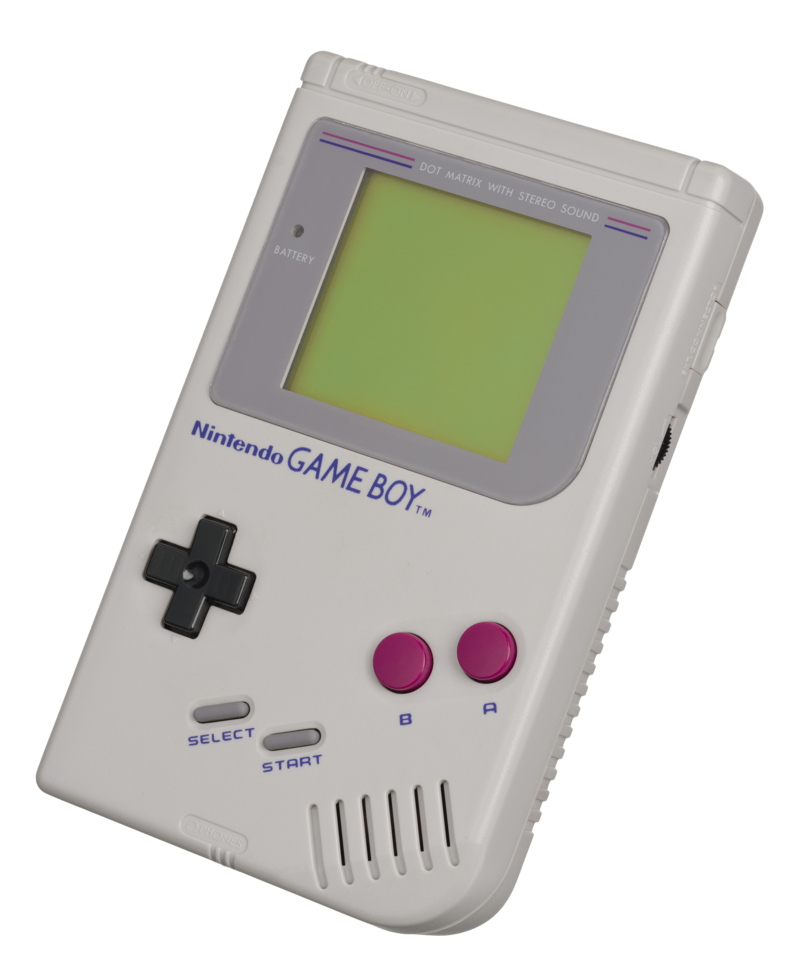
File:Game-Boy-FL.png · Wikimedia Commons · See Wikimedia Commons
Game Boy
Sign in to saveAlso known as Nintendo Game Boy, Gameboy, Nintendo Gameboy, GB, Nintendo GB, Game Boy Classic, GB Classic, 1989 Game Boy
1989 portable video game console
The Game Boy is a portable video game console that was released in 1989, allowing people to play video games on the go rather than being tied to a home television. It became an important device in gaming history because it brought gaming into a portable, accessible format that millions of people adopted.
AI-generated from the Wikipedia summary — may contain errors.
Wikidata facts
- Subclass of
- handheld game console
- Part of
- Game Boy family
- Series
- Game Boy family
- Followed by
- Game Boy Color
- Follows
- Game & Watch series
- Developer
- Nintendo Research & Development 1
- Manufacturer
- Nintendo
- Official website
- gameboy.com
- Image
- Game-Boy-FL.jpg
Show 11 more facts
- Commons category
- Game Boy
- topic's main category
- Category:Game Boy
- publication date
- 1990-09-28
- price
- 89.95
- discontinuation date
- 2003-03-23
- clock frequency
- 2.19
- different from
- Game Boy Color
- title
- Gēmubōi
- source of energy
- AA battery
- units sold
- 118690000
- output device
- liquid-crystal display
Sources (12)
via Wikidata · CC0
~25 min read
Encyclopedic overview
The Game Boy is a handheld game console developed and marketed by Nintendo. It was released in Japan on April 21, 1989, in North America on July 31, 1989, and in Europe on September 28, 1990. Nintendo's first handheld to use ROM cartridges, it succeeded the Game & Watch line of handheld electronic games and competed with Sega's Game Gear, Atari's Lynx, and NEC's TurboExpress in the fourth generation of video game consoles.
Nintendo Research & Development 1, under Gunpei Yokoi and Satoru Okada, designed the Game Boy. To expand on the single-game Game & Watch, Nintendo adopted a dot-matrix display and interchangeable game cartridges. They prioritized affordability, battery life, and durability over the faster processors and color graphics of its competitors; following Yokoi's philosophy of using mature, low-cost technology, the Game Boy has a monochromatic display and an 8-bit processor. It retains the Game & Watch D-pad and the Game Link Cable, developed by Okada, which enables multiplayer connectivity and data transfer between consoles.
Excerpted from Wikipedia’s “Game Boy” article, available under the CC BY-SA 4.0 licence.
Gallery (8)
Available in 60 languages
- Español
- Français
- Deutsch
- 中文
- 日本語
- Русский
- Português
- Italiano
- العربية
- Aragonese
- Asturian
- Bahasa Indonesia
- Basque
- Belarusian
- Bosnian
- Catalan
- Central Kurdish
- Croatian
Show 41 more
- Czech
- Danish
- Egyptian Arabic
- Esperanto
- Estonian
- Finnish
- Galician
- Georgian
- Greek
- Hebrew
- Hungarian
- Icelandic
- Ido
- Kazakh
- Kurdish
- Lao
- Lithuanian
- Lombard
- Malay
- Nederlands
- Norwegian
- Norwegian Nynorsk
- Nyanja
- Polski
- Romanian
- Serbian
- Serbian (Latin)
- simple
- Slovak
- Slovenian
- Svenska
- Tiếng Việt
- Türkçe
- Ukrainian
- Wu Chinese
- Yiddish
- zh_min_nan
- zh_yue
- فارسی
- ไทย
- 한국어
via Wikidata sitelinks · CC0