Category
page 1Heraldic charges

rainbow
thumb|upright=1.35|Double rainbow and supernumerary rainbows on the inside of the primary arc. The shadow of the photographer's head at the bottom of the photograph marks the centre of the rainbow circle (the antisolar point).

angel
thumb|Statue of the angel of the Annunciation, , [[Metropolitan Museum of Art]]
thumb|right|Schutzengel ("Guardian angel") by Bernhard Plockhorst depicts a [[guardian angel watching over two children.]]
thumb|right|The Michael (archangel)|Archangel Michael.
An angel is a spiritual heavenly, or supernatural entity, usually humanoid with bird-like wings, often depicted as a messenger or intermediary between God (the transcendent) and humanity (the profane) in various traditions like the Abrahamic religions. Other roles include protectors and guides for humans, such as guardian angels and servant

pomegranate
The pomegranate (Punica granatum) is a fruit-bearing, deciduous shrub in the family Lythraceae, subfamily Punicoideae, that grows to between tall. Rich in symbolic and mythological associations in many cultures, it originated in the region spanning the Caucasus and Iranian plateau — including modern-day Iran,Turkmenistan, Afghanistan and Pakistan. Pomegranate was first domesticated by ancient Iranians in the Persian plateau and nearby regions about 5,000 years ago. It is extensively cultivated for its fruit.
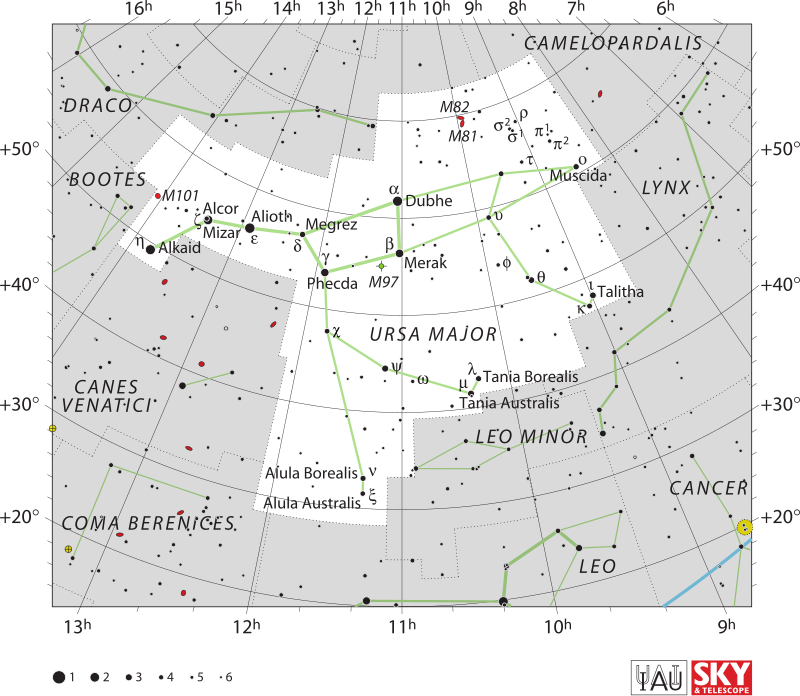
Ursa Major
constellation visible throughout the year in most of the northern hemisphere

lighthouse
thumb|300px|Barnegat Lighthouse at the coast of [[Ocean County, New Jersey, U.S., facing the Atlantic Ocean at sunrise]]
thumbnail|Aerial drone footage of the Roman Rock Lighthouse off the southern coast of South Africa.
.jpg)
sickle
thumb|240px|One of 12 roundels depicting the "Labours of the Months" (1450–1475)
A sickle, bagging hook, reaping-hook or grasshook is a single-handed agricultural tool designed with variously curved blades and typically used for harvesting or reaping grain crops, or cutting succulent forage chiefly for feeding livestock. Falx was a synonym, but was later used to mean any of a number of tools that had a curved blade that was sharp on the inside edge.

scythe
thumb|right|Typical stance; the pouch at belt contains a Sharpening stone|whetstone.
[[File:Scythe.svg|thumb|right|Parts of a scythe:

Crux
Crux ( ) is a constellation of the southern sky that is centred on four bright stars in a cross-shaped asterism commonly known as the Southern Cross. It lies on the southern end of the Milky Way's visible band. The name Crux is Latin for cross. Though it is the smallest of all 88 modern constellations, Crux is among the most easily distinguished, as each of its four main stars has an apparent visual magnitude brighter than +2.8. It has attained a high level of cultural significance in many Southern Hemisphere states and nations.

anvil
thumb|upright=1.35|Single-horn anvil
thumb|A blacksmith working [[iron with a hammer and anvil]]
thumb|A blacksmith working with a [[sledgehammer, assistant (striker) and Lokomo anvil in Finland]]

rake
agricultural tool used for moving soil or other material

anchor
thumb|Stockless anchor|Stockless ship's anchor and chain on display
thumb|Anchor of Amoco Cadiz in [[Portsall, north-west Brittany, France]]
thumb|Memorial anchor in Kirjurinluoto, [[Pori, Finland]]
thumb|Massive anchor chain for large ships. The weight of the chain is vital for proper holding of the anchor.

Star of David
Jewish national, cultural and religious symbol

acorn
thumb|English oak acorn
thumb|Acorns of the willow oak in South Carolina (from small to large, counterclockwise from center): Q. phellos (willow oak), Q. falcata (southern red oak; top right), Q. alba (white oak), and Q. coccinea (scarlet oak). Scale bar at upper right is 1 cm.

horseshoe
thumb|Horseshoes are commonly made of steel, and are nailed to the underside of the hoof.
thumb|A variety of horseshoes, including aluminum racing plates (light or dark); there is also a variety of ox#Shoeing|oxshoes at the lower right

hammer and sickle
symbol of communism

crossbow
thumb|A typical crossbow|upright=1.3
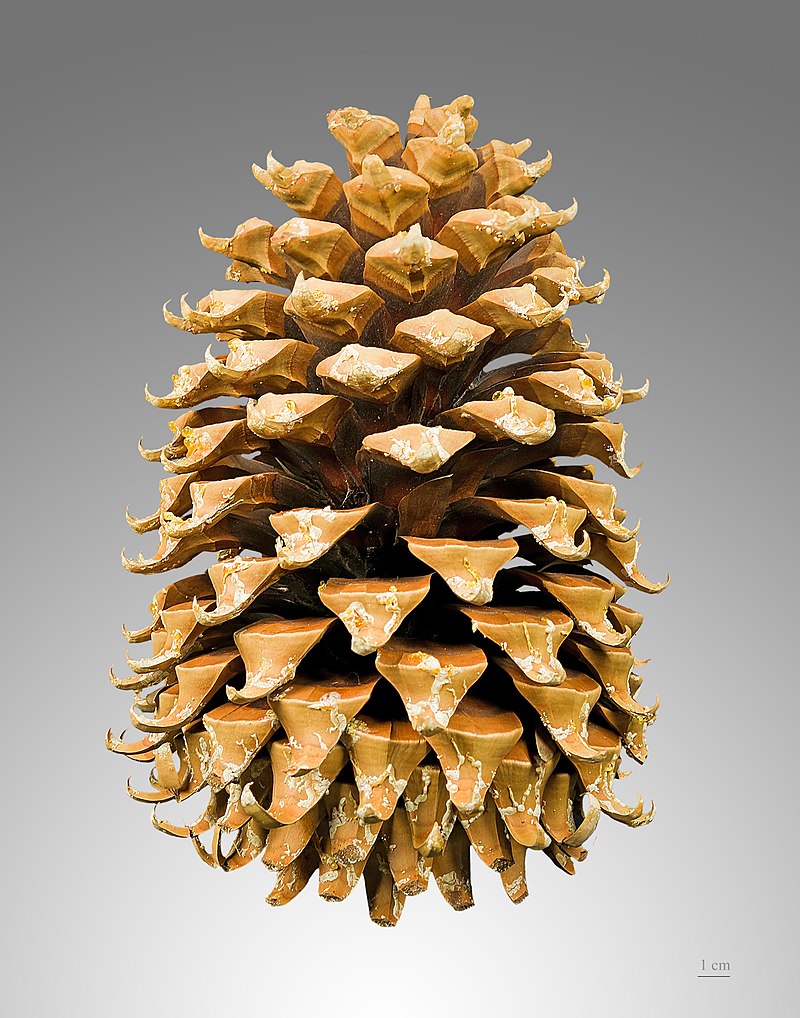
cone
seed-bearing organ on gymnosperm plants

stele
thumb|260px|Stele N from Copán, [[Honduras, depicting King K'ac Yipyaj Chan K'awiil ("Smoke Shell"), as drawn by Frederick Catherwood in 1839]]
thumb|Stele to the French 8th Infantry Regiment. Commons:Category:Battle of Waterloo steles|One of more than half a dozen steles located on the Waterloo battlefield.
A stele ( ) or stela ( ) is a stone or wooden slab, generally taller than it is wide, erected in the ancient world as a monument. The surface of the stele often has text, ornamentation, or both. These may be inscribed, carved in relief, or painted.

musket
thumb|right|Muskets and bayonets aboard the [[frigate Grand Turk]]

Fortuna
Fortuna (), sometimes anglicized as Fortune, is the goddess of luck or fortune in Roman religion. She came to represent life's capriciousness, and was a goddess of fate. In antiquity she was also known by the epithet Automatia (; , "she who does what she will"). Her Greek equivalent is Tyche.

cherub
thumb|A tetramorph cherub, in [[Eastern Orthodox iconography]]
A cherub (; : cherubim; kərūḇ, pl. kərūḇīm) is one type of supernatural being in the Abrahamic religions. The numerous depictions of cherubim assign to them many different roles, such as protecting the entrance of the Garden of Eden.

trident
thumb|300px|Trident of Poseidon

triskelion
thumb|Neolithic triple-spiral symbol

cornucopia
thumb|upright|Cornucopia of a Roman statue of Livia as [[Fortuna, 42-52 AD, marble, Altes Museum, Berlin ]]
thumb|Cornucopia, part of a Roman statue, Archaeological Museum A. Salinas, Palermo, Sicily, Italy
In classical antiquity, the cornucopia (; ), also called the horn of plenty, is a symbol of abundance and nourishment, commonly a large horn-shaped container overflowing with produce, flowers, or nuts. In Greek, it was called the horn of Amalthea (), after Amalthea, a nurse of Zeus, who is often part of stories of the horn's origin.

Rod of Asclepius
symbolic rod from Greek mythology

caduceus
thumb|upright|Modern depiction of the caduceus as the symbol of logistics
thumb|upright| carrying a winged caduceus upright in his left hand. A Roman copy after a Greek original of the 5th century BCE (Museo Pio-Clementino, [[Rome)]]

millstone
upright|thumb|The basic anatomy of a millstone. This is a runner stone; a bedstone would not have the "Spanish Cross" into which the supporting millrind fits.

fasces
thumb|upright=0.4|A fasces image, with the axe in the middle of the bundle of rods
A fasces ( ; ; a , from the Latin word , meaning 'bundle'; ) is a bound bundle of wooden rods, often, but not always, including an axe (occasionally two axes) with its blade emerging. The fasces is an Italian symbol that had its origin in the Etruscan civilization and was passed on to ancient Rome, where it symbolized a Roman king's power to punish his subjects, and later, a magistrate's power and jurisdiction. The axe has its own separate and older origin. Initially associated with the labrys (; ), the double-b

red star
symbol often historically associated with communist ideology and more recently with socialism

crescent
A crescent shape (, ) is a symbol or emblem used to represent the lunar phase (as it appears in the northern hemisphere) in the first quarter (the "sickle moon"), or by extension a symbol representing the Moon itself.

sceptre
thumb|upright|Relief carving of Darius the Great of [[Persia on his throne, holding a sceptre and lotus]]
A sceptre (spelled scepter in American English) is a staff or wand held in the hand by a ruling monarch as an item of royal or imperial insignia, signifying sovereign authority.

Lady Justice
deity

Alpha and Omega
Christian symbol, first and last letters of the Greek alphabet

crosier
thumb|A crozier on the coat of arms of Basel, Switzerland which was ruled by [[Prince-Bishops during the Middle Ages]]

fleur-de-lis
thumb|Fleur-de-lis
thumb|Arms of the Kings of France blazoned Azure, three fleurs-de-lis or
The fleur-de-lis, also spelled fleur-de-lys (plural fleurs-de-lis or fleurs-de-lys), is a common heraldic charge in the (stylized) shape of a lily (in French, and mean and respectively). Most notably, the fleur-de-lis is depicted on multiple flags of Quebec and on the traditional coat of arms of France that was used from the High Middle Ages until the French Revolution in 1792, and then again in brief periods in the 19th century. This design still represents France and the House of Bourbon in the form o
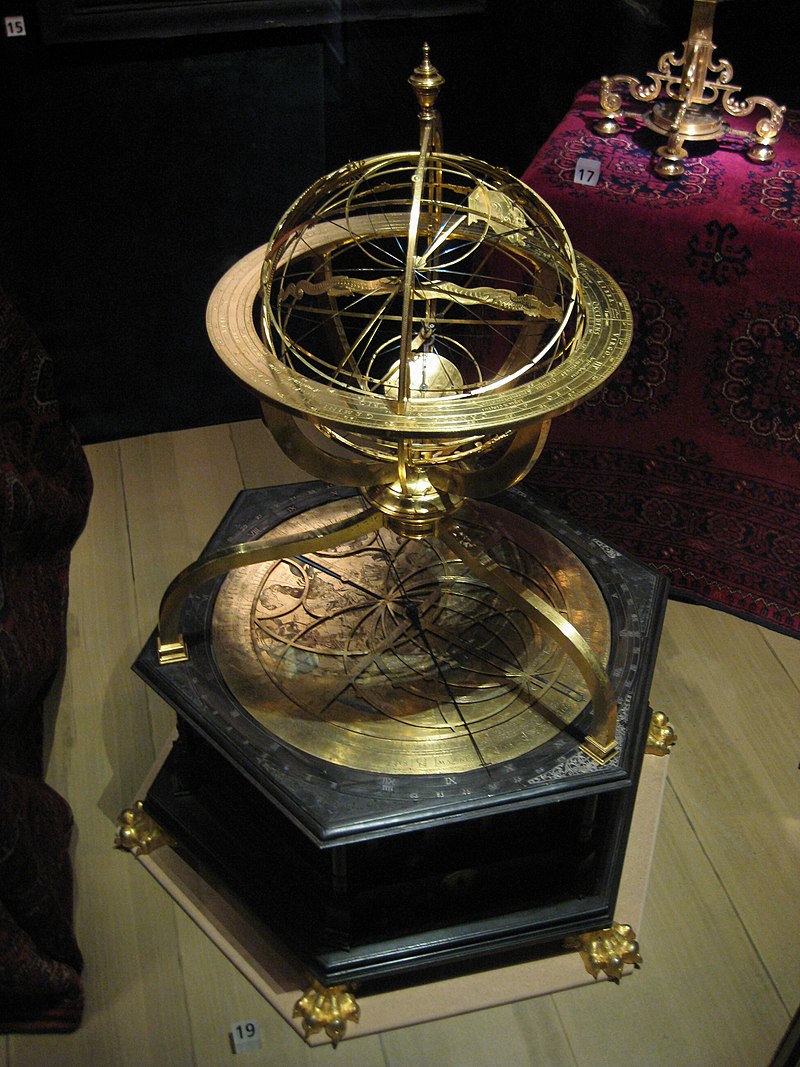
armillary sphere
model of objects in the sky

thistle
thumb|Musk thistle, C. Nutans in the Carpathian Mountains
thumb|Milk thistle flowerhead
thumb|Cirsium arizonicum, showing arachnoid cobwebbiness on stems and leaves, with ants attending aphids that might be taking advantage of the shelter.

Eye of Providence
symbol of the all-seeing eye (usually shown surrounded by rays of glory and/or in a triangle)

astronomical symbol
abstract pictorial symbols used to represent astronomical objects, theoretical constructs and observational events in European astronomy

bow and arrow
ranged weapon system consisting of an elastic launching device and long-shafted projectiles

Zulfiqar
Zulfiqar or Zulfaqar (, ), also spelled Zu al-Faqar, Zulfakar, Dhu al-Faqar, or Dhulfaqar) is the sword of Ali ibn Abi Talib that was distinguished by having a double blade.
heart
symbol representing the heart
star and crescent
symbol
sheaf
bundle of grain
.jpg)
spur
thumb|320x320px|Pair of steel spurs from the Auckland War Memorial Museum Collection
shuttle
tool designed to neatly and compactly store a holder that carries the thread of the weft yarn while weaving with a loom
orb
globular object sometimes topped with a cross; Christian symbol of authority

trishula
thumb|Statue of Shiva holding a trishula.
The trishula () is a trident, a divine symbol, commonly used as one of the principal symbols in Hinduism. It is most commonly associated with the deity Shiva and widely employed in his iconography.
Vergina Sun
rayed solar symbol

Pectinidae
Scallop () is a common name that encompasses various species of marine bivalve molluscs in the taxonomic family Pectinidae, the scallops. However, this common name is also sometimes applied to species in other closely related families within the superfamily Pectinoidea, which also includes the thorny oysters.

tamga
thumb|Tamgha of the Bayundur, which represents a [[falcon according to Mahmud al-Kashgari]]
A tamga, or tamgha (from ), was an abstract seal or brand used by Eurasian nomads and cultures influenced by them, initially as a livestock branding. The tamga was used as a livestock branding for a particular tribe, clan or family. They were common among the Eurasian nomads throughout Classical Antiquity and the Middle Ages. As clan and family identifiers, the collection and systematic comparison of tamgas is regarded to provide insights into relations between families, individuals and ethnic groups in

portcullis
thumb|Portcullis at Desmond Castle, Adare, [[County Limerick, Ireland]]
thumb|The inner portcullis of the Torre dell'Elefante in [[Cagliari, Sardinia, Italy]]
Sun of May
national emblem of Argentina and Uruguay

plowshare
thumb|upright=1.2|Components of a simple drawn plow:
thumb|right|Instrument for cleaning a plowshare used at a mill near Horažďovice, [[Czech Republic]]
In agriculture, a plowshare (US) or ploughshare (UK; ) is a component of a plow (or plough). It is the cutting or leading edge, preceding the moldboard, and it closely follows the coulter (one or more ground-breaking spikes) when plowing.
Luther rose
widely recognized symbol for Lutheranism

Senyera
The Senyera is a vexillological symbol often called "the four bars", much older than the Crown of Aragon.
Venus symbol
planetary, alchemical and gender symbol
torse
In heraldry, a torse or wreath is a twisted roll of fabric laid about the top of the helmet and the base of the crest. It has the dual purpose of masking the join between helm and crest, and of holding the mantling in place.
Mars symbol
planetary, alchemical and gender symbol
Welsh Dragon
national symbol of Wales