Category
page 1Islamic architectural elements

minaret
thumb|Minaret at the Umayyad Mosque in [[Damascus]]

Qibla
thumb|Muslims surrounding and facing the [[Kaaba for prayer]]
The qibla () is the direction towards the Kaaba in the Sacred Mosque in Mecca, which is used by Muslims in various religious contexts, particularly the direction of prayer for the salah. According to Islamic tradition, the Kaaba is believed to be a sacred site built by prophets Abraham and Ishmael, and that its use as the qibla was ordained by God in several verses of the Quran revealed to Muhammad in the second Hijri year. Prior to this revelation, Muhammad and his followers in Medina faced Jerusalem for prayers. Most mosques conta

harem
thumb|upright=1.2|Ladies of Caubul|Kabul (1848 lithograph, by James Rattray) showing unveiling in [[zenana areas.]]

mihrab
thumb|Mihrab in the Prophet's Mosque, Medina
Mihrab (, ', pl. ') is a niche in the wall of a mosque that indicates the qibla, the direction of the Kaaba in Mecca towards which Muslims should face when praying. The wall in which a mihrab appears is thus the "qibla wall".
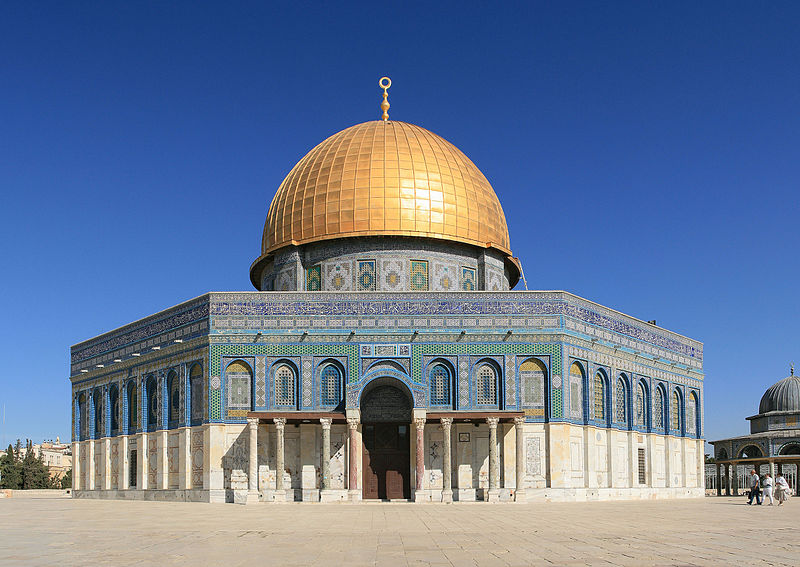
Islamic architecture
architectural style

minbar
thumb|Ottoman Empire|Ottoman-era minbar of the [[Molla Çelebi Mosque in Istanbul.]]A minbar (; sometimes romanized as mimber) is a pulpit in a mosque where the imam (leader of prayers) stands to deliver sermons (, khutbah). It is also used in other similar contexts, such as in a Husayniyya, where the speaker sits and lectures the congregation.

arabesque
thumb|340px|Stone relief with arabesques of tendrils, palmettes and half-palmettes in the [[Umayyad Mosque, Damascus, Syria]]
thumb|Part of a 15th-century ceramic panel from Samarkand ([[Uzbekistan) with white calligraphy on a blue arabesque background]]The arabesque is a form of artistic decoration consisting of "surface decorations based on rhythmic linear patterns of scrolling and interlacing foliage, tendrils" or plain lines, often combined with other elements. Another definition is "Foliate ornament, used in the Islamic world, typically using leaves, derived from stylised half-palmettes,
.jpg)
iwan
thumb|330px|Multiple iwans and tiled domes of the 16th-century Persian-style Po-i-Kalyan#Mir-i Arab Madrassah|Mir-i-Arab madrasa, [[Bukhara, Uzbekistan]]
An iwan (, also ivan or ivān/īvān; ) is a rectangular hall or space, usually vaulted, walled on three sides, with one end entirely open. The formal gateway to the iwan is called '''''', a Persian term for a portal projecting from the facade of a building, usually decorated with calligraphy bands, glazed tilework, and geometric designs. Since the definition allows for some interpretation, the overall forms and characteristics can vary greatly

windcatcher
thumb |An ab anbar (water reservoir) with windcatchers (openings near the top of the towers) in the central desert city of [[Yazd, Iran]]
thumb |Aghazadeh Mansion in Abarkooh, [[Iran, has an elaborate 18-m windtower with two levels of openings, plus some smaller windtowers.]]
.jpg)
muqarnas
thumb|upright=1.3|Muqarnas as seen from below in the iwan entrance to the Shah Mosque in [[Isfahan, Iran (17th century)]]
thumb|upright=1.3|Muqarnas dome in the Sala de Dos Hermanas at the Alhambra in [[Granada, Spain (14th century)]]
Muqarnas (), also known in Iberian architecture as Mocárabe (from ), is a form of three-dimensional decoration in Islamic architecture in which rows or tiers of niche-like elements are projected over others below. It is an archetypal form of Islamic architecture, integral to the vernacular of Islamic buildings, and typically featured in domes and vaults, as well
Islamic calligraphy
artistic practice of calligraphy in the Islamic world

squinch
thumb|250px|Squinches supporting a dome in Odzun Basilica, Armenia, early 8th century

hypostyle
thumb|Central columns of the Great Hypostyle Hall in the [[Temple of Karnak, Egypt]]
.jpg)
kiswah
thumb|right|Kaaba in [[Makkah (Mecca)]]
thumb|right| as pictured on February 22, 2024.
.JPG)
musalla
thumb|Fatihova Musalla
thumb|Muslim prayer section (musalla) at Hong Kong International Airport

husayniyya
{|class="wikitable" align="right"
|-
! colspan="2" align="center" bgcolor="#CCCCCC" | Husayniyya
|-
| colspan="2" align="center" | 250px A husayniyya in Dar es Salaam, Tanzania
|-
| colspan="1" align="left" | Arabic
| colspan="1" align="right" | (ḥusayniyya) (maʾtam)
|-
| colspan="1" align="left" | Azerbaijani
| colspan="1" align="right" |
|-
| colspan="1" align="left" | Hindi
| colspan="1" align="right" | (imāmbāṛā)
(āshurkhānā)
|-
| colspan="1" align="left" | Bengali
| colspan="1" align="right" | (imāmbāṛā)
|-
| colspan="1" align="left" | Iranian Persian
| colspan="1" align="right" |

chhatri
thumb|270px|Chhatris up close at Bada Bagh, [[Rajasthan]]

voussoir
thumb|William Henry Playfair, [[University of Edinburgh: bevelled edges of each stone block emphasise the voussoirs, which have a curved base and together form a semi-circle at the top of each arch.]]
A voussoir (UK: ; US: ) is a wedge-shaped element, typically a stone, which is used in building an arch or vault.
thumb|Joggled voussoir arch, located at the Mausoleum of Theodoric in [[Ravenna, Italy. (520 CE)]]
Each voussoir is formed in a specific way to fit within the arch or vault created. Normally, different colored stones are shaped to fit together in a curved way that relies on the balanc
reflecting pool
water feature found in gardens, parks, and at memorial sites, consists of a shallow pool of water, undisturbed by fountain jets, for a reflective surface
Mughal gardens
gardens built by Mughals

Mashrabiya
thumb|300px|A mashrabiya in Tunisia

shadirvan
thumb|A şadırvan for ritual ablutions in front of Hagia Sophia, Istanbul, Turkey
thumb|Shadırvan in Po-i-Kalyan, Bukhara, Uzbekistan

zellij
thumb|A wall covered in zellīj at the Ben Youssef Madrasa in Marrakesh
Zellij (), also spelled zillij or zellige, is a style of mosaic tilework made from individually hand-chiseled tile pieces. The pieces were typically of different colours and fitted together to form various patterns on the basis of tessellations, most notably elaborate Islamic geometric motifs such as radiating star patterns composed of various polygons. This form of Islamic art is one of the main characteristics of architecture in the western Islamic world. It is found in the architecture of Morocco, the architecture of Alg
horseshoe arch
emblematic arch common in Moorish architecture

jali
thumb|Jali at Taranga Jain temple|Ajitnath Jain Temple, 11th-century [[Gujarat]]
thumb|A jali is typically open, but this example of a 17th-century jali from the last Mughal period was owned by a wealthy merchant and probably placed with the external portal. Basically, the impression is friendly and inviting as the inside of the palace, but secure to outside world. The iris (plant)|iris pattern at the top is a departure from the earlier geometry and indicates a Persian influence.

maqsurah
thumb|The wooden maqsura in the Great Mosque of Kairouan ([[Tunisia) |alt=]]
Maqsurah (, literally "closed-off space") is an enclosure, box, or wooden screen near the mihrab or the center of the qibla wall in a mosque. It was typically reserved for a Muslim ruler and his entourage, and was originally designed to shield him from potential assassins during prayer. The imam officiating inside the maqsurah typically belonged to the same school of law to which the ruler belonged.

Zenana
thumb|Ladies of the zenana on a roof terrace by Ruknuddin. Bikaner, 1675

külliye
thumb|right|400px|Süleymaniye Mosque and Külliye in [[Istanbul]]

sahn
thumb|right|260px|Large sahn of the Great Mosque of Kairouan, surrounded by riwaq (arcades), in [[Tunisia.]]
sebil
fountain and or water kiosk
howz
In traditional Persian architecture, a howz () is a centrally positioned symmetrical axis pool. If in a traditional house or private courtyard, it is used for bathing, aesthetics or both. If in a sahn of a mosque, it is used for performing ablutions. A howz is usually around deep. It may be used as a "theatre" for people to sit on all sides of the pool while others entertain.

Eidgah
thumb|250px|right|Dhanmondi Shahi Eidgah [[Dhaka, Bangladesh]]
thumb|250px|Sholakia Eidgah, Kishoreganj, the largest Eidgah in terms of congregation in Bangladesh
250px|right|thumb|Shahi Eid Gah Mosque, [[Multan, Pakistan]]
Moroccan riad
traditional Moroccan house or palace with an interior garden or courtyard
Islamic geometric pattern
geometric pattern characteristic of Muslim art

charbagh
thumb|The charbagh at the Tomb of Jahangir in [[Lahore, Pakistan]]
Islamic garden
expressive estate of land that includes themes of water and shade

tadelakt
thumb|A tadelakt-covered wall

rill
thumb|right|A downslope view of part of the erosion|eroding rill network from [[County Tyrone, Northern Ireland. See below for a close-up view of a single rill]]
In hillslope geomorphology, a rill is a shallow channel (no more than a few inches/centimeters deep) cut into soil by the erosive action of flowing surface water. Similar but smaller incised channels are known as microrills; larger incised channels are known as gullies.

ablaq
thumb|Reception hall of Azm Palace|Azem Palace in [[Damascus, Syria, using ablaq technique (18th century)]]Ablaq (; particolored; literally 'piebald') is an architectural technique involving alternating or fluctuating rows of light and dark stone. It is an Arabic term describing a technique associated with Islamic architecture in the Arab world. The technique is used primarily for decorative effect. It may have its origins in earlier Byzantine architecture in the region, where alternating layers of white stone and orange brick were used in construction. Its use began early in the history of Is

Girih
thumb|upright=1.2|Girih pattern with inlaid floral decoration from :en:Shah-i-Zinda|Shah-i-Zinda in [[Samarkand, Uzbekistan]]
four-centred arch
type of arch with a pointed apex

shabestan
thumb|right|Shabestan of the Jameh Mosque of Tabriz; as Tabriz does not have a hot climate, the Shabestan here was not built underground.
A shabestan or shabistan (; is an underground space that can be usually found in traditional architecture of mosques, houses, and schools in ancient Iran.
Girih tiles
five tiles used in Islamic decorative art

bedug
thumb|Model of a Sundanese people|Sundanese [[mosque with bedug hung horizontally at lower right, front part of the building. To its left a slit drum is hung vertically.]]
The bedug is one of the drums used in the gamelan. It is also played in mosques in Indonesia and Malaysia to signal prayer times. The hitting of the instrument is particularly done according to a rhythm that goes in an increasingly rapid (or accelerando) pace.

Semi-dome
thumb|257x257px|Typical Early Christian/Byzantine apse with a hemispherical semi-dome decorated in [[mosaic (Basilica di Sant'Apollinare in Classe in Ravenna)]]
In architecture, a semi-dome (or half-dome) is a half dome that covers a semi-circular area in a building.

Alfiz
The alfiz (, from Andalusi Arabic alḥíz, from Standard Arabic alḥáyyiz, meaning 'the container';) is an architectural adornment, consisting of a moulding, usually a rectangular panel, which encloses the outward side of an arch. It is an architectonic ornament of Etruscan origin, used in Visigothic, Asturian, Moorish, Mozarabic, Mudéjar and Isabelline Gothic architecture.
chahartaq
structure in medieval Iranian architecture consisted of four barrel vaults and a dome

Dikka
thumb|The dikka in the Mosque-Madrasa of Sultan Hassan|Mosque of Sultan Hasan in [[Cairo]]
thumb|The müezzin mahfili in the Selimiye Mosque, Edirne|Selimiye Mosque of [[Edirne, Turkey]]
A dikka or dakka (), also known in Turkish as a müezzin mahfili, is a raised platform or tribune in a mosque from which the Quran is recited and where the muezzin chants or repeats in response to the imam's prayers. It is also used by the muezzin to chant the second call to prayer (iqama), which indicates to worshippers that the prayer is about to begin. On special occasions or evenings, such as during the mont
Islamic ornament
interlaced knotwork in Islamic art
Paradise garden
form of garden of Old Iranian origin

Jharokha
thumb|Jharokha balcony in Jodhpur (Mehrangarh) Jharokha
thumb|upright|A jharokha in Maheshwar Fort, Madhya Pradesh

Qubba
thumb|Qubbat al-Sulaibiyya in Samarra, Iraq, the oldest surviving Islamic domed mausoleum (9th century)
A qubba (, pl. qubāb), also transliterated as ḳubba, kubbet and koubba, is a cupola or domed structure, typically a tomb or shrine in Islamic architecture. In many regions, such as North Africa, the term qubba is applied commonly for the tomb of a local wali (local Muslim saint or marabout), and usually consists of a chamber covered by a dome or pyramidal cupola.

artesonado
thumb|180px|Artesonado in the Throne Room of the Aljafería in [[Zaragoza, Spain]]
thumb|180px|Artesonado in the Tlaxcala City Cathedral, Mexico
Artesonado or Spanish ceiling is a term for "a type of intricately joined wooden ceiling in which supplementary laths are interlaced into the rafters supporting the roof to form decorative geometric patterns", found in Spanish architecture. It is an example of Mudéjar style.
riwaq
islamic architectural feature
Liwan
thumb|right|350px|An architectural drawing of a typical Levantine house, with the liwan area in grey.
Liwan (, , from Persian ) is a long narrow-fronted hall or vaulted portal in ancient and modern Levantine homes that is often open to the outside. An Arabic loanword to English, it is ultimately derived from the Persian , which preceded by the article al ("the"), came to be said as in Arabic, and later, English.
Banna'i
thumb|right|Banna'i brickwork in the [[Mausoleum of Khoja Ahmed Yasavi. The blue brickwork spells out the names of Allah, Muhammad and Ali in square Kufic calligraphy.]]
In Iranian architecture, '''banna'i''' (, "builder's technique" in Persian) is an architectural decorative art in which glazed tiles are alternated with plain bricks to create geometric patterns over the surface of a wall or to spell out sacred names or pious phrases. This technique originated in Syria and Iraq in the 8th century, and matured in the Seljuq and Timurid era, as it spread to Iran, Anatolia and Central Asia.
Chhajja
thumb|The tomb of Salim Chishti in [[Fatehpur Sikri (India) exhibiting a deep chhajja following the perimeter of the building supported with elaborate brackets]]
A chhajja is an overhanging eave or roof covering found in Indian architecture. It is characterised with large support brackets with different artistic designs. Variation is also seen in its size depending on the importance of the building on which it features or the choice of the designer.
multifoil arch
architectural element
Kucheh
thumb|A Kucheh in Kashan. Photo was taken from entrance to [[Tabatabai House looking outside into the Kucheh.]]
In traditional Persian architecture, a kucheh or koocheh (), is a narrow especially designed alley. Remnants of it are still seen in modern Iran and regional countries.
Al-Qatt Al-Asiri Al Saudi
traditional art style from Saudi Arabia