Category
page 2Islamic terminology

aqidah
Aqidah (, , pl. , ) is an Islamic term of Arabic origin that means "creed". It is also called Islamic creed or Islamic theology.

Lex talionis
expression supporting proportional punishment; no more and no less

Muhajirun
The Muhajirun (, singular , ) were the converts to Islam and the Islamic prophet Muhammad's advisors and relatives, who emigrated from Mecca to Medina; the event is known in Islam as the Hijra. The early Muslims from Medina are called the Ansar ("helpers").
Inshallah
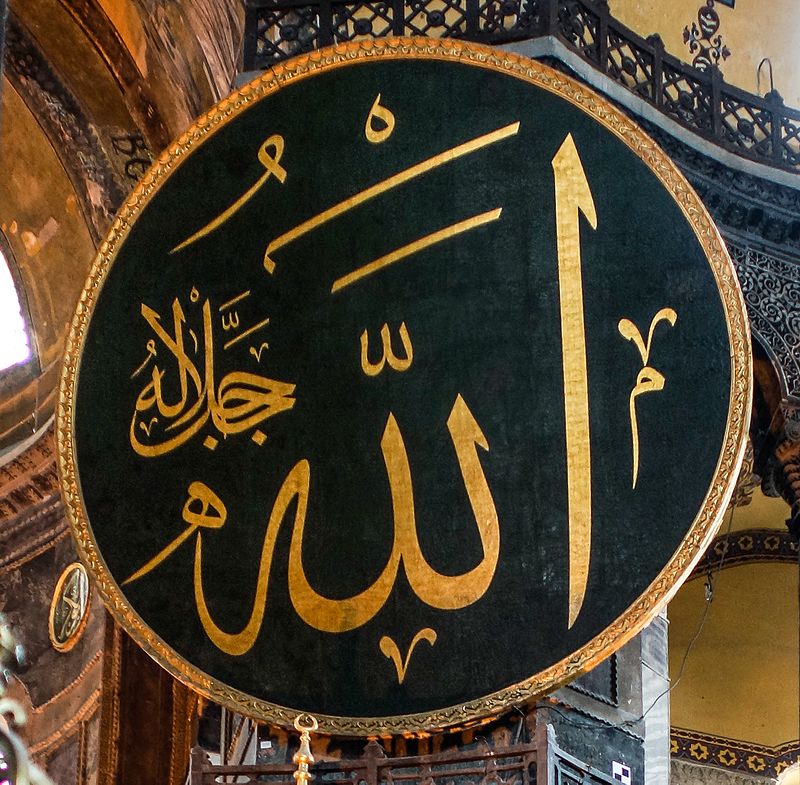
Inshallah, usually called the , is an Arabic-language expression meaning or . It is mentioned in the Quran, surah Al-Kahf (23-24), which requires its use when mentioning intended actions. It signifies that nothing, neither action nor thought, happens without God's permission.

Masih ad-Dajjal
Islamic eschatological figure
Day of Arafat
nineth day of the month of Dhu al-Hijja in Islamic calendar

tariqa
A tariqa () is a religious order of Sufism, or specifically a concept for the mystical teaching and spiritual practices of such an order with the aim of seeking , which translates as "ultimate truth".

Jahiliyyah
In Islamic salvation history, the Jāhiliyyah (Age of Ignorance) is an Arabic expression for an era of pre-Islamic Arabia as a whole or only of the Hejaz leading up to the lifetime of Muhammad.

Ansar
an Islamic term that literally means "helpers" and denotes the Medinan citizens that helped Muhammad and the Muhajirun on the arrival to the city after the migration to Medina

Quranism
Quranism () is an Islamic denomination that generally rejects the authoritative role of Hadiths, and considers the Qur'an to be the only dependable religious text. Quranist Muslims believe that the Qur'an is clear and complete and can be fully understood without recourse to external sources.

shahid
Shahid, also spelled shaheed, is an Islamic term of Arabic-origin meaning "martyr", used by Muslims for mujahideen who die while fighting in the way of Allah. The word is used frequently in the Quran in the generic sense of "witness" but only once in the sense of "martyr" (i.e. one who dies for his faith); the latter sense acquires wider usage in the hadith. The term is also used in some non-Muslim communities whose cultures were influenced by Islamic persianate empires, such as amongst Hindus and Sikhs in India.
Muhajir
Urdu speaking multi-ethnic group

qawwali
thumb|Qawwali at Ajmer Sharif Dargah
Qawwali is a form of Sufi Islamic devotional singing originating in South Asia. Originally performed at Sufi shrines throughout the Indian subcontinent, it is famous throughout Pakistan, India, Bangladesh and Afghanistan and has also gained mainstream popularity and an international audience as of the late 20th century.

Mid Sha'ban
'''Mid-Sha'ban' ( or laylat niṣf min šaʿbān'' "night on the half of Sha'ban") is a Muslim holiday observed by Shia and Sunni Muslim communities on the eve of 15th of Sha'ban (i.e., the night following the sunset on the 14th day) — the same night as Shab-e-barat or Laylat al-Bara’ah ().
Imamate
Religious and political leaders of Shia Islam
Sufi lodge
a building designed specifically for gatherings of a Sufi brotherhood

prophetic biography
thumb|upright=0.8|An early manuscript of Ibn Hisham's
Al-Sīra al-Nabawiyya (), commonly shortened to Sīrah and translated as prophetic biography, are the traditional biographies of the Islamic prophet Muhammad written by over centuries Muslim historians, from which, in addition to the Quran and Hadith literature, most historical information about his life and the early history of Islam is derived.
dawah
''''' (, , "invitation", also spelt , , , or ') is the act of proselytizing people to Islam. The plural is () or (). Preachers who engage in dawah are known as da'i.

Alhamdulillah
Alhamdulillah (, '') is an Arabic phrase meaning "praise be to God", sometimes translated as "thank God" or "thanks be to the Lord". This phrase is called Tahmid (). A longer variant of the phrase is al-ḥamdu l-illāhi rabbi l-ʿālamīn'' (), meaning "all praise is due to God, Lord of all the universes", the first verse of Surah Al-Fatiha, the opening chapter of the Quran.
Arba'een
In Shia Islam, '''Arba'in''' () marks forty days after Ashura, which is the martyrdom anniversary of Husayn ibn Ali, grandson of the Islamic prophet Muhammad and the third Shia imam. Husayn was killed, alongside most of his relatives and his small retinue, in the Battle of Karbala on 10 Muharram 61 AH (680 CE) against the army of the Umayyad caliph Yazid ibn Mu'awiya (). The battle followed Husayn's refusal to pledge his allegiance to Yazid, who is often portrayed by Muslim historians as impious and immoral. In Shia Islam, Karbala symbolizes the eternal struggle between good and evil, the pinn
Zabur
book, mentioned in the Quran and hadith as revealed to Dawood (David); usually identified with the Book of Psalms

Zulfiqar
Zulfiqar or Zulfaqar (, ), also spelled Zu al-Faqar, Zulfakar, Dhu al-Faqar, or Dhulfaqar) is the sword of Ali ibn Abi Talib that was distinguished by having a double blade.
glossary of Islam
Wikimedia glossary list article

Tajwid
thumb|235px|Muṣḥaf al-tajwīd, an edition of the Qur'an|Quran printed with colored letters to facilitate tajwid.
Zakat al-Fitr
charity given to the poor at the end of the fasting in the Islamic holy month of Ramadan
akhirah
Al-Ākhirah (, derived from Akhir which means last, ultimate, end or close) is an Arabic term for "the Hereafter".
Islamic New Year
Muslims' holiday
Predestination in Islam
Concept of Divine Fate in Islamic teachings

miswak
The miswak is a teeth-cleaning twig made from the Salvadora persica tree. The miswak's properties have been described as follows: "Apart from their antibacterial activity which may help control the formation and activity of dental plaque, they can be used effectively as a natural toothbrush for teeth cleaning. Such sticks are effective, inexpensive, common, available, and contain many medical properties".
mahr
In Islam, a mahr (in ; ; Bengali: দেনমোহর; ; ; ; also transliterated mehr, meher, denmohor, mehrieh, or mahriyeh) is the bride wealth obligation, in the form of money, possessions or teaching of verses from the Quran by the groom, to the bride in connection with an Islamic wedding. While the mahr is often money, it can also be anything agreed upon by the bride such as jewellery, home goods, furniture, a dwelling or some land. Mahr is typically specified in the marriage contract signed upon marriage.

messianism
Messianism is the belief in the advent of a messiah who acts as the savior of a group of people. Some religions also have messianism-related concepts. Religions with a messiah concept include Christianity (Jesus), Hinduism (Kalki), Judaism (Mashiach), Islam (Mahdi and Isa), Druze faith (Hamza ibn Ali), Zoroastrianism (Saoshyant), Buddhism (Maitreya),
Taoism (Li Hong), and Bábism (He whom God shall make manifest).
Year of the Elephant
year in which Muhammad was born
Maturidi
Maturidism () is a school of theology in Sunni Islam named after Abu Mansur al-Maturidi. It is one of the three creeds of Sunni Islam alongside Ash'arism and Atharism, and prevails in the Hanafi school of jurisprudence.
Eid Mubarak
traditional Muslim greeting
tabi‘un
The ' (, or , ' , ) are the generation of Muslims who followed the companions () of the Islamic prophet Muhammad, and thus received their teachings secondhand. A knew at least one . As such, they played an important part in the development of Islamic thought and knowledge, and in the political development of the early caliphate.
%2004.jpg)
sadaqah
'''''''' ( , "charity", "benevolence", plural ) in the modern-day Islamic context has come to signify "voluntary charity". Unlike zakat, which is a obligatory form of almsgiving and one of the five pillars of Islam, ṣadaqah'' is a voluntary offering whose amount and nature are determined solely by the benefactor, as emphasized in the Quran.

Mashallah
thumb|Mashallah in Arabic calligraphy
Mashallah or Ma Sha Allah or Masha Allah or Ma Shaa Allah () is an Arabic phrase generally used to positively denote something of greatness or beauty and to express a feeling of awe. It is often used to convey a sense of respect and to protect against the evil eye, suggesting that the speaker is acknowledging something positive without invoking jealousy.
gazi
an individual who participates in a battle or raiding [ghazw], often those of a religious origin or led by Muhammad
Quds Day
annual event held on the last Friday of Ramadan

khaṭīb
thumb|Abbasid dynasty|Abbasid [[Qadi delivers Khutbah in Mosque on the Minbar. (Khutbah is delivered by Qadis and Imams)]]
In Islam, a khatib or khateeb ( khaṭīb) is a person who delivers the sermon (khuṭbah) (literally "narration"), during the Friday prayer and Eid prayers.
nikah mut‘ah
temporary marriage in Shiite Islam

maktab
thumb|Interior of a 19th-century kuttab in Cairo, Egypt
A kuttab ( kuttāb, plural: kataatiib, ) or maktab () is a type of elementary school in the Muslim world. Though the kuttab was primarily used for teaching children in reading, writing, grammar, and Islamic studies, such as memorizing and reciting the Qur'an (including ''Qira'at''), other practical and theoretical subjects were also often taught. The kuttāb represents an old-fashioned method of education in Muslim majority countries, in which a sheikh teaches a group of students who sit in front of him on the ground. Until the 20th centur
۞
Arabic start of Rub al-Hizb (U+06DE), symbol consisting of an octagram and frequently a circle in the center, sometimes also of eight-petaled floral form; indicates boundaries of parts of sections in Quranic texts
Usul al-fiqh
traditional methodological principles used in Islamic jurisprudence (fiqh) for deriving the rulings of Islamic law (sharia)
waḥy
Waḥy (also waḥi, , ; : , ) is the Arabic word for revelation. In Islamic belief, revelations are God's word delivered by his chosen individuals – known as messenger prophets – to mankind.
Sama
Sufi ceremony performed as dhikr
Tahajjud
Tahajjud, () also known as the "night prayer" or "Qiyam-u-lail", as well as "Namaaz-e-Shab" (نماز شب) in Persian (later borrowed into Urdu and Hindi) is a voluntary prayer performed by followers of Islam. It is not one of the five obligatory prayers required of all Muslims, although the Islamic prophet Muhammad was recorded as performing the tahajjud prayer regularly himself and encouraging his companions. The Tahajjud prayer is usually performed in the last third of the night.
qurban
ritual animal sacrifice in Islam
Akika
ʿAqīqah (), aqeeqa, or aqeeqah is the Islamic tradition of the sacrifice of an animal on the occasion of a child's birth. Aqiqah is a type of sadaqah and it is also sunnah, though not obligatory.
Munafiq
Barzakh
Barzakh () is a Persian word meaning "obstacle", "hindrance", "separation", or "barrier". In Islamic eschatology, it denotes a barrier separating the world of humans (heaven, earth, underworld) from the world of spirits. It can also refer to a phase/"stage" between an individual's death and their resurrection in "the Hereafter". It is also considered as a place where souls rest until the day of judgement. It bears resemblance to the intermediate state in Christianity.
.jpg)
Itikaf
thumb|upright=1.3| at the University of Tehran in [[Iran, April 2016]]
'''''' (, also or ) is an Islamic practice in which a person secludes himself or herself in a mosque for a period of time, devoting the days to worship and staying away from worldly affairs. The word derives from the Arabic root (ع-ك-ف), meaning to adhere, cling, or devote oneself to something. The practice is especially associated with the last ten days of Ramadan, during which the Islamic prophet Muhammad is reported to have regularly withdrawn into the mosque seeking Laylat al-Qadr (the Night of Decree).
.JPG)
musalla
thumb|Fatihova Musalla
thumb|Muslim prayer section (musalla) at Hong Kong International Airport

walī
The term wali is most commonly used by Muslims to refer to a saint, or literally a "friend of God".

Hudud
In traditional Islamic jurisprudence, Hudud (also transliterated as Hadood, Hadud, Hudood, ; sing.: Hadd ), meaning "borders, boundaries, limits",
refers to punishments (ranging from public lashing, public stoning to death (disputed by some modern scholars), amputation of hands (or fingers for Shi'a for high thief) , crucifixion, depending on the crime), for several specific crimes (drinking alcohol, illicit sexual intercourse, false accusations of adultery, theft, apostasy from Islam, highway robbery, revolt against the ruler who is not unjust. some of these punishments are disputed by moder

As-Sirāt
thumb|Image from a from India, created around 1610-1630, depicting the Last Judgement, on the top with a trumpet, a below with a torch, the ( and ) waiting to pass the Bridge to the afterlife with sinners falling off into hell filled with snakes, and the souls of the believers above in heaven.
alt=|thumb|upright=1.35|Diagram of () on the Day of Judgment. () is the line across of (, the dark grey circle). Also shown are the (), pulpits for the righteous (), seven rows of angels, [[Gabriel (), (the Barrier), the Pond of Abundance (, a blue circle), (; where the prophet Muhammad will stand to int
iḥsān
Ihsan ( , also romanized ehsan) is an Arabic term meaning "to do beautiful things", "beautification", "perfection", or "excellence" (Arabic: , ). Ihsan is a matter of taking one's inner faith (iman) and showing it in both deed and action, a sense of social responsibility born from religious convictions.

husayniyya
{|class="wikitable" align="right"
|-
! colspan="2" align="center" bgcolor="#CCCCCC" | Husayniyya
|-
| colspan="2" align="center" | 250px A husayniyya in Dar es Salaam, Tanzania
|-
| colspan="1" align="left" | Arabic
| colspan="1" align="right" | (ḥusayniyya) (maʾtam)
|-
| colspan="1" align="left" | Azerbaijani
| colspan="1" align="right" |
|-
| colspan="1" align="left" | Hindi
| colspan="1" align="right" | (imāmbāṛā)
(āshurkhānā)
|-
| colspan="1" align="left" | Bengali
| colspan="1" align="right" | (imāmbāṛā)
|-
| colspan="1" align="left" | Iranian Persian
| colspan="1" align="right" |
Salaf
Salaf (, or ), also often referred to with the honorific expression of al-salaf al-ṣāliḥ (, ), are often taken to be the first three generations of Muslims. This comprises companions of the Islamic prophet Muhammad (the ), their followers (the ), and the followers of the followers (the ). Their religious significance lay in the statement attributed to Muhammad: "The best of my community are my generation, the ones who follow them and the ones who follow them", a period believed to exemplify the purest form of Islam. The generations of Muslims after the third are referred to as the Khalaf.
Hijri year
calendar era, used with the Islamic calendar, counting the number of years since the Hijra (migration of Muhammad and his followers from Mecca to Medina) in 622 CE